Framework opened pre-orders Tuesday for a refreshed Laptop 12 that starts at $699 with Fedora Linux already installed, Intel Core Series 3 processors, and a claimed 70 percent jump in 4K streaming battery life. The 12.2-inch convertible keeps its modular design and five colorways while adding Thunderbolt 4, Wi-Fi 7, and optional fingerprint and backlit keyboard features. First units ship in October.
The price cut and free OS choice are the headlines. The quieter move is Framework treating Linux as the default for the machine its own surveys call the most loved in the lineup.
What changed under the hood
The heart of the refresh is Intel’s Core Series 3 platform, also known as Wildcat Lake. Framework offers three chips: Core 3 304, Core 5 320, and for the first time on this model a Core 7 350. The company says the architecture matches the Cougar Cove P-cores and Xe3 graphics used in its larger Laptop 13 Pro, just with fewer cores and lower power targets suited to a small chassis.
In early testing with the Core 5 320, Framework reported a 70% increase in Netflix 4K streaming battery life versus the original Laptop 12’s Core i5-1334U. The battery remains 50Wh. Rear Expansion Card slots now carry Thunderbolt 4, so users can drive eGPUs or two 4K 60Hz displays. Front slots stay USB 3.2 Gen 2. All four still accept power input. Memory moves to faster DDR5-6400 SO-DIMMs up to 64GB. Wi-Fi is now an upgradeable Intel BE213 card supporting Wi-Fi 7.
- Backlit US English keyboard available on higher configs and as a DIY option, running open-source ZMK firmware
- Fingerprint reader built into the power button on Core 5 and Core 7 models, with libfprint support already integrated
- New Core Series 3 mainboard, fingerprint board, and backlit input cover are backward-compatible with first-generation units
- Storage stays modular M.2 2230 up to 2TB
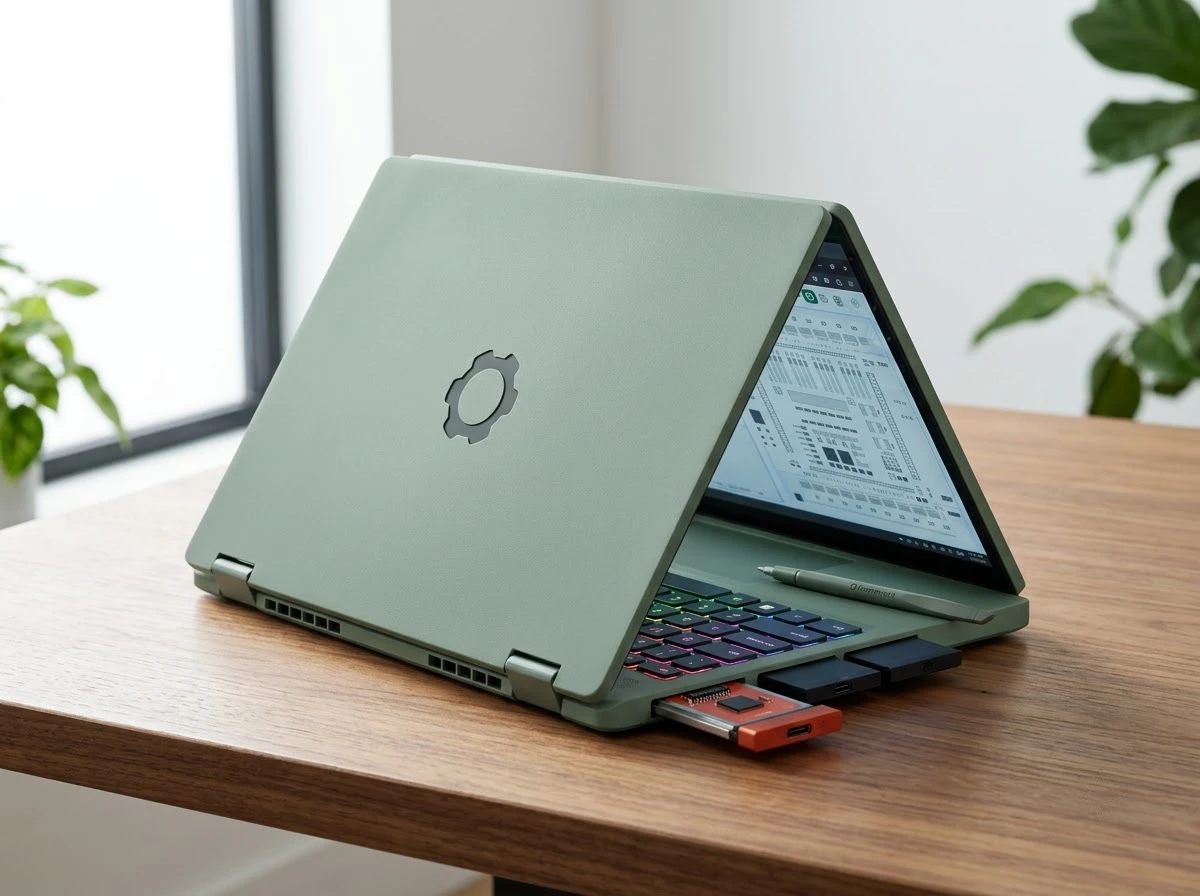
The 12.2-inch convertible with stylus support keeps its 1920×1200 touchscreen above 400 nits, USI 2.0 pen support, 360-degree hinge for clamshell, tent, and tablet modes, privacy kill switches for camera and mics, and MIL-STD-810 durability testing that includes 48-inch drops onto plywood.
Why Fedora ships as the base OS
Almost 80 percent of existing Framework Laptop 12 owners already run Linux across multiple distributions. That figure came from customer surveys and forum data, and it shaped the product. Pre-built systems now ship with Fedora 44 KDE Plasma Desktop ready to use. Windows 11 Home remains an option for an extra $100.
The Fedora KDE Plasma Desktop contributors work hard to make the Fedora KDE Plasma Desktop edition the premier KDE experience for users. It’s great to see Framework customers have the choice to have it pre-installed.
Jef Spaleta, Fedora Project Lead, said that in Framework’s announcement. Aleix Pol, president of KDE e.V., added that the teams put effort into touch and pen input so the convertible modes feel natural. Framework has also been sending pre-release hardware to CachyOS, Bazzite, and other partners. New silicon and the BE213 radio need kernel 7.1 or newer; the fingerprint sensor needs recent libfprint.
The company has long positioned itself as Linux-friendly. Shipping a polished pre-load on its cheapest machine turns that stance into the default path rather than an advanced user choice. An earlier Framework Linux sponsorship debate showed how closely the community watches the brand’s open-source moves. This refresh answers with product, not just grants.
The price ladder and what $699 actually buys
Pre-built Fedora configurations start at $699 for the Core 3 304 with 8GB RAM and 512GB storage. That is Framework’s lowest pre-built price yet. Windows adds $100. Jumping to 16GB RAM requires the Core 5 320 tier, which PCMag reported at $1,099 and includes the fingerprint reader and backlit keyboard. The Core 7 350 sits at $1,399. DIY Editions start lower (Framework cites $549 for new Series 3 boards and $499 for remaining original stock) but ship without RAM, storage, or OS unless the buyer adds them. Expansion cards, a stylus ($59), and a charger are separate.
| Config | Processor | Starting price | Notable inclusions |
|---|---|---|---|
| Pre-built base | Core 3 304 | $699 (Fedora) | 8GB RAM, 512GB SSD; Windows +$100 |
| Pre-built mid | Core 5 320 | $1,099 | 16GB path, fingerprint, backlit keyboard |
| Pre-built high | Core 7 350 | $1,399 | Highest Core Series 3 option |
| DIY Edition | Core 3 304 | from $549 | No RAM/storage/OS included; five colors |
Pre-built units ship in sage. DIY opens Bubblegum, Lavender, Black, and Gray as well. Batch 1 leaves in October.
How it lines up against the $699 sealed crowd
Apple’s MacBook Neo and Dell’s latest XPS 13 both start near the same money. The Neo, now listed from $699 after an earlier $599 launch, uses Apple’s A18 Pro, sealed aluminum, and up to 16 hours of claimed battery in a 13-inch Liquid Retina package. Framework’s base Core 3 sits a tier below the Core 5 320 that Dell put in its $699 XPS 13, and the 8GB starting RAM is the clear weak spot for Windows users who multitask.
Where Framework differs is the ownership model. Memory, storage, ports, Wi-Fi card, and even the mainboard can be swapped with one screwdriver. iFixit gave the original Laptop 12 a perfect 10 out of 10 repairability score. The new mainboard and input cover drop into older chassis, so first-wave buyers are not stranded. Sealed machines at this price become e-waste when the soldered RAM or battery ages; this one is built to be opened repeatedly.
Stats snapshot
- 70% longer Netflix 4K streaming battery (Core 5 320 vs prior i5-1334U, Framework testing)
- ~80% of existing Laptop 12 owners already on Linux
- 50Wh battery capacity unchanged
- 1.3kg weight, 18.45mm thick, five color options on DIY
The MacBook Neo starting price and aluminum design still set the style and polish bar many buyers expect. Framework counters with ports you choose, a stylus-ready touchscreen that folds flat, and the ability to keep the same chassis for years while swapping silicon.
The upgrade path that outlives the purchase
Framework posted a technical video walking through a full gen-1 to Series 3 upgrade, part by part. The new mainboard, fingerprint power button, and backlit cover are sold separately and fit the original shell. That turns the Laptop 12 into a platform rather than a one-time SKU. Buyers who started on 13th-gen Intel can move to the more efficient Wildcat Lake silicon without buying a second laptop.
Community reaction on X tracked the same themes. Framework’s own launch post drew tens of thousands of views within hours. Owners who already lived on Linux welcomed the battery-focused architecture after the previous generation’s shorter runtime. Others immediately asked for a better digitizer for artists. The base 8GB configuration drew the usual warnings for Windows users, while DIY builders calculated lower totals by sourcing their own RAM and SSD.
Who this machine is actually for
Students, developers, and anyone who wants a small convertible that can be repaired after a backpack drop sit at the center. The MIL-STD testing and overmolded TPU shell target education and field use. The Fedora pre-load removes the install friction that kept some Linux curious buyers on Windows Chromebooks or sealed PCs. Power users who need more than 8GB will skip the $699 tier and land on Core 5 or DIY with their own 16GB or 32GB stick. Windows buyers pay the OS premium and still face the same RAM jump.
The product remains a compromise on absolute performance and display polish versus Apple or a fully optioned XPS. It wins on the things Framework has always sold: the right to open it, the right to keep it, and now a first-class Linux experience that matches how most of its owners already use the machine.
Pre-orders are live. October will show whether the battery numbers hold in the wild and whether the 8GB base becomes a footnote or a friction point. For the large share of buyers already living in Linux, the sleeper change is that the cheapest Framework now arrives ready for them.
Frequently Asked Questions
What operating systems can the new Framework Laptop 12 ship with?
Pre-built models offer Fedora 44 KDE Plasma Desktop at no extra charge or Windows 11 Home for an additional $100. DIY Editions ship without an OS so owners can install any distribution or Windows license they already own. Kernel 7.1 or newer is required for full Core Series 3 and Wi-Fi 7 support on Linux.
Can I upgrade an original Framework Laptop 12 to the new Core Series 3?
Yes. The new mainboard, fingerprint reader power-button board, and backlit input cover are designed to drop into first-generation chassis with standard tools. Framework published a part-by-part upgrade video alongside the announcement.
Why does the $699 base model only include 8GB of RAM?
Framework set the entry pre-built at Core 3 with 8GB and 512GB storage to hit the lowest possible ready-to-use price with Fedora. Higher memory requires stepping to the Core 5 configuration or choosing the DIY Edition and installing a larger SO-DIMM yourself; the single slot supports up to 64GB DDR5-6400.
How much longer is the claimed battery life?
Framework’s own July 2026 testing on a Core 5 320 system with 16GB RAM measured a 70 percent increase in Netflix 4K streaming runtime compared with the original Core i5-1334U Laptop 12 under identical brightness and power settings. Real-world results vary with brightness, Wi-Fi, and workload.
Is the Framework Laptop 12 still fully repairable?
Yes. iFixit scored the original model 10/10. Memory, storage, Expansion Cards, Wi-Fi module, battery, and now the mainboard and input cover remain user-replaceable. The chassis meets MIL-STD-810 drop and durability tests while keeping orange pull tabs, QR-linked guides, and captive screws.