The United States men extended their flag football dynasty with a 46-26 win over Italy on Sunday in Düsseldorf, but Canada’s women ended the American four-title chase 27-20 and both Canadian sides locked Olympic berths for Los Angeles 2028. Mexico’s women and Italy’s men also earned early tickets while the hosts already sat inside as the home nation.
Four years after the IOC added the five-on-five non-contact game, the IFAF World Championships doubled as the first major qualifier and produced clear early winners and losers on the road to the Games.
Gold, Bronze and the Four Early Tickets
Men’s quarterback Nico Casares threw two touchdown passes as the U.S. claimed a sixth straight world title. “Gold is the only standard,” Casares said. “That’s our motto. That’s what we play by, that’s what we live by.”
Canada’s Sara Parker engineered the women’s upset. The game sat 14-14 at halftime after Caroline Moquin-Joubert’s catch. Parker then set up Frederique Morneau early in the second half. The Americans reached fourth down near the goal line with three seconds left and failed to convert. Parker hugged her mother afterward and said, “I feel so happy, I can’t believe it. Literally the best day ever.” It was Canada’s third women’s title and first since 2014.
Because the U.S. teams already held host berths, reaching the finals handed Italy (men) and Canada (women) automatic Olympic places. The bronze games decided the remaining early spots.
| Event | Gold | Silver | Bronze / Olympic note |
|---|---|---|---|
| Men | United States 46-26 | Italy | Canada 34-26 OT over Mexico (Canada Olympic) |
| Women | Canada 27-20 | United States | Mexico 20-19 over Great Britain (Mexico Olympic) |
Mexico’s women held off a Great Britain rally from 20-6 down. Canada’s men needed overtime; Michael O’Connor threw four touchdown passes, including the winner to Antony Auclair, while Marc-Antoine Dequoy intercepted and François Rocheleau recorded three sacks.
The medal weekend therefore sorted two very different outcomes. Finalists from nations without host places walked away with tickets. Bronze winners claimed the last automatic berths on offer. Everyone else left with unfinished business.
How the Six-Team Olympic Field Now Looks
Los Angeles 2028 will stage six-team tournaments with 10 athletes each per gender, 120 total athletes. Games run five-on-five in two 20-minute halves with no tackling and heavy emphasis on speed.
The United States holds both host berths. This weekend filled two more per gender: men Italy and Canada; women Canada and Mexico. The final three berths per gender come from the 2028 Olympic Q-Series after 2027 continental championships. Already-qualified nations sit out the Q-Series. Those three must cover at least two continents.
- Host: United States men and women
- 2026 Worlds: Italy men, Canada men, Canada women, Mexico women
- Remaining: three men and three women via Q-Series (Montreal and Orlando legs in June 2028)
Athletes must turn 18 by the end of 2028. National Olympic Committees make the final selections.
That structure leaves little room for late surprises among the already locked sides. It also concentrates pressure on the chase pack, which must clear continental events and then the two-leg Q-Series without a single bye.
Canada Walks Away With Both Berths
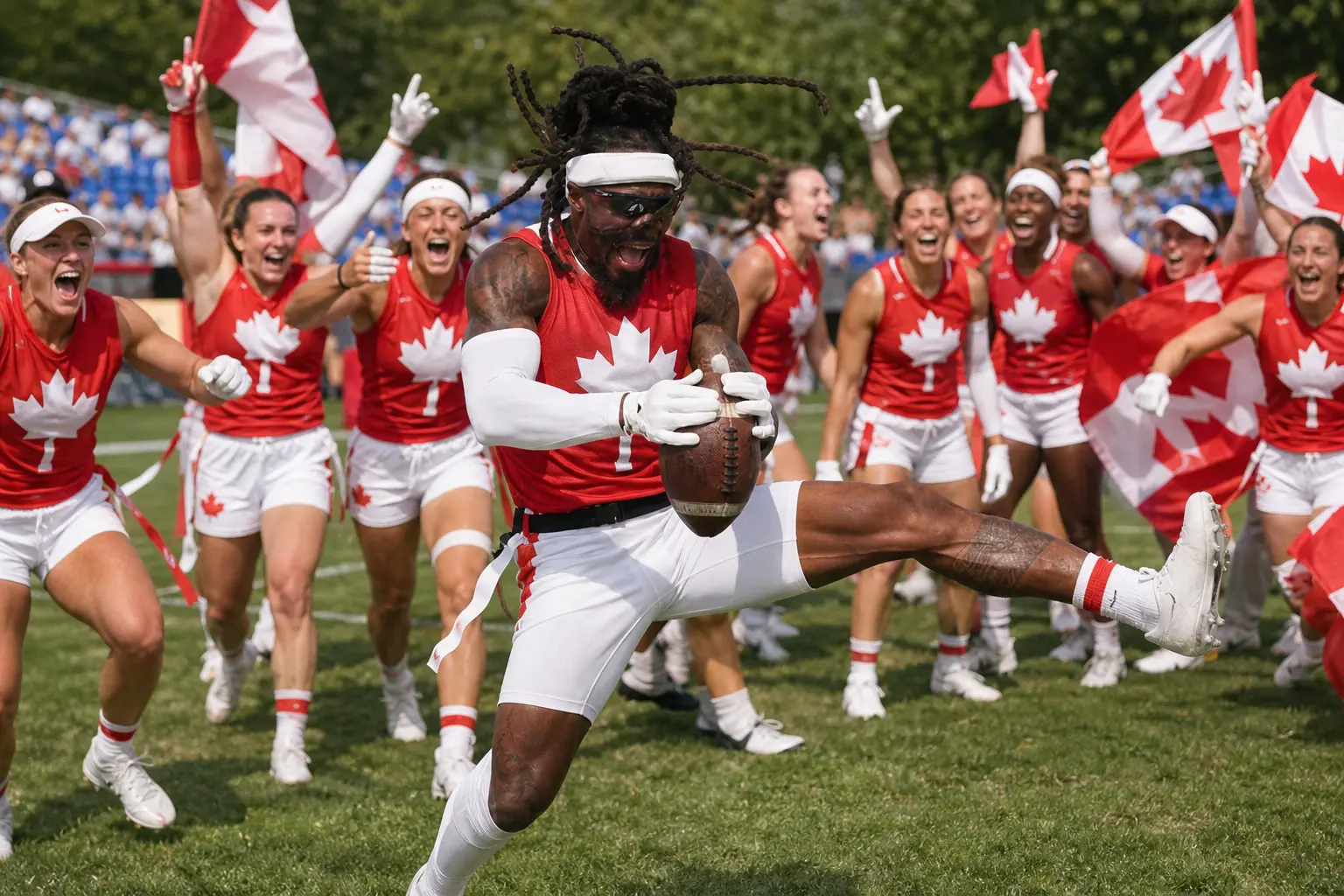
Few nations leave a world championship with two Olympic tickets and a gold medal. Canada did exactly that. The women completed a perfect tournament. The men fought through the bronze game after losing the men’s semifinal to Italy.
On X the reaction mixed national pride with sharp humor. An NFL highlight of the last-play women’s win drew more than 750,000 views; Canadian replies celebrated cooking the Americans “in their own sport.” Both teams now have two full years to prepare without the pressure of further qualification.
Literally the best day ever.
Sara Parker said that after the final. The dual qualification also gives Canada a rare chance to build joint training infrastructure and cross-gender coaching knowledge before the Exposition Park Stadium debut venue opens the Olympic program in July 2028.
Shared camps, shared film study and shared strength staff become practical options when both programs already know they will be in Los Angeles. Rivals still hunting berths cannot plan the same way.
Mexico’s Bronze Tears and Italy’s Breakthrough
Mexico’s women cried on the field after the 20-19 bronze win. The side, long a power and home to star quarterback Diana Flores, had taken World Games gold in 2025 and sat high in the rankings. Securing the Olympic place on the final play of a wild comeback against Great Britain kept one of the sport’s most visible faces on the LA28 stage.
Italy’s men reached their first world final in recent cycles and left with silver plus an Olympic berth. They beat Canada in the semifinal 41-36 before falling to the U.S. dynasty. For a European program, the result marks a genuine step into the global top tier two years before the Games.
Great Britain’s women and Mexico’s men walked away empty-handed after leading or contending deep into the bronze games. Both now face the continental and Q-Series route with no margin for error.
- Mexico women: bronze, Olympic berth secured, Diana Flores stays on the LA28 path
- Italy men: first recent world final, silver, automatic Olympic place
- Great Britain women: late rally from 20-6 fell short at 20-19
- Mexico men: overtime bronze loss to Canada, full qualifier route still ahead
Those four results defined the weekend as sharply as the gold-medal games. One bounce either way in either bronze contest would have redrawn the early Olympic map.
What the Remaining Spots Demand
Three berths per gender remain. The 2027 continental championships feed two teams per continent into a 10-team Q-Series field. Already-qualified sides cannot enter. The top three at the Q-Series advance, provided at least two continents are represented.
Already locked: USA, Canada (both genders), Italy men, Mexico women.
Strong chase pack: Mexico men, Great Britain women, Austria, Japan, France, Germany and rising African and Asian sides (Nigeria missed this event on visas).
The full full schedule and results from Düsseldorf show how deep the 16-team fields ran. Pool upsets and tight bronze games proved the gap between the top four and the next tier is closing fast.
The continent rule matters as much as the win column. A Q-Series podium filled by a single region would force the next eligible side upward until two continents appear. That safeguard keeps the Olympic field global even if one area surges.
NFL Professional Leagues and the College Pipeline
The league has already cleared its players to compete for national teams at the Olympics. Commissioner Roger Goodell previously said professional men’s and women’s flag leagues would launch “in the next couple of years” ahead of LA28. NFL clubs cleared players for Olympic flag participation under agreed rules with the players’ association and IFAF.
That infrastructure arrives just as the Olympic field crystallizes. Names such as Patrick Mahomes, Jalen Hurts (IFAF global ambassador) and Joe Burrow have publicly floated interest. Whether they appear depends on national-team selection and club calendars, yet the permission itself raises the ceiling.
On the amateur side the same momentum feeds the path toward the first NCAA women’s flag title targeted for 2028. High-school and college flag programs now have a clear Olympic and professional horizon that did not exist five years ago.
Permission, pro leagues and a college championship path all point in the same direction. The sport’s talent base is widening at the exact moment half the Olympic field is already named.
American Dynasty Meets a Wider Map
The U.S. men have now won seven world golds overall and six in a row dating to their 2014 title. The women still own three golds but dropped their first final since the streak began. Austria, France, Mexico and Canada have all taken titles in earlier cycles; the medal tables remain American-led yet no longer one-sided.
Los Angeles organizers already carry Los Angeles organizers’ three-peat ambitions across the broader Games. Flag football supplies a home-sport narrative that can fill seats at Exposition Park and introduce the non-contact game to a global television audience.
Two years remain. Canada arrives with both teams and fresh gold. Italy and Mexico hold early footholds. The United States still owns the men’s standard and the host advantage. Everyone else now plays for the last three tickets. The winners left Düsseldorf with certainty. The rest left with a shorter runway and a clearer target.
Early Berths Rewrite the Next Two Years
Automatic qualification does more than stamp a passport for 2028. It changes how staffs spend the calendar that still sits between Düsseldorf and Los Angeles.
Canada, Italy’s men and Mexico’s women can treat 2027 continental events as development windows rather than must-win qualifiers. They can rest veterans, trial younger athletes and experiment with packages without risking an Olympic place. Nations still on the outside cannot.
- 2026 Worlds (Düsseldorf): four early tickets issued beyond the U.S. hosts
- 2027 continental championships: two teams per continent advance toward the Q-Series
- June 2028 Q-Series: Montreal and Orlando legs decide the last three berths per gender
- July 2028: Exposition Park Stadium opens the Olympic flag program
That sequence leaves the chase pack with stacked seasons and no safety net. A single poor continental showing can end the Olympic path before the Q-Series even begins.
For the locked sides the same timeline becomes a runway. Joint camps, longer install periods and fuller recovery cycles all become realistic. The gap between certainty and pursuit will shape roster building as much as any single game still to come.
The Bronze Games Redrew the Margin
Gold medals drew the headlines. Bronze games drew the map. Canada’s men needed overtime and four touchdown passes from Michael O’Connor to beat Mexico. Mexico’s women needed every point of a 20-19 edge after watching Great Britain climb back from 20-6.
Those two results alone decided half of the non-host early berths. Italy’s men had already secured theirs by reaching the final. Canada’s women had done the same. Everything else hinged on the third-place contests.
| Bronze game | Score | Olympic outcome |
|---|---|---|
| Canada men vs Mexico men | 34-26 OT | Canada locked; Mexico men to Q-Series path |
| Mexico women vs Great Britain women | 20-19 | Mexico locked; Great Britain to Q-Series path |
Pool depth earlier in the week had already signaled that the next tier was closing in. The bronze finishes confirmed it. One stop, one sack or one extra completion would have flipped an Olympic ticket from one program to another.
That thin margin is now the working reality for every side still chasing. The field is small. The remaining seats are fewer. The runway is shorter than it was when the Düsseldorf brackets opened.
Frequently Asked Questions
How many teams will play flag football at the LA28 Olympics?
Exactly six men’s teams and six women’s teams, each carrying a roster of 10 athletes for a total of 120 competitors. Preliminaries run across the first five competition days with the top four per gender advancing to semifinals; men’s medals fall on 21 July 2028 and women’s on 22 July.
Which nations have already qualified for Olympic flag football?
The United States (both genders as hosts), Canada (both genders), Italy (men) and Mexico (women). These berths are final and those nations sit out the later Q-Series.
How will the remaining three spots per gender be decided?
Through the 2028 Olympic Q-Series after the 2027 continental championships. Two teams per continent feed a 10-team field; the top three finishers advance provided at least two continents are represented. Already-qualified nations cannot enter.
What are the basic rules of Olympic flag football?
Five-on-five play in two 20-minute halves with no tackling. Players wear flags at the waist that defenders must pull to stop the ball carrier. The emphasis sits on speed, route running and precise throwing rather than contact.
Has the United States dominated the world championships historically?
Yes on the men’s side with seven golds and six consecutive titles through 2026. The women’s side is more balanced: the United States, Mexico and Canada each hold three golds across the history of the event that began in 2002.