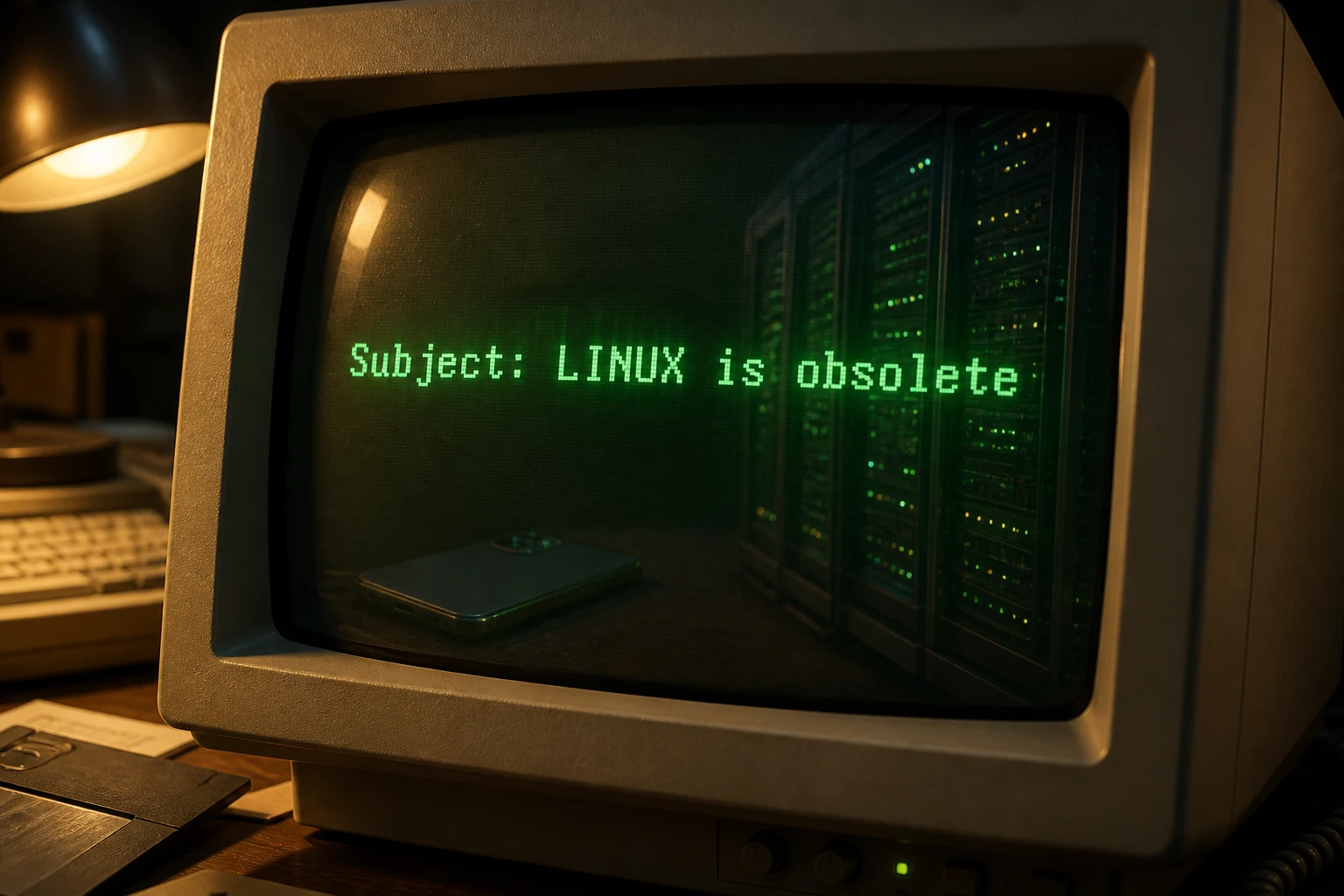
On 29 January 1992 Andrew S. Tanenbaum, the MINIX creator and OS textbook author, posted to comp.os.minix that “LINUX is obsolete.” A monolithic kernel tied to the Intel 386 was, he wrote, “a giant step back into the 1970s.” Microkernels had already won. Linus Torvalds replied the same day that Linux simply worked and could be downloaded that week. The prediction that this approach had no future has aged into one of computing’s sharpest ironies.
Working code beat elegant theory. The same traits Tanenbaum flagged as fatal let contributors pile on, ports multiply, and the kernel reach phones, clouds, appliances and every system on the current TOP500 supercomputer rankings.
The Post That Called a Kernel Dead on Arrival
Tanenbaum was no outsider. He had written the OS book Torvalds studied and shipped MINIX, a teaching system built as a microkernel. Major services ran as separate processes. Message passing kept the kernel small. He believed that model was cleaner and more future-proof as hardware grew complex.
Writing a monolithic kernel in 1991 is a giant step back into the 1970s.
That line, and the claim that “among the people who actually design operating systems, the debate is essentially over. Microkernels have won,” framed the attack. He also warned that Linux’s close ties to the 386 looked reckless while RISC chips gathered speed. Anyone wanting a modern free Unix-like system should look toward portable microkernel work, perhaps GNU.
The full archived Tanenbaum-Torvalds exchange later appeared in the 1999 book Open Sources. It preserved every jab and technical point for later readers.
Torvalds Answered With Code That Already Ran
Torvalds did not claim theoretical purity. He admitted microkernels looked nicer on paper. His counter was blunt and practical.
“If the GNU kernel had been ready last spring, I’d not have bothered to even start my project: the fact is that it wasn’t and still isn’t. Linux wins heavily on points of being available now.”
That availability mattered more than architecture purity in 1992. People could compile Linux, break it, patch it and ship improvements the same week. GNU tools wrapped around the kernel. Contributors arrived because something usable existed. The flame war itself pulled eyes to the project. A Japanese observer later noted that Tanenbaum’s harsh critique, including a line about not letting a student advance with such work, helped put Linux on the map.
How the 386-Bound Kernel Learned to Travel
Tanenbaum’s portability critique was fair at the time. Early Linux leaned hard on 386 features. Leaving it there would have frozen the project. Instead developers spent years peeling hardware assumptions out of the code.
Today the kernel runs on ARM, ARM64, PowerPC, RISC-V, IBM s390, LoongArch and more. Android put the same kernel on billions of phones and tablets, almost all ARM-based. Embedded gear, routers, appliances and cloud instances followed. The original desktop PC origin story became the minority case.
Portability was not free. It required exactly the grinding engineering Tanenbaum said would be needed. The project paid that cost and kept going.
The Argument Returned in 2006
Usenet archives and the Open Sources reprint kept the 1992 thread alive. In May 2006 Tanenbaum co-authored a Computer magazine cover story, “Can We Make Operating Systems Reliable and Secure?” He argued isolation could stop one bad driver from taking down an entire system. Slashdot linked the piece to the old debate. Torvalds answered again. Tanenbaum published a Tanenbaum 2006 reliability follow-up on his Vrije Universiteit page clarifying he held no personal grudge and that his real interest was reliable systems, not microkernels for their own sake.
By then Linux was already a commercial force. The technical case for isolation never vanished. Microkernels and hybrids still power high-reliability niches: QNX in routers and cars, Integrity in aerospace, L4 variants in research. The mass market, however, had already chosen the monolithic path that shipped first and improved in public.
Where the “Obsolete” Kernel Landed
Desktop remains the holdout. Windows and macOS still dominate personal computers. StatCounter desktop OS share figures put global Linux in the low single digits for most recent months, with a disputed July 2026 spike near 7.5 percent that some analysts blame on bot traffic and reclassified “unknown” hits. North American and U.S. numbers climbed higher in the same data, but Cloudflare human-traffic checks paint a more modest picture. Desktop share is real growth from near-zero, yet still modest.
Everywhere else the picture flips.
| Segment | Linux / Kernel Share | Notes |
|---|---|---|
| TOP500 supercomputers | 100% | Every system since November 2017; leaders run RHEL, Kylin, TOSS and similar |
| Global mobile (Android) | ~67% | StatCounter April 2026; kernel under nearly all Android devices |
| Server / cloud workloads | ~45-51% | Varies by survey; dominant in public cloud |
| Global desktop | ~3% typical, up to ~7.5% disputed July 2026 | StatCounter; bots and privacy tools muddy recent jumps |
Android alone puts a Linux kernel in more hands than any desktop OS ever reached. Cloud providers, telecom gear and the entire high-performance computing list run it. Broadcast tooling has followed the same pattern, with shops leaning on broadcast tools built on Linux and Docker to cut memory costs under AI loads.
- Servers and cloud: Linux is the default for most new deployments and containers.
- Mobile and embedded: the kernel is invisible infrastructure under Android and countless devices.
- Supercomputing: unbroken 100% on TOP500 for nearly a decade.
- Desktop: slow, real growth that still trails Windows and macOS by a wide margin.
Even Microsoft moved from calling Linux a cancer to shipping its own distributions and filling Azure with it, a path covered in the long Microsoft shift from Linux cancer remark.
GNU Hurd Chose the Path Tanenbaum Preferred
GNU’s own kernel, the Hurd, followed the microkernel route Tanenbaum favored. Decades later it is still “almost there.” A February 2026 FOSDEM update reported the x86_64 port essentially complete, SMP progress, roughly 75% of Debian packages building, and eyes on AArch64. Developers still invite help. It has never become the widely used free Unix-like system Linux turned into.
MINIX itself evolved. MINIX 3 aimed at reliability and self-healing with a tiny microkernel and user-mode drivers. It remains valuable for teaching and research. It did not displace Linux in production.
The contrast is the irony made concrete. The theoretically cleaner free design stayed unfinished. The “obsolete” design that shipped in 1991 absorbed the world’s hardware diversity and contributor energy.
- 29 January 1992: Tanenbaum posts “LINUX is obsolete” on comp.os.minix.
- 29 January 1992: Torvalds replies the same day stressing availability now.
- 1999: Open Sources book reprints the full debate.
- May 2006: Tanenbaum’s Computer magazine article on reliability restarts the argument; both men respond.
- November 2017 onward: Linux reaches and holds 100% of the TOP500 list.
- 2026: Hurd still described as almost ready; Linux kernel remains the default for phones, servers and supercomputers.
Why Availability Beat Architecture Purity
Tanenbaum’s technical reasoning still reads as serious. Monolithic kernels do share fate across drivers and services. Isolation has clear value for reliability and security. Microkernels and capability systems continue to matter in safety-critical and research settings. The larger design debate never fully closed.
What aged poorly was treating Linux’s early compromises as a reliable forecast of its ceiling. Torvalds had a kernel people could install and improve immediately. Contributors fixed the portability debt. Hardware moved; Linux moved with it. That feedback loop proved stronger than the initial architecture scorecard.
The Linux Foundation itself marked the 1992 thread in August 2026 as the defining early open-source architecture debate, noting that the monolithic design remains a cornerstone of high-performance computing. Crowd commentary still circles the same three Tanenbaum predictions: microkernels would rule, x86 would fade for RISC, and a free GNU OS would take over. RISC did rise, yet Linux simply ported to it. Free software did win large territories, yet it won on the monolithic kernel that was already shipping.
The obsolete kernel got crowded. The cleaner alternative is still finishing its homework.
Frequently Asked Questions
What exactly did Andrew Tanenbaum say about Linux in 1992?
He titled the post “LINUX is obsolete,” called writing a monolithic kernel in 1991 a giant step back into the 1970s, declared that microkernels had won the design debate, and criticized Linux’s tight binding to the Intel 386 while RISC machines gained ground. He suggested people seeking a modern free OS look at portable microkernel projects such as GNU instead.
How did Linus Torvalds reply to the obsolete claim?
Torvalds answered within hours, conceded that microkernels looked nicer theoretically, then stressed that Linux already ran and could be improved by anyone. He wrote that if the GNU kernel had been ready the previous spring he would not have started, and that Linux “wins heavily on points of being available now.”
Is the microkernel versus monolithic debate settled today?
No. Linux’s practical success settled the mass-market question, but reliability and isolation arguments for microkernel-style designs remain active in embedded, aerospace, real-time and research systems. Projects such as seL4, QNX and L4 variants continue, and even Linux has added modularity and isolation features over time without becoming a pure microkernel.
What is the current status of the GNU Hurd?
As of early 2026 presentations the x86_64 port is essentially complete, SMP work continues, about 75 percent of Debian packages build, and AArch64 interest exists, yet developers still describe the system as “almost there” and seek more contributors. It has not reached the everyday usability or hardware breadth Linux achieved decades earlier.
How dominant is the Linux kernel outside the desktop?
It powers essentially all Android devices (roughly two-thirds of the global mobile OS market), the large majority of public-cloud and many private-server workloads, and 100 percent of the TOP500 supercomputers continuously since November 2017. Desktop share remains the clear laggard at a few percent globally by most StatCounter readings.