More than two million people in France have bought tickets this year to watch a Mizrahi Jewish family come of age in a Paris housing block. Fewer than half a million Jews live in the entire country. The film is Just An Illusion, called Juste une illusion in French, the most personal work yet from longtime directing partners Eric Toledano and Olivier Nakache, and it is now playing in Israeli theaters.
It arrives at a specific moment. French authorities logged 1,320 antisemitic acts in 2025, nearly triple the 2022 count, and thousands of French Jews moved to Israel last year. Toledano and Nakache built a movie about ordinary Sephardi family life in the 1980s rather than a message film about hatred, and audiences well beyond the Jewish community bought tickets anyway.
Two Million Tickets Against a Much Smaller Community
Juste une illusion opened in France on April 15, 2026, in 665 theaters. It drew more than 600,000 admissions in a coming-of-age tale set in 1985, according to Unifrance, the French agency that tracks the country’s cinema at home and abroad. By its fourth week, the running total had passed 900,000. By the time Toledano sat for an interview about the film’s Israeli run this month, it had crossed two million admissions nationwide.
France’s Jewish community, the largest in Europe, numbers roughly 450,000 people in current demographic estimates. Two million ticket buyers is well over four times that. Toledano said the pattern was unmistakable: the film was reaching far outside the community it depicts.
Some scale helps. Toledano and Nakache’s 2011 hit Intouchables, the wheelchair drama that became a global phenomenon, still dwarfs this one.
| Film | French Release | Ticket Trajectory |
|---|---|---|
| Juste une illusion | April 15, 2026 | 600,000 opening weekend; past 2 million by mid-July 2026 |
| Intouchables | November 2, 2011 | 15.7 million in France by year-end 2011; sold 51.5 million tickets worldwide before Lucy overtook it in 2014 |
Juste une illusion was never going to match that run. It opened against an animated blockbuster and held its own without topping the weekend chart. For a small, specific family drama, two million admissions and counting is still a genuine crossover, not a niche result.
Antisemitic Incidents Have Nearly Tripled Since 2022
Toledano said he and Nakache made the film aware of the climate it would enter. Government figures compiled in the EU Agency for Fundamental Rights’ 2026 overview of antisemitism in France show why the timing mattered to him.
- 1,320 antisemitic acts were formally recorded in France in 2025, against 436 in 2022.
- 126 physical assaults on Jews were logged in 2025, up from 42 in 2022, a tripling in three years.
- Jews are under 1% of the French population but are targeted in more than half of religiously motivated hate crimes.
- 3,300 French Jews made aliyah to Israel in 2025, 45% more than the year before.
Toledano connected the numbers to the choices on screen. “I think the atmosphere in France, what we were living through with antisemitism and the opposition between people, perhaps made us want to show how normal we are,” he said. “We fall in love. The father loses his job. The mother wants to have a career. She is taking care of two teenagers. The teenagers are fighting over music, over funk and new wave.”
He added a line that doubles as the film’s thesis: “We wanted to depict who we really are.”
Two Fathers, One Film, One Unplanned Timing
Just An Illusion is dedicated to both directors’ fathers. Toledano’s father died on the first day of shooting. Nakache’s father died months later, near the end of the editing room process, an overlap neither man had planned or expected.
“Naturally, it was as though we had felt in advance that they were going to leave us,” Toledano said. “We wanted to depict and capture a piece of the time we spent together in the 1980s.”
I was living with one hand in reality and one hand in fiction. The fiction was helping me. I was spending time with an actor who represented my father, with the same coat and the same habits, such as reading the newspaper every day, sometimes yelling, and having this typical Sephardi reaction of wanting to have the last word every time.
Toledano said the making of the film during that period. He was careful, though, not to let the ending define the portrait. “At the end of their lives, everything was very hard for our fathers to live through,” he said. “But you cannot remain only with the image of the end of his life, because the rest of his life was wonderful.”
Names Chosen to Disappear Into France
Toledano’s parents emigrated from Morocco. Nakache’s came from Algeria. Both countries were under French administration, Algeria as a colony and Morocco as a protectorate, and French culture had a strong hold on both Jewish communities well before either family reached Paris.
That history shows up in a small, deliberate detail: the film’s teenage brothers are named Vincent and Arnaud, not Isaac or Moshe. “The names were a sign that we wanted integration, complete integration,” Toledano said. “They wanted to be French.”
- Vincent and his brother Arnaud carry French, not Hebrew or biblical, first names, a generational choice their screen parents made deliberately.
- Sandrine, the mother played by Camille Cottin, leaves secretarial work behind to become a junior executive, a step her own mother’s generation rarely got.
- Yves, the father played by Louis Garrel and modeled on Toledano’s own, ties his self-worth to a white-collar job, and losing it triggers the film’s central crisis.
- A job-interview scene stages a row of men dressed identically to Yves, a nod to a classic Jacques Tati sequence that Toledano remembers from childhood.
Most demographic accounts of French Jewry put the community at roughly 60% Sephardi or Mizrahi in origin, the legacy of mass emigration from North Africa after Algeria, Morocco and Tunisia gained independence in the 1950s and 1960s. The film is not telling a minority story within French Jewish life. It is telling the majority one, on a mainstream commercial screen, for the first time at this scale.
Vincent’s Bridge Year
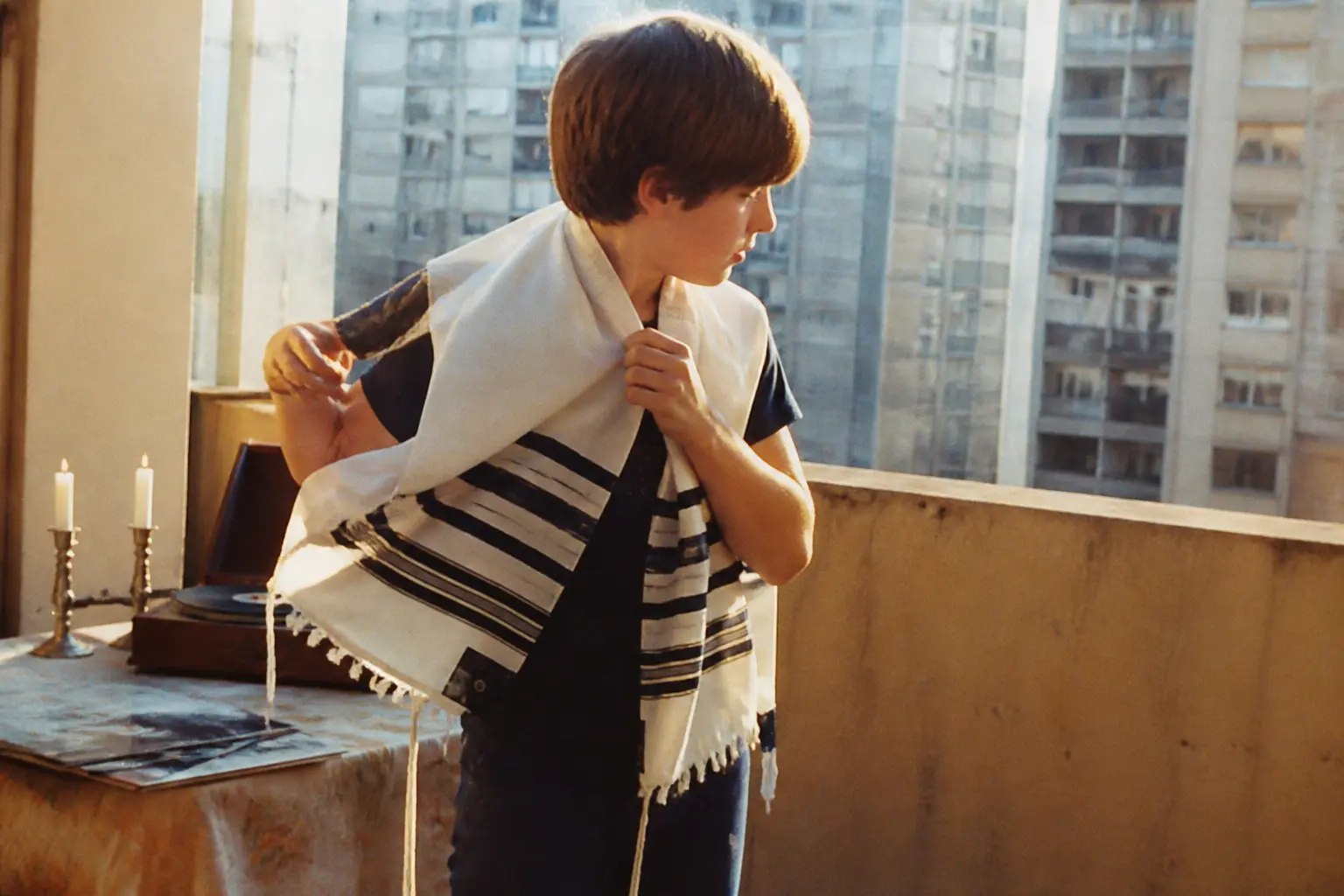
Most of the film follows Vincent, played by Simon Boublil, a shy teenager discovering girls, dreading his bar mitzvah and trying to work out the rest of his life. Toledano pointed to Francois Truffaut’s The 400 Blows as a natural comparison, though Vincent’s family, unlike Truffaut’s Antoine Doinel, is warm rather than neglectful.
Toledano and Nakache, both around 50, said adolescence has been on their minds lately for personal reasons. “There is a French expression,” Toledano said. “They say that at 40, you are old to young people, and at 50, you are young to old people. It is exactly like a bridge. You are not old, but you are not young anymore. It throws you back toward the teenage years, when you were also standing on a bridge.”
He described those adolescent years as compressed and disorienting: “You discover love. You discover sex. You discover desire. You discover religion. You discover God. You discover that your parents are not really heroes. All of this happens in a very short time, and you have to understand it.”
Directing Boublil added a layer neither man anticipated. “It was very intense to direct him because, when you make a movie about this period, you are also stealing pieces of his real life,” Toledano said. “For Simon, it is not cinema. He is really that age.”
Funk Beat New Wave for the Soundtrack
Music carries much of the film’s period texture. The soundtrack pulls from Joy Division, Earth, Wind and Fire, The Cure and The Alan Parsons Project, reflecting a real split in the directors’ own teenage tastes.
“Olivier was really, really into new wave,” Toledano said. “He has photographs in which he looks like Robert Smith, dressed in black. I was very into funk. Funk is very positive, and we have put funk music in many of our movies, including The Intouchables and many other movies.”
On screen, that split becomes a running joke between Vincent and Arnaud, two brothers arguing over turntables in a shared bedroom, a small domestic detail standing in for a much larger question the film keeps returning to: what gets kept from home, and what gets traded for France.
Why Release a Bar Mitzvah Story Now?
Toledano’s answer is direct: the timing was deliberate, not incidental. He said a joyful, specific Sephardi family story landing during a period of rising hostility functions as a statement of normalcy rather than a political argument, and bringing that same film to Israeli screens extends the same choice to an audience shaped by a different set of pressures.
Israeli distributor Lev Cinemas is releasing the film into a summer arthouse calendar that already has international titles competing for attention. Cannes-winning Sentimental Value headlining the festival’s summer return gave Israeli audiences one high-profile import this season; Just An Illusion is reaching them instead through ordinary commercial release, competing on regular screens rather than a festival slot.
Toledano was careful to separate the film from activism. “When there is a war in Israel, there are consequences outside Israel,” he said. “The connection between the Diaspora and Israel is more complicated than before. When there is a war, it is always complicated.” He pointed to antisemitic incidents from both the political right and left in France as part of that same complication.
“Sometimes people want directors and actors to behave like militants, to make speeches and defend positions,” he said. “From the beginning, Olivier and I have believed that the work we do is the best expression of what we feel.”
“Certainly, it is more meaningful now than it might have been at another time,” Toledano said. “We are going to continue trying to say something through our movies, to bring out more humanity and more feeling.”