South Korea’s KOSPI closed nearly 1 percent higher Monday, clawing back part of Friday’s 5.72 percent plunge, as a pause in the Middle East fighting sent oil prices tumbling. Chipmakers and Naver led the board. Foreign investors sold anyway, and the won slipped further.
The same day, a Chinese memory chipmaker’s Shanghai debut vaulted its market value past $489 billion, a preview of the competition now bearing down on Samsung and SK hynix. Foreign funds sold a net 2.89 trillion won, roughly $2 billion, extending an exodus that Korean market trackers put at roughly $108.5 billion this year.
Chipmakers Rally While Refiners and Defense Stocks Sink
The benchmark Korea Composite Stock Price Index added 65.13 points to close at 6,755.75, recovering a chunk of Friday’s rout that had briefly dragged the index below the 7,000 mark it had held for weeks. Trading was choppy and thin: 270.9 million shares changed hands worth 23.5 trillion won (about $16 billion), with gainers edging decliners 494 to 372.
Individuals and local institutions did the buying, scooping up a net 1.98 trillion won and 862.4 billion won of shares. Foreign investors did the opposite, unloading a net 2.89 trillion won even as the index climbed.
| Company | Monday Close | Change |
|---|---|---|
| Samsung Electronics | 254,000 won | +1.8% |
| SK hynix | 1.8 million won | +3.24% |
| Naver | 225,000 won | +8.43% |
| Hanmi Semiconductor | 204,500 won | +2.25% |
| Hyundai Motor | 403,000 won | +0.5% |
| LG Energy Solution | 333,000 won | +1.06% |
| Hanwha Aerospace | 899,000 won | -8.17% |
| SK Innovation | 116,700 won | -10.3% |
SK Innovation’s 10.3 percent slide was the sharpest move on the board, a mirror image of the gains chip stocks posted the same session.
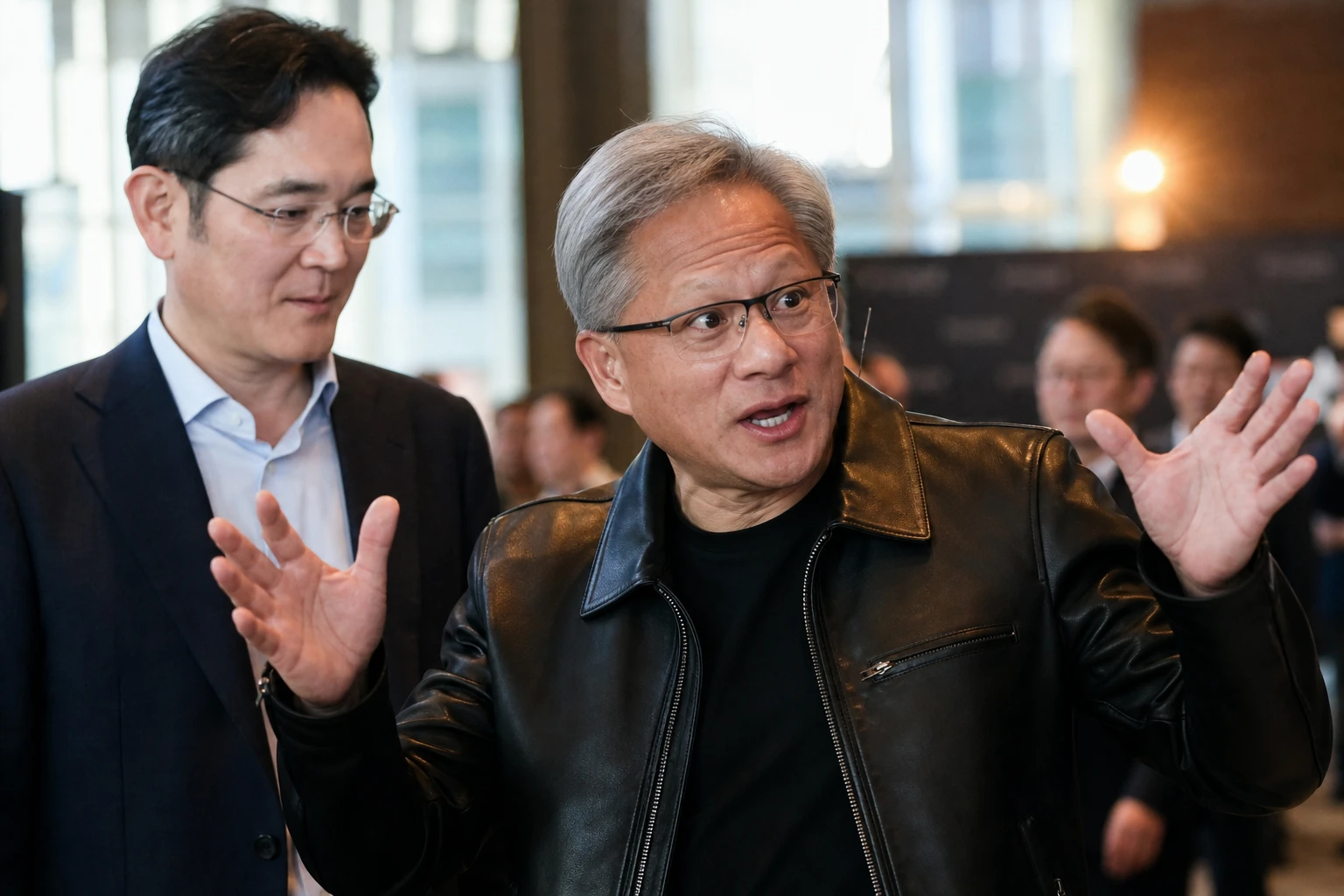
Nvidia Widens Its Korean Footprint
Naver surged 8.43 percent to 225,000 won after confirming a tie-up first reported around the weekend’s gathering of tech executives in San Francisco. Nvidia is taking a stake in the Korean internet giant by buying 7.2 million newly issued shares at 204,500 won each, a deal worth roughly 1.48 trillion won, or about $1.01 billion.
The money is earmarked for a data center buildout tied to Naver’s DSX platform, expanding planned capacity from 55 megawatts to 200 megawatts. Three pieces of the wider push stand out:
- The Naver stake – Nvidia’s roughly $1.01 billion investment funds new data center capacity for Naver’s AI ambitions.
- Brookfield talks – Naver and Nvidia are discussing up to $9 billion in outside financing from the asset manager to build out the project.
- An expanded SK Group alliance – Nvidia and the conglomerate that owns SK hynix are targeting more than two gigawatts of AI data center capacity, a push expected to generate over $500 billion in future purchases of memory chips and AI supercomputers.
That last piece explains why SK hynix, not just Samsung, jumped 3.24 percent to 1.8 million won. The stock’s Monday gain traces directly to a specific contract pipeline, not just general optimism about chips. Samsung, the market’s bellwether, rose a steadier 1.8 percent to 254,000 won, and Hanmi Semiconductor, which makes the equipment chipmakers use to package memory, added 2.25 percent to 204,500 won.
Samsung and SK hynix have whipsawed on this exact pairing of Iran headlines and chip demand before. Both fell even after posting record quarterly profits the last time oil spiked on Middle East strikes.
A Chinese Rival Goes Public at Half a Trillion Dollars
Analysts said Monday’s mood also owed something to a listing 550 miles away. ChangXin Memory Technologies, known as CXMT, priced its Shanghai STAR Market debut at 8.66 yuan a share, valuing the DRAM maker at 579 billion yuan (about $85.2 billion) and raising roughly $8.5 billion, according to the South China Morning Post. Shares then rose 472 percent on their first day of trading, pushing CXMT’s market capitalization to $489 billion and making it mainland China’s most valuable listed company, the outlet reported. It was the largest-ever STAR Market listing and the second-biggest IPO on any mainland Chinese exchange, trailing only Agricultural Bank of China’s 2010 offering.
CXMT is now the world’s fourth-largest memory chipmaker behind Samsung, SK hynix and America’s Micron Technology. The company has said proceeds will fund DRAM capacity expansion and research into high-bandwidth memory, the stacked-chip technology that feeds data to Nvidia’s AI processors and that has powered much of SK hynix’s recent run.
Seoul’s reaction was muted rather than alarmed. Lee Kyung-min, an analyst at Daishin Securities, framed it as a limited near-term threat.
Solid AI investment and collaborations with global tech companies offer upside pressure on the index. However, the listing of CXMT would have limited gains in the South Korean chip shares.
Lee’s caveat is the operative word. CXMT’s IPO money is going toward DRAM lines and HBM research, not a finished, qualified product Nvidia is buying today. But a company that just became China’s single most valuable stock on paper, in an industry Korea has dominated for two decades, is not a rounding error either. The Seoul sell-off in June, which wiped out more than a trillion dollars across Seoul and New York, showed how fast sentiment can turn on this exact sector.
Why Are Foreign Investors Still Selling?
Because the exodus predates Monday’s rally and has not stopped. Foreign investors have pulled roughly $108.5 billion out of Korean equities so far this year, according to Korean financial media tallies, a pace that continued even as the index bounced. Monday’s net foreign selling of 2.89 trillion won added to that total rather than reversing it.
The Korean won weakened 1.9 won to close at 1,468.5 per dollar as of 3:30 p.m., a small daily move that sits inside a much larger slide. Index data tracked over the past month shows a market that has swung through multiple 5 percent-plus sessions in July alone, with the currency sliding in tandem each time foreign selling accelerated.
Individuals and local pension-linked institutions absorbed what foreigners sold Monday, which is why the index could rise even as the single largest class of investors kept walking out. That split, retail and institutional buying against foreign selling, has become the market’s default pattern this year rather than an exception.
Oman Works the Phones as a Fragile Truce Holds
The rally’s other engine was oil. Brent crude fell 4.7 percent to $92.27 a barrel and US West Texas Intermediate dropped 5.1 percent to $84.89, days after briefly touching $100 a barrel. The United States suspended a two-week campaign of strikes on Iran as of Friday, and Iran stopped its counterattacks in response. Oman has been mediating talks over shipping through the Strait of Hormuz, the narrow waterway between Iran and the Gulf states that a large share of the world’s seaborne oil and gas passes through.
Accounts of what was actually agreed diverge sharply.
- Iran’s state television – reported that Tehran and Washington reached a draft understanding letting Oman help manage Hormuz shipping at prewar levels.
- The White House – dismissed that account as “a complete fabrication.”
Markets have been burned by this exact sequence before. An earlier ceasefire in the spring collapsed within weeks, and a fresh round of strikes and threats against Hormuz shipping followed in late June, before the latest two-week campaign and now this pause. That history is why the stocks that gained the most from war fear gave the most back Monday. Hanwha Aerospace, the defense contractor, sank 8.17 percent to 899,000 won, and SK Innovation, which runs Korea’s largest oil refinery, tumbled 10.3 percent to 116,700 won.
One Session Will Not Erase a Year of Outflows
Hyundai Motor and LG Energy Solution barely moved, up 0.5 percent to 403,000 won and 1.06 percent respectively to 333,000 won, a reminder that Monday’s story belonged almost entirely to chips, one internet platform and the geopolitics feeding both. Samsung and SK hynix still closed higher. So did the pile of won foreign investors sold on their way out the door.
Frequently Asked Questions
What is the STAR Market, where CXMT just listed?
The STAR Market is the Shanghai Stock Exchange’s board for high-growth technology companies, launched as China’s answer to Nasdaq. CXMT’s debut there was the largest listing in the board’s history and the second-largest IPO on any mainland Chinese exchange, behind only Agricultural Bank of China’s 2010 offering.
What is HBM, and why does it matter to Samsung and SK hynix?
High-bandwidth memory stacks multiple DRAM chips together so they can feed data to AI processors far faster than standard memory. SK hynix has built much of its recent earnings strength on HBM supply deals tied to Nvidia’s chips, which is why a well-funded new entrant chasing the same technology draws attention even when its near-term output is small.
Why does a weaker won matter when the stock index is rising?
Foreign investors need won to buy Korean shares, so when they sell stock, they typically sell the currency too. A weaker won then erodes the dollar-denominated returns on the shares foreign funds still hold, which can encourage further selling even during a rally driven by local buyers.
Why does the Strait of Hormuz move oil prices so much?
The strait is the narrow shipping lane between Iran and Oman that a large share of the world’s seaborne crude and natural gas exports must pass through. Any threat to close it, or any sign that naval strikes could resume nearby, tends to send oil prices swinging within hours, which is why Oman’s mediating role in the current talks carries weight well beyond the Middle East.