
The International Monetary Fund (IMF) urged central banks on July 23 to tighten governance over artificial intelligence in trading, lending and supervision. Its financial stability chief, Tobias Adrian, the IMF’s Financial Counsellor and Director of the Monetary and Capital Markets Department, warned that the sharper danger now is not a single AI program malfunctioning. It is dozens of them reaching the same conclusion at once and trading on it together.
Adrian’s language describes a problem Wall Street has already lived through. Quantitative hedge funds running near-identical models unwound in near-unison in August 2007, a crisis known ever since as the quant quake. The mechanics he is describing now move in minutes instead of days, across a far larger slice of daily trading volume.
Adrian’s Three-Point Fix for AI Risk
Adrian laid out his case in a blog post published on the IMF’s website on July 23, arguing that AI is reshaping how financial firms price risk, allocate credit and respond to stress. He said the technology is already pricing financial risks, allocating credit, executing trades and supporting supervisory work across the system.
He set out three priorities for policymakers trying to keep pace:
- Strengthen oversight of AI-driven trading, lending and supervisory technology, known as SupTech, the software regulators use to scan markets and institutions for trouble in real time.
- Improve transparency around AI adoption, model dependencies and correlated investment strategies, so supervisors can see when too many institutions are leaning on the same underlying model.
- Expand international cooperation on cybersecurity and operational resilience, since an AI failure at one major vendor can ripple across borders instantly.
This is not the IMF’s first pass at the subject. Its October 2024 Global Financial Stability Report already devoted a full chapter to AI’s effect on markets. Adrian’s July post reads like an escalation of a warning the fund has been building for nearly two years, now aimed squarely at central banks rather than at markets in general.
Faster Markets Cut Both Ways
Adrian was careful not to cast AI as purely dangerous. Under normal conditions, he said, AI-driven trading has enhanced liquidity, lowered transaction costs and improved price discovery. AI-powered lending has strengthened fraud detection and widened access to credit by pulling in alternative data on small businesses and consumers who lack a long paper trail.
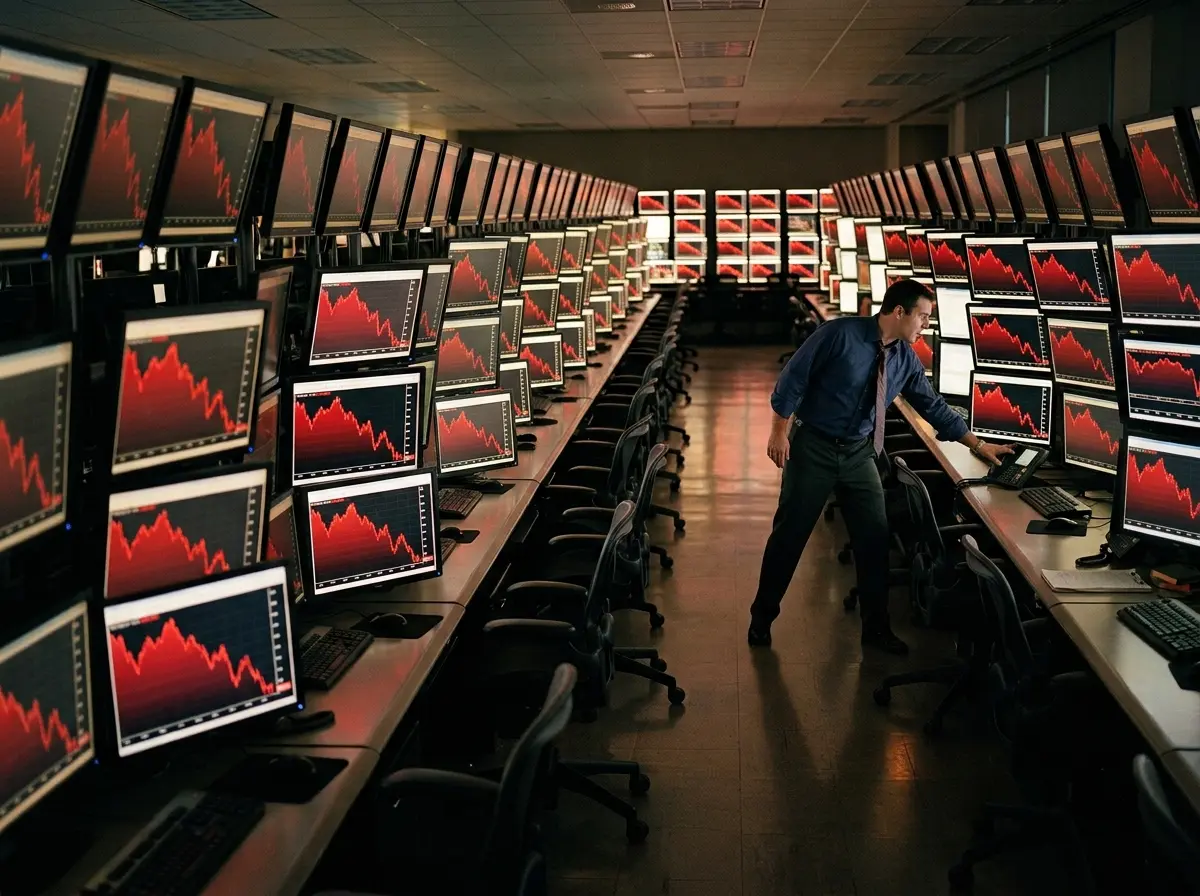
The same features turn on their users under stress. Adrian cited IMF research showing some AI-managed investment funds rebalance their portfolios significantly faster than traditional funds do, which raises the odds of synchronized trading that intensifies market swings. When hundreds of institutions run models trained on similar data, they tend to see the same danger signal and react to it at the same moment.
| Financial Function | What AI Improves Day to Day | Where It Can Amplify Stress |
|---|---|---|
| Trading | Better liquidity, lower transaction costs, faster price discovery | Synchronized selling across funds using similar signals |
| Lending | Sharper fraud detection, wider credit access via alternative data | Correlated credit tightening if models agree at once |
| Supervision (SupTech) | Real-time monitoring of institutions and markets | Shared blind spots when regulators lean on the same tools |
A separate IMF staff note on AI and cybersecurity published in June makes a related point about concentration. The bigger concern is not new categories of cyberattack, the note argues, but the way AI can widen the “blast radius” once a shared piece of technology fails, since so many institutions now lean on the same handful of vendors.
Who Absorbs the Shock?
Central banks with thin AI-supervision budgets, small businesses scored by opaque credit algorithms and ordinary savers in index and pension funds all sit downstream of a synchronized AI trading shock, even though none of them wrote a line of the code involved.
The IMF’s membership skews toward economies with far smaller supervisory-technology budgets than the Federal Reserve or the European Central Bank can deploy. That gap is exactly why Adrian’s third priority, deeper international cooperation, matters as much for a regulator in Lagos or Manila as for one in London or Washington.
Small businesses and consumers are exposed from the other direction. The same alternative-data models that Adrian credits with broadening credit access are the ones that could tighten in sync if their inputs all point the same way during a downturn, potentially freezing out the very borrowers they were built to include.
Individual regulators are not waiting for a global playbook. Canada’s Office of the Superintendent of Financial Institutions (OSFI), the country’s federal bank regulator, had already warned banks about cyber risk tied to Anthropic’s Claude models months before Adrian’s post, a sign national supervisors are moving on their own timelines rather than waiting for Basel or the IMF to set the rules first.
Wall Street Ran This Experiment in August 2007
The closest precedent for what Adrian is describing did not involve AI at all. It involved statistical-arbitrage hedge funds running quantitative models that turned out to be far more alike than anyone had realized.
Research from the National Bureau of Economic Research (NBER), a US nonprofit that publishes peer-reviewed economic analysis, traced how densely overlapping portfolios from hundreds of funds running similar factor strategies unwound in a cascade that summer, one that amplified losses well beyond what any single fund’s own risk model had anticipated.
- August 1, 2007: A mini-unwind hits between 10:45 a.m. and 11:30 a.m., an early tremor few outside the funds noticed at the time.
- August 6, 2007: A sustained unwind begins at the market open and runs until 1 p.m., starting with financial-sector stocks before spreading.
- August 8, 2007: Highbridge Capital Management’s Statistical Opportunities Fund is down 18% for the month.
- End of August 2007: Renaissance Technologies tells investors a key fund lost 8.7% for the month, a rare stumble for one of the industry’s most consistent performers.
The NBER paper on the 2007 quant meltdown found no single bad trade caused the damage. The damage came from too many funds holding, in effect, the same portfolio without knowing it. Adrian’s warning about AI describes an identical failure mode, just compressed from days into a fraction of a trading session.
Regulators Are Building the Guardrails Now
Other watchdogs are moving in parallel with the IMF, not waiting for it. The Financial Stability Board (FSB), the G20-created body that sets global standards for financial regulation, published twelve draft sound practices for AI adoption in June, with its comment period closing on July 22 and a final report due in October.
The Bank of England reported in late June that autonomous AI trading systems now execute trades without human sign-off at more than half of the finance firms it surveyed, and the central bank has floated the idea of a market-wide kill switch for AI-driven trading during extreme volatility.
Academics are formalizing the same worry Adrian raised. A working paper posted on arXiv this year built a formal model of algorithmic herding and cognitive dependency in financial markets, giving regulators a theoretical framework for a risk that, until now, mostly lived in speeches and blog posts.
None of these efforts are binding yet. The FSB’s October report will show whether the twelve draft practices harden into enforceable rules or stay as guidance regulators can adopt at their own pace.
Frequently Asked Questions
What Is SupTech?
SupTech is short for supervisory technology, the software and data tools financial regulators use to monitor banks and markets. Modern SupTech systems can scan trading data, flag unusual lending patterns and cross-check disclosure filings in something close to real time, which is exactly why Adrian wants regulators to know when their own tools share a common AI model with the institutions they supervise.
Has AI Already Caused a Real Market Crash?
No confirmed AI-specific crash has happened yet. The closest analog regulators point to remains the August 2007 quant quake, along with the 2010 flash crash, both cases where automated strategies amplified a shock well beyond its original size, even though neither involved the kind of AI systems banks use today.
What Is the Financial Stability Board Proposing?
The FSB’s twelve draft sound practices, opened for public comment on June 10 and closed on July 22, cover how financial firms should govern AI models, test them for concentration risk and report their use to supervisors. A final version is due in October 2026, which will be the next concrete marker of whether global regulators can agree on shared rules.
Does This Change Anything for Everyday Bank Customers?
It already has, in ways most customers never see. AI credit-scoring tools now shape loan approvals and pricing at many lenders, and pension or index funds that use AI-driven rebalancing could see sharper volatility swings in a stress event, even though deposit insurance and core prudential oversight remain human-run for now.