Google’s Pixel 11 lineup arrives August 12 with a new light strip built into its camera bar, and leaks point to a starting price near $900, roughly $100 more than the Pixel 10 cost a year ago. The feature is real. So is the price problem behind it.
That problem did not start in Mountain View. A global shortage of memory chips, the DRAM and NAND that store data and run apps on every phone, laptop and server on the planet, has been building since late 2025 as AI data centers buy up capacity that used to go to consumer electronics. Google is simply the next major phone maker to walk into it, on stage, in New York, in about three weeks.
What Pixel Glow Actually Changes
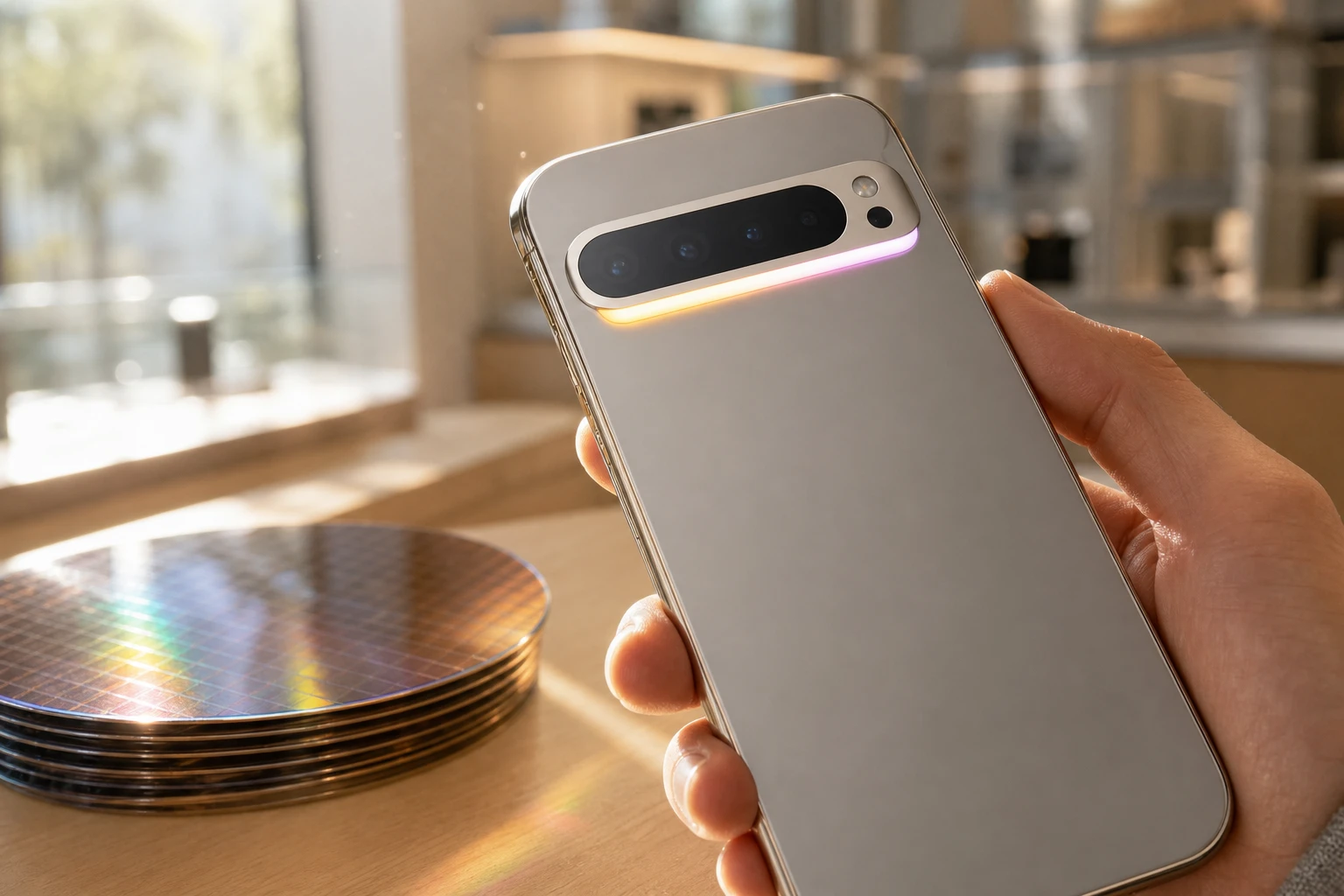
The feature is called an RGB LED array built into the camera bar, replacing the rear thermometer sensor that first showed up on the Pixel 8 Pro. It works something like Nothing’s Glyph lighting: colors and patterns tied to specific contacts, apps or charging status, visible even when the phone is face down or across a room. Google’s own teaser images confirmed the hardware is real, following Google’s own confirmation of the Pixel Glow hardware ahead of the August unveiling.
It is a legitimate hardware flex at a moment when phone design has mostly stalled. Bezels have shrunk to the point where there is little room left to add anything new to the front of a device, so Google moved the trick to the back.
- Tensor G6, built on TSMC’s 2 nanometer process, Google’s first chip at that node
- An RGB light strip in the camera bar, replacing the rear thermometer sensor
- A MediaTek M90 modem, ending a six-year run with Samsung-made modems
- Four models again: Pixel 11, Pro, Pro XL, with a Pro Fold arriving separately in October
- A starting price rumored near $900, about $100 above the Pixel 10
That is not in dispute among the leakers who have been tracking this launch for months. What is in dispute is what all of it will cost, and why.
A Memory Market Turned Upside Down
For most of the smartphone era, memory chips were an afterthought in a phone’s bill of materials. That has flipped. Data center operators building out AI infrastructure now want the same DRAM and NAND that go into phones, just packaged differently as high-bandwidth memory, and they are willing to pay far more for it.
Samsung Electronics, SK Hynix and Micron control the overwhelming majority of global DRAM production, and all three have been shifting cleanroom space and capital spending toward HBM for Nvidia-class AI accelerators instead of the LPDDR5X that goes into a phone. Research firm IDC (International Data Corporation) called it a permanent reallocation of the world’s silicon wafer capacity, projecting 2026 DRAM and NAND supply growth of just 16% and 17%, well under the 20 to 30% that used to be normal.
Francisco Jeronimo, who leads mobile device research at IDC, described the effect on smartphones as “a tsunami-like shock originating in the memory supply chain.” Nabila Popal, a senior research director at the same firm, put it more bluntly: “there is no return to business as usual for vendors and consumers.” IDC now expects the average smartphone to sell for a record $523 in 2026, a 14% jump, while global shipments fall by a record 12.9% to 1.12 billion units, the weakest year in more than a decade.
The contract price data shows how fast this moved. According to TrendForce’s own pricing survey for the second quarter, conventional DRAM contract prices were projected to rise 58 to 63% quarter over quarter, with NAND flash up 70 to 75%.
| Quarter | DRAM Contract Price (QoQ) | NAND Contract Price (QoQ) |
|---|---|---|
| Q1 2026 | +90 to 95% | +33 to 38% |
| Q2 2026 | +58 to 63% | +70 to 75% |
| Q3 2026 (forecast) | +13 to 18% | +10 to 15% |
Every number in that table comes from TrendForce surveys. The trend is cooling, but only because buyers are running out of room to keep absorbing the increases, not because supply is loosening.
Why Might the Pixel 11 Ship With Less RAM?
Short answer: leaked documents point to Google cutting the base Pixel 11’s RAM from 12GB to 8GB to control costs, while a competing leak says Google might hold the line at 12GB. Either way, the debate exists because of the same memory squeeze hitting every other phone maker this year.
Multiple leak sources, tracing back to a document attributed to Telegram leaker Mystic Leaks, describe the base Pixel 11 dropping to 8GB of RAM, a step down from the Pixel 10’s 12GB. A separate, competing set of leaks says Google may keep 12GB across the entire lineup instead. Neither is confirmed. Pro and Pro XL models are widely expected to hold onto 16GB, the configuration Google introduced starting with the Pixel 9 Pro.
The stakes here are not cosmetic. Google confirmed in May that its Gemini Intelligence system, the headline AI feature of this generation, requires a flagship chip, at least 12GB of RAM and Gemini Nano version 3 or newer to run on-device. If the 8GB leak holds, the cheapest Pixel 11 would ship below Google’s own minimum spec for Google’s own signature feature. Apple Intelligence, by comparison, runs on 8GB of RAM.
Google is also reportedly working to soften the cost of whatever RAM configuration it lands on by sourcing cheaper memory from CXMT (ChangXin Memory Technologies), a Chinese DRAM maker, for parts of the Pixel 11 line. That is no longer a fringe workaround. CXMT has grown into the world’s fourth largest DRAM producer, and its share of the global market climbed to roughly 8% in early 2026 from about 3% a year earlier. Even Apple is testing the waters: Apple has begun testing CXMT’s memory chips for devices sold in China while it lobbies Washington for broader approval to use them.
What We Know
- August 12 is real. Google sent official invitations for a Made by Google event in New York City, matching the pattern of the last two launches.
- The Tensor G6 is moving to 2 nanometers. Multiple independent leak sources agree Google’s chip will be built on TSMC’s N2 process, a first for any smartphone.
- The Samsung modem is gone. After six years, Google is switching to a MediaTek M90 modem.
What’s Unconfirmed
- Base RAM is contested. Leaks split between an 8GB base model and a retained 12GB configuration.
- Final US pricing. The $900 starting figure and roughly $100 to $114 increases reported across regions are leak-based, not official.
- Whether Pro models keep 16GB. Widely assumed, not yet confirmed by Google.
How Samsung and Apple Are Riding Out the Same Storm
Google is late to this particular party, not alone at it. Samsung’s own Galaxy S26 already launched with a confirmed $100 increase tied directly to memory costs, the same pressure now baked into Google’s pricing standoff against the Galaxy S26 Ultra. Xiaomi’s 17 Ultra came in roughly 10% pricier than its predecessor.
| Phone Maker | 2026 Price Move | Why |
|---|---|---|
| Samsung Galaxy S26 | Up $100 vs. Galaxy S25 | Confirmed increase tied to memory costs |
| Xiaomi 17 Ultra | Roughly 10% pricier than predecessor | Higher DRAM and NAND bill of materials |
| Google Pixel 11 (rumored) | Roughly $900 base, up about $100 | Leaks point to a RAM trim to offset costs |
| Apple iPhone, iPad, Mac | Prices raised across almost the entire lineup | Even early supply deals were not enough to fully absorb costs |
| Budget Android (Transsion, Oppo, Vivo) | Some models up 50%+; shipment targets cut 20 to 40% | Thinnest margins, least able to absorb the shock |
Apple has fared better than almost anyone, having locked in DRAM supply agreements and built inventory reserves early, and it is still gaining share as smaller rivals falter. But even Apple was not spared; it raised prices across nearly its entire product catalog this year and is now testing Chinese memory as a hedge. Budget Android brands operating on thin margins have it worst, with some CCS Insight-tracked models climbing more than 50% in price and shipment targets slashed by 20 to 40% for the year. A separate forecast of a 15% smartphone shipment decline in 2026 pins the sub-$100 phone segment as effectively disappearing.
There is an irony sitting underneath all of it. Samsung’s chip division posted 53.7 trillion won, about $36.1 billion, in operating profit in the first quarter of 2026, accounting for roughly 94% of the entire company’s quarterly profit, much of it from the same memory boom squeezing Samsung’s own phone division. SK Hynix posted record quarterly revenue of its own. The manufacturers causing the pain and the manufacturers absorbing it are, in Samsung’s case, the same company.
The Tensor G6 Still Has a Point to Prove
None of this would sting as much if the Tensor G6 were a clean generational leap on raw performance. It might be, on efficiency. Leaked configurations describe a seven-core layout, a departure from the usual six or eight, built around a single ARM C1-Ultra prime core clocked at 4.11GHz alongside four performance cores and two efficiency cores. Paired with TSMC’s 2 nanometer process, the chip is expected to deliver 15 to 20% better power efficiency than the Tensor G5, a real jump that could finally fix the thermal throttling and battery drain complaints that have followed Tensor chips for years, a step covered in more detail alongside Google shipping the first 2nm smartphone chip ahead of the iPhone 18.
Graphics are a different story. Leaked documentation points to a PowerVR GPU architecture that first appeared commercially around 2021, an unusually old design to pair with a brand-new process node. Google has never chased raw gaming performance with Tensor, prioritizing camera processing and on-device AI instead. That approach gets harder to defend at a $900-plus price point, where buyers increasingly expect the phone to keep up with a Snapdragon 8 Elite Gen 5 in games as well as photos.
What August 12 Needs to Settle
The newest pricing data suggests the worst of the spike may be easing, just slightly. TrendForce’s most recent survey, reported by Tom’s Hardware’s analysis of the third-quarter memory market, points to DRAM and NAND contract prices still rising in the third quarter, just at a much slower pace than the roughly 60% jumps recorded in the second quarter. That cooldown is happening because manufacturers are running out of room to pass costs along, not because supply is loosening. Samsung and SK Hynix have both said tightness could persist into 2027 and beyond, and Micron has said the same.
Google will confirm actual pricing, actual RAM and actual availability of Gemini Intelligence on every model on August 12 in New York. Until then, the Pixel 11 is a phone with a genuinely new trick on its back and a genuinely uncertain price tag on its front, both shaped by a chip market Google does not control.
Frequently Asked Questions
Will the Pixel 11 actually start at $900?
That figure comes from a recent leak, not an official Google announcement. European leaks separately point to roughly a 100 euro increase across the lineup, and a comparable 80 pound jump in the UK, both consistent with a rough $100 to $114 increase versus the Pixel 10. Google confirms final pricing on August 12.
Why doesn’t Apple face the same RAM pressure as Google?
Apple’s scale gives it leverage smaller phone makers do not have. It locked in long-term DRAM supply agreements and built inventory reserves before prices spiked, and it is now testing Chinese-made CXMT memory as an additional hedge, even though it still had to raise prices across nearly its whole lineup this year.
When exactly does the Pixel 11 launch?
Google’s Made by Google event is set for August 12, 2026, at 6 p.m. Eastern time in New York City. Retail availability is expected around August 20, based on leaked timing, with the Pixel 11 Pro Fold following separately in October.
Will phone prices keep climbing after 2026?
Analysts at Samsung and SK Hynix have both warned that memory tightness could last into 2027 and beyond, with meaningful new fab capacity unlikely to reach volume production before then. Some forecasts put real relief as far out as 2028.