A parliamentary committee warned on 6 July 2026 that the UK “may not be able to count on its allies” for access to frontier AI. The trigger was the United States cutting two of Anthropic’s newest models off from foreign users for 18 days in June. The Science, Innovation and Technology Committee’s report, “Science Diplomacy: Sovereignty, strategy, and the global race,” ties the controls to a wider gap in UK strategy.
Chaired by Dame Chi Onwurah, the committee’s report says the government has “no coherent strategic framework” for how it will use its world-leading science base to advance diplomatic or economic goals. It lists an absent priority list of partner countries, technologies and intended outcomes. It points to a Sovereign AI Unit backed by £500 million and an AI Minister whose definition of sovereignty centres on access to foreign frontier models. It describes the resulting approach, in its own words, as “opportunistic.” What the committee is asking the next government for is a written plan with named partners and dated milestones.
The 18 Days That Came Due in June
On 12 June 2026, the US Department of Commerce sent Anthropic a letter informing the AI developer that export controls had been imposed on two of its newest models, Fable 5 and Mythos 5. The order, issued under the Export Control Reform Act and signed by Commerce Secretary Howard Lutnick, required a Commerce licence before any foreign national, including Anthropic’s own overseas employees, could access either model. A CSIS analysis of the episode notes that the order cited emerging-technology authority under the act and Section 744.22 of the Export Administration Regulations. Anthropic’s public response was categorical.
| Date | Action |
|---|---|
| 12 June 2026 | Commerce imposes export controls on Fable 5 and Mythos 5; Anthropic disables both models for foreign users and itself worldwide. |
| 26 June 2026 | Lutnick authorises Mythos 5 for around 100 vetted US organisations focused on critical infrastructure defence; Fable 5 remains offline for the wider public. |
| 30 June 2026 | Commerce withdraws the licensing requirement entirely; Fable 5 and Mythos 5 are restored on Anthropic’s Claude products the following day. |
Anthropic stated at the time that “the net effect of this order is that we must abruptly disable Fable 5 and Mythos 5 for all our customers to ensure compliance.” Fable 5 was the public-facing version of Anthropic’s Mythos-class line; Mythos 5 had been running with a smaller, vetted set of users under the company’s Project Glasswing cybersecurity programme. Both models went dark worldwide on the same week.
Lutnick partially eased the restriction on 26 June, authorising Mythos 5’s release to around 100 vetted US organisations focused on critical infrastructure defence while keeping Fable 5 offline for the wider public. On 30 June, Commerce withdrew the controls entirely; Fable 5 and Mythos 5 returned to Anthropic’s Claude products the following day. The lifting followed a letter from more than 100 signatories, including former Facebook security chief Alex Stamos and bug-bounty advocate Katie Moussouris, arguing the directive had taken the strongest available models away from defenders without a corresponding security benefit. Anthropic also trained an improved jailbreak classifier that the Center for AI Standards and Innovation tested and called “extraordinarily strong.” OpenAI confirmed on the same day it had delayed the full launch of GPT-5.6 at the US government’s request, limiting initial access to vetted partners under a voluntary review framework.
Four Findings the Committee Cannot Outrun
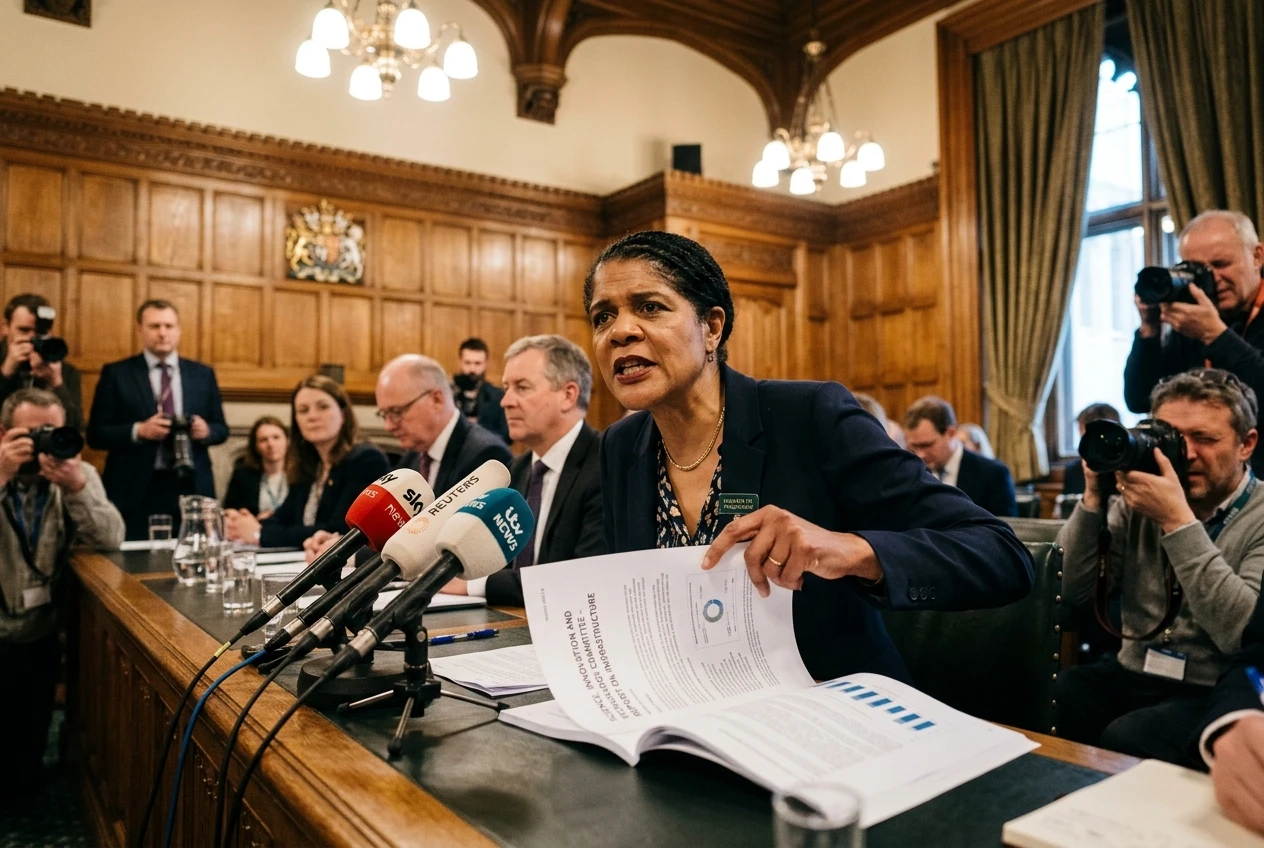
The committee’s published statement on science diplomacy makes one opening claim. It says the government “may not be able to count on its allies” for access to critical technologies and must set out an AI sovereignty strategy. The report itself, published as House of Commons paper HC 62, names four specific failures in the way the government has handled science diplomacy to date.
- No coherent strategic framework. The government has not set out how it will use its scientific base to advance its diplomatic or economic goals.
- No priority list. The government has not named which partner countries, which priority technologies, or which intended outcomes it will work to for science and tech partnerships.
- Specialisation gap. The UK’s approach to space and quantum, two sectors the committee labels “key,” remains unclear.
- Security framework gap. The UK’s open approach to collaboration has not been matched by what the report calls a “sufficiently robust” framework for managing the associated risks to research security.
The four findings sit alongside a committee prescription. The committee wants an “over-arching plan” for tech sovereignty, naming partner countries, priority sectors and intended outcomes, with delivery timetables giving industry certainty. It also asks the government to address what it calls “gaps in later-stage funding for deep tech companies through more targeted investment and public procurement.” Many innovative UK firms, the report says, are still forced to move overseas to grow because the scale-up capital is not available at home. The committee also flags a “lack of specialist funds” and “a lack of growth-stage lead investors” willing to back British deep tech at the late stages where capital matters most.
There is a global race for sovereignty in technologies like AI, whether the government recognises it or not, and leverage may not be sufficient to achieve this. The government needs a realistic plan to achieve sovereign capabilities in critical areas or risk having its access cut off at the whim of its partners.
Dame Chi Onwurah, chair of the Science, Innovation and Technology Committee, in the committee’s published statement.
The committee chair’s published framing is that the UK is in “the premier division of science and the premier division for diplomacy” but cannot say where it stands on science diplomacy. In the same statement she said she hoped “the incoming administration will learn from the mistakes of its predecessors and move quickly to create a clear plan.” The committee’s report sums up the resulting approach as “opportunistic.”
The committee also diagnoses two commercial failures holding the UK back. Many innovative UK firms, the report says, are still forced to move overseas to grow because the scale-up capital is not available at home. The committee points to a lack of specialist funds and a lack of growth-stage lead investors willing to back British deep tech at the late stages where capital matters most. It also wants the government to address “gaps in later-stage funding for deep tech companies through more targeted investment and public procurement.”
A £500m Fund Against One Letter
The UK has invested in the language of AI sovereignty. The government has launched a Sovereign AI Unit with £500 million of public funding to back what ministers call “national champions” in artificial intelligence, according to the Commons Library briefing on digital sovereignty. The briefing also records an estimated annual government spend of around £14 billion on digital services, of which a small share is open to UK-headquartered suppliers. The AI Minister, Kanishka Narayan, defines sovereignty in AI as “the ability for a state to have strategic leverage when it comes to this technology, such that it can ensure ongoing access to critical inputs.” That definition permits dependence on a foreign frontier model so long as the bilateral relationship looks stable.
The Commons Library does not itself pass judgment on whether Narayan’s framing is sufficient to the moment. The committee’s report says it is not, citing the controls on Anthropic as the evidence. The committee’s preferred word for what is missing is “sovereign capability,” meaning the UK must be able to build things at home rather than rely on continued access to a foreign provider.
The “Own, Collaborate, Access” Frame That Lost Its Frame
The previous Conservative government set out an “own-collaborate-access” framework for picking where the UK would invest, where it would partner, and where it would simply buy. The current Labour administration has not referred to that framework in any of its publications, the committee notes, and has refused to publish any list of technologies requiring sovereign investment. Outgoing Prime Minister Keir Starmer told MPs that publishing such a list would mean “telegraphing our specific vulnerabilities to hostile actors.” The committee’s report rejects the security argument and with it the administration’s preferred reasoning for staying quiet. The committee proposes sharing the strategy “in confidence with the Intelligence and Security Committee of Parliament,” a body that already handles classified material.
If the UK got into an argument today with Trump, over Greenland, Israel, or trade, then Trump could swiftly close down the UK’s government, by closing down US owned IT and Cloud systems.
Open Rights Group, cited in the House of Commons Library briefing on digital sovereignty.
The committee’s report asks the next UK administration to plan sovereign capability in AI and adjacent sectors. It cites the 18-day Anthropic episode as the reason such capability is now urgent. The Open Rights Group, the campaign group, has put the same case in the starkest terms in the Commons Library record.
The chamber will get its first formal chance to scrutinise the report on 9 July 2026, when the committee presents it to the House of Commons under a select committee statement. The committee’s report does not name a deadline for an overarching plan. What it does name is a Sovereign AI Unit with money but no published strategy and an AI Minister whose definition depends on the bilateral relationship looking stable. It also names a government that has so far declined to publish either a partner list or a priority list.
Defence, Quantum, and a Race the UK Has Not Joined
The committee’s reading of the wider world is unusually stark. Heightened geopolitical pressure and continuing wars in Ukraine and Iran have, the report says, pushed Nato allies in Europe and Canada to lift defence expenditure to 5% of GDP. The commercial use of AI and autonomous drone technology in warfare has, the report notes, driven a substantial boost in venture capital for defence-technology startups in the US and Europe.
The committee’s reading of where the spending is going is specific. Investment, the report says, is flowing into AI, quantum computing, biotech and robotics, four sectors the committee treats as both economic and military capabilities. The UK is described by the committee as having world-class early-stage research in some of these areas but as struggling to scale companies domestically. Many innovative UK firms, the committee says, “are still forced to move overseas to grow” because the scale-up capital is not available at home. The committee points to a lack of specialist funds and a lack of growth-stage lead investors willing to back British deep tech at the late stages where capital matters most.
On the home side the committee flags what it calls a security-framework gap. The UK’s “traditionally open approach to international collaboration,” the report says, “has not been matched by a sufficiently robust framework for managing the associated risks,” leaving research security, intellectual property protection and protection against exploitation by hostile actors under-specified. The report wants a tightened framework, comparable in seriousness to the export controls the United States has just used.
The Anthropic episode showed that frontier AI access can be switched off by one letter from one agency in one country, inside an 18-day window. The committee’s answer is to build sovereign capability in the key sectors and to publish, even in confidence with the Intelligence and Security Committee, a partner list and a priority list. Starmer’s outgoing government has until now declined to publish either. The committee’s report now sits with whoever takes office next.
Frequently Asked Questions
What did the US actually do to Anthropic’s AI in June 2026?
On 12 June, Commerce’s Bureau of Industry and Security ordered Anthropic to require an export licence before any foreign national could access two of its newest models, Fable 5 and Mythos 5, citing emerging-technology authority under the Export Control Reform Act. Anthropic disabled both models worldwide the same day. Commerce partly eased the restriction on 26 June for around 100 vetted US organisations working on critical infrastructure defence, then lifted it entirely on 30 June.
What did the UK Science, Innovation and Technology Committee ask for?
The committee called on the government to publish an “over-arching plan” for tech sovereignty, naming partner countries, priority sectors and intended outcomes, and to back that plan with delivery timetables giving industry certainty. It also urged the government to address gaps in later-stage funding for deep tech companies through more targeted investment and public procurement. The committee pointed to the Anthropic and OpenAI episodes as evidence that the UK cannot rely on a single foreign provider for frontier AI capability.
What is the Sovereign AI Unit?
It is a unit within the Department for Science, Innovation and Technology, set up with £500 million of public funding to support what ministers call “national champions” in artificial intelligence. The Prime Minister, the Commons Library briefing records, has framed the goal as making the UK “an AI maker, not an AI taker.” The committee’s report does not pass judgment on the unit itself; its complaint is the absence of an overarching strategy for what the unit and its neighbours should be doing.
Why are “own, collaborate, access” framework details important?
The framework, drafted under the previous Conservative government, sorted UK technology investment into three categories: own (build it domestically), collaborate (work with named partners), or access (buy from allies as needed). The committee says the current Labour administration has not referred to that framework in any of its publications, leaving the UK without a published set of categories into which any given technology falls. Without those categories, the committee argues, the UK cannot say what its sovereign capability is, only what its sovereign ambition might be.