American Airlines and Google signed a record-setting sustainable aviation fuel agreement on June 9, 2026, covering 35 million gallons over three years, the largest publicly announced SAF certificate deal of its kind between an airline and a single corporate customer. The arrangement is expected to cut nearly 300,000 metric tons of carbon dioxide equivalent in lifecycle emissions, with the fuel itself produced largely from waste feedstocks like used cooking oil.
American will take physical delivery at Chicago O’Hare under a long-term supply contract with Valero Marketing and Supply Company, an arrangement the airline says was made possible by an Illinois SAF tax credit. Google, in turn, will receive the environmental benefits through the SAFc Registry to count against employee business travel emissions. The deal lands in a market the International Air Transport Association now calls another disappointing year, with 2026 SAF output projected at 0.8% of aviation fuel use and an extra $4.3 billion cost to airlines.
The Deal American and Google Just Signed
American’s press release, filed from Fort Worth, calls the agreement the largest publicly announced SAFc arrangement between an airline and a single corporate customer to date. Under the structure, American will purchase and take delivery of physical fuel at Chicago O’Hare International Airport through existing infrastructure, with the SAF portion produced from waste feedstocks like used cooking oil. Google will receive the environmental benefits via the SAFc Registry, the industry’s book-and-claim system, to address emissions from employee business travel, as laid out in the 35-million-gallon agreement and its lifecycle emissions math.
The mechanism at work is the SAF certificate, and it is what lets Google’s payment translate into physical fuel that lands in Chicago. American takes ownership of the molecule; Google takes ownership of the emissions reduction attached to it. The three-year term is what gives the deal its weight, because long-term offtake is the kind of demand signal fuel producers say they need before they build new capacity. American used the commitment to lock in a new long-term SAF offtake with Valero Marketing and Supply Company for delivery to O’Hare. The fuel itself, produced from feedstocks including waste oil and fats, can reduce emissions by up to 80% compared with traditional jet fuel, per the airline’s release.
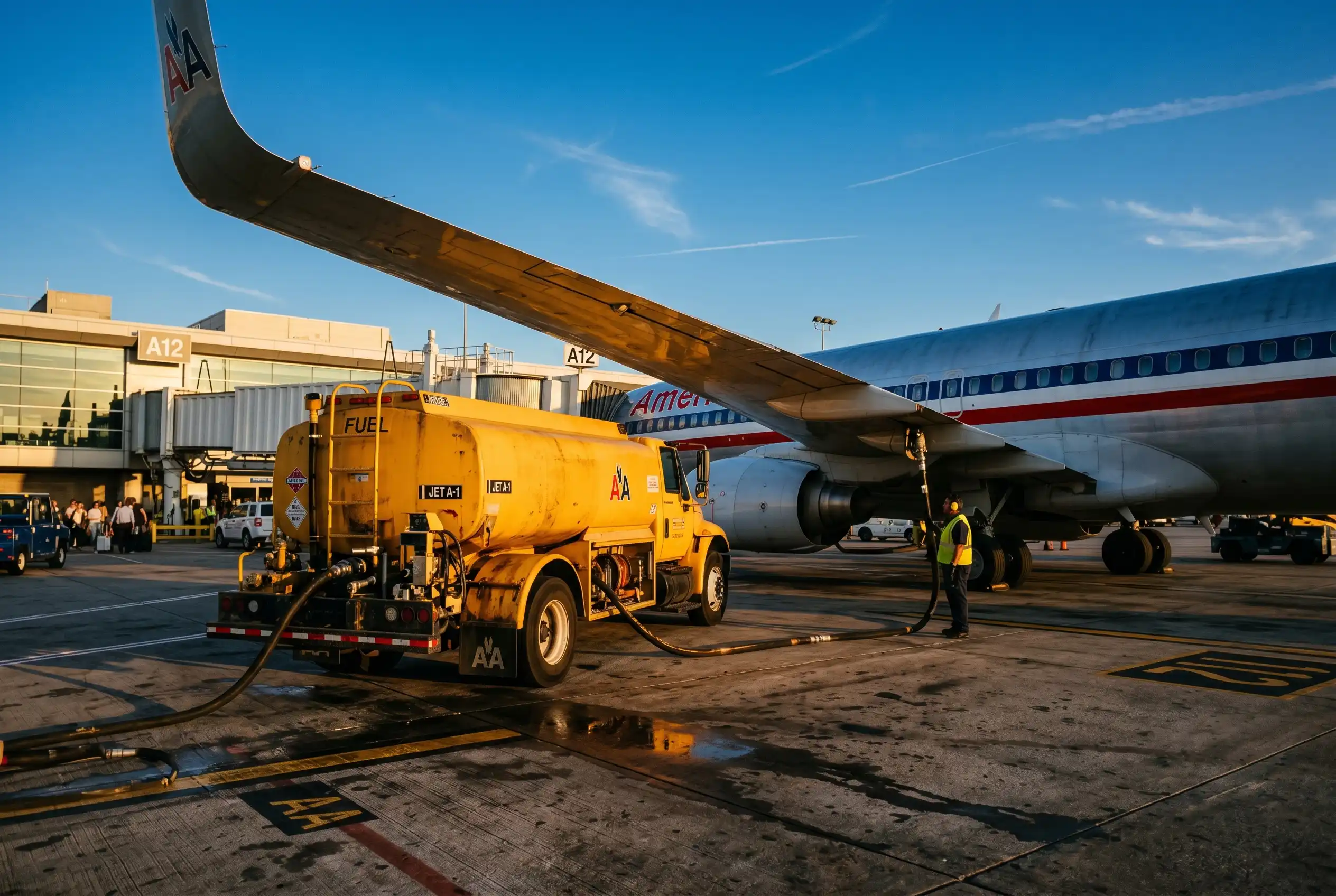
How the Certificates Move Fuel Across Borders
The certificate is not a metaphor. It is a register entry that follows a physical batch of fuel from refinery to wing, with the environmental attribute separated from the molecule and sold to a buyer who never touches the jet. The SAFc Registry, referenced in the American release, exists to make that separation traceable, so that two companies can sit on different continents and trade the climate value of the same gallon of fuel without anyone double-counting. That bookkeeping is what turns a long-term corporate purchase into a piece of supply chain finance that refineries can underwrite. Without the registry, the Google side of the deal would not exist as a tradable product.
The wider industry has been building toward book-and-claim for years. Shell and American Express Global Business Travel jointly operate Avelia, a separate book-and-claim platform for SAF environmental attributes. The American Airlines release notes that Google is already a customer of that registry, and is also a participant in the United Airlines Ventures Sustainable Flight Fund that backs SAF startups. The O’Hare deal slots into a working infrastructure, not a pilot.
- American takes ownership of the physical fuel molecule at O’Hare.
- Google takes ownership of the emissions reduction tied to that fuel, registered through the SAFc Registry.
- The two sides trade dollars, fuel, and credits across separate ledgers, with the registry keeping the chain traceable.
Why Chicago, Why Valero, Why Illinois
The headline players are American and Google. The deal only works because two quieter parties agreed to terms. Valero Marketing and Supply Company signed on as the long-term fuel supplier, the kind of multi-year offtake commitment that refiners typically require before they will move SAF through a dedicated pipeline into an airport. Chicago O’Hare was selected as the delivery point specifically because Illinois Governor JB Pritzker and the Illinois General Assembly have enacted an SAF tax credit that made the economics stack up at that airport. Without either leg, the agreement would not have cleared the airline’s procurement bar.
Pritzker framed the credit as a market-shaping tool in the airline’s announcement.
Illinois is proud to be at the forefront of the clean energy industry. This agreement demonstrates how our nation-leading SAF tax credit can bring industry leaders together as we work toward a more sustainable future. Through partnerships with innovators like American Airlines and Google, we’re strengthening Illinois’ role as a global aviation hub and accelerating the transition to cleaner energy.
American’s chief sustainability officer, Jill Blickstein, called the deal an industry-leading step that helps grow demand for SAF and supports a stronger market. The political and commercial scaffolding underneath the announcement is what makes a three-year, 35-million-gallon commitment possible at a single airport hub, and it is the part of the story that does not show up in the headline number.
What Google Is Building Beyond This Deal
The O’Hare agreement is the loudest entry in a longer Google file on aviation fuel. The company has previously worked to accelerate the SAF market in Singapore, signed a long-term agreement with American Express Global Business Travel and Shell to source environmental attribute information through the Avelia registry, and joined the United Airlines Ventures Sustainable Flight Fund that backs startups advancing SAF research and technology. Read together, those moves describe a buyer strategy, not a one-off purchase.
Google’s chief sustainability officer, Kate Brandt, called the American agreement a demand signal aimed at catalysing investment and bringing more SAF to market. That framing lines up with how Google has used its procurement elsewhere: long-dated, large enough to move a marginal producer’s spreadsheet, and structured so the environmental benefit travels with the dollar. Google’s own account of the partnership leans on the same lifecycle math American published.
The pattern matters for what the O’Hare deal can plausibly do. A single 35-million-gallon agreement is a real commercial event for one refinery in one state. A buyer showing up in three different SAF market structures in three years is a different kind of signal to producers deciding whether to finance new capacity. American is the operational counterparty in each case. Google’s role is the consistent one: paying for the environmental attribute, in volume, on terms that allow supply to scale behind it.
The Sober Backdrop IATA Just Laid Out
The deal is the largest publicly announced corporate book-and-claim SAF agreement to date, and it is still a rounding error in the global jet fuel market. The International Air Transport Association published its 2026 estimate on June 6, three days before the American-Google announcement, and the numbers set a hard floor under the optimism. Global SAF production is projected to reach around 2.4 million tonnes this year, representing just 0.8% of aviation fuel use, at an extra $4.3 billion cost to airlines, per IATA’s June 2026 SAF production estimate. For context, 2024 output was about 1 million tonnes, so 2026 represents a roughly two-and-a-half-fold increase from a very small base.
Walsh, IATA’s director general, did not soften the diagnosis. The association is calling for coordinated action on renewable energy supply, open access to fuel infrastructure, sequenced policy incentives, and a global book-and-claim market to make SAF accessible to airlines and producers regardless of location. It also warned that the next regulatory wave, e-SAF mandates in the UK and EU, is heading toward a 0.6 million tonne 2030 target while global operating and under-construction capacity sits at around 0.02 million tonnes.
It looks to be another disappointing year for SAF production. Five years after committing to achieve net zero by 2050, SAF production will only account for 0.8% of airline fuel use this year. The path to meeting 65% of our needs in 2050 is growing more difficult with each year of ineffectively sequenced government policies and oil companies’ manifest lack of interest. The current energy shock should add even more urgency to the development of renewables, including SAF. But we have yet to see either the energy shock, the need to develop energy independence and jobs, or the urgency to mitigate climate change materialize in the incentives needed to create a viable SAF market.
The industry’s 2050 target is 65% of fuel from SAF, and the gap between 0.8% and 65% is the figure that hangs over every agreement of the size American and Google just announced.
- 2.4 million tonnes: projected global SAF output in 2026 (IATA)
- 0.8% of aviation fuel use: 2026 SAF share (IATA)
- $4.3 billion: extra 2026 cost to airlines from the SAF premium (IATA)
- 65%: industry’s 2050 SAF target under the net-zero roadmap (IATA)
- 1 million tonnes: 2024 global SAF output, for context (IATA)
The Other Wager: AI to Steer Planes Around Contrails
The O’Hare deal is the louder half of the American-Google partnership. The quieter half is a separate bet that artificial intelligence can steer planes around the ice-crystal clouds that aviation has spent less time talking about, and that may warm the planet as much as the fuel itself. Contrails form when aircraft fly through cold, humid air, and persistent contrails trap heat in the atmosphere. Google uses AI trained on satellite imagery, weather patterns, and flight paths to generate forecast maps of where contrails are most likely to form, and the airline can adjust altitude or routing to avoid those zones.
American and Google first applied AI to contrail avoidance in 2023, working with Contrails.org and flight planning provider Flightkeys. The first trial covered 70 flights over six months. The follow-up ran from January 15 to May 13, 2025, and widened the test to 2,400 of American’s transatlantic flights, with 112 flights actually rerouted to follow the AI’s recommended path.
For the 112 flights that followed the contrail-avoidance flight paths, contrail formation dropped by 62% compared with a control group, with up to 69% reduction in associated warming impact, and what the researchers described as “no statistically significant difference” in fuel burn, per the 62% contrail reduction across 112 flights. The American Airlines release describes the same 16-week trial as having produced a “statistically significant 62% reduction in contrail formation and a substantial reduction in related warming.”
The two trial rounds show how the project moved from a proof of concept to something an airline’s dispatchers can use in the normal course of business.
| Attribute | 2023 initial trial | 2025 expanded trial |
|---|---|---|
| Flights tested | 70 | 2,400 transatlantic (112 rerouted) |
| Duration | over six months | 17 weeks (Jan 15 to May 13, 2025) |
| Contrail formation reduction | 54% | 62% |
| Fuel impact | as little as 0.3% | “no statistically significant difference” |
What the Numbers Do Not Resolve
The deal does three things at once. It locks in fuel supply at one airport, gives a corporate buyer the environmental attribute it can carry on its books, and tests whether long-term offtake can crowd private capital into a thin market. It does not change the ratio of SAF to conventional jet fuel globally, and it does not move the needle on the 0.6 million tonne 2030 e-SAF mandate the EU and UK have set.
Walsh said on the Sunday before the American-Google announcement that the airline industry’s 2050 net-zero target may need to be reviewed as SAF production and access to carbon credits remain below current targets. American and Google have not committed to a 2030 milestone, and their deal is structured as a three-year bridge, not a glide path to the 65% 2050 share the industry has named. The wager is that demand, banked through certificates, can pull supply forward faster than the e-SAF mandates will allow. IATA’s June numbers say that bet is still wide open, and the next 12 months of fuel data at O’Hare will be the first real reading on whether the market is listening.
Frequently Asked Questions
How much fuel is in the American Airlines-Google SAF deal?
American Airlines and Google announced a three-year agreement for 35 million gallons of sustainable aviation fuel certificates, expected to reduce nearly 300,000 metric tons of carbon dioxide equivalent over the term.
What is a sustainable aviation fuel certificate?
An SAF certificate lets a buyer claim the environmental benefits of physical SAF delivered elsewhere. The SAFc Registry’s book-and-claim system tracks the chain. American takes physical delivery at O’Hare; Google receives the emissions benefits to count against employee business travel.
What is sustainable aviation fuel made from?
SAF can be produced from feedstocks including used cooking oil, waste fats and greases, and synthetically using captured carbon dioxide and renewable electricity. American and Google said the fuel for this deal will largely come from waste feedstocks like used cooking oil.
Why was Chicago O’Hare chosen for the deal?
American and Google pointed to an Illinois SAF tax credit enacted by Governor JB Pritzker and the Illinois General Assembly. The credit made a long-term supply arrangement with Valero Marketing and Supply Company viable at O’Hare.
How big is global SAF production today?
IATA’s June 2026 estimate puts global SAF production at around 2.4 million tonnes, or 0.8% of aviation fuel use, with the available supply expected to cost airlines $4.3 billion this year. The industry’s 2050 target is 65% of fuel from SAF.