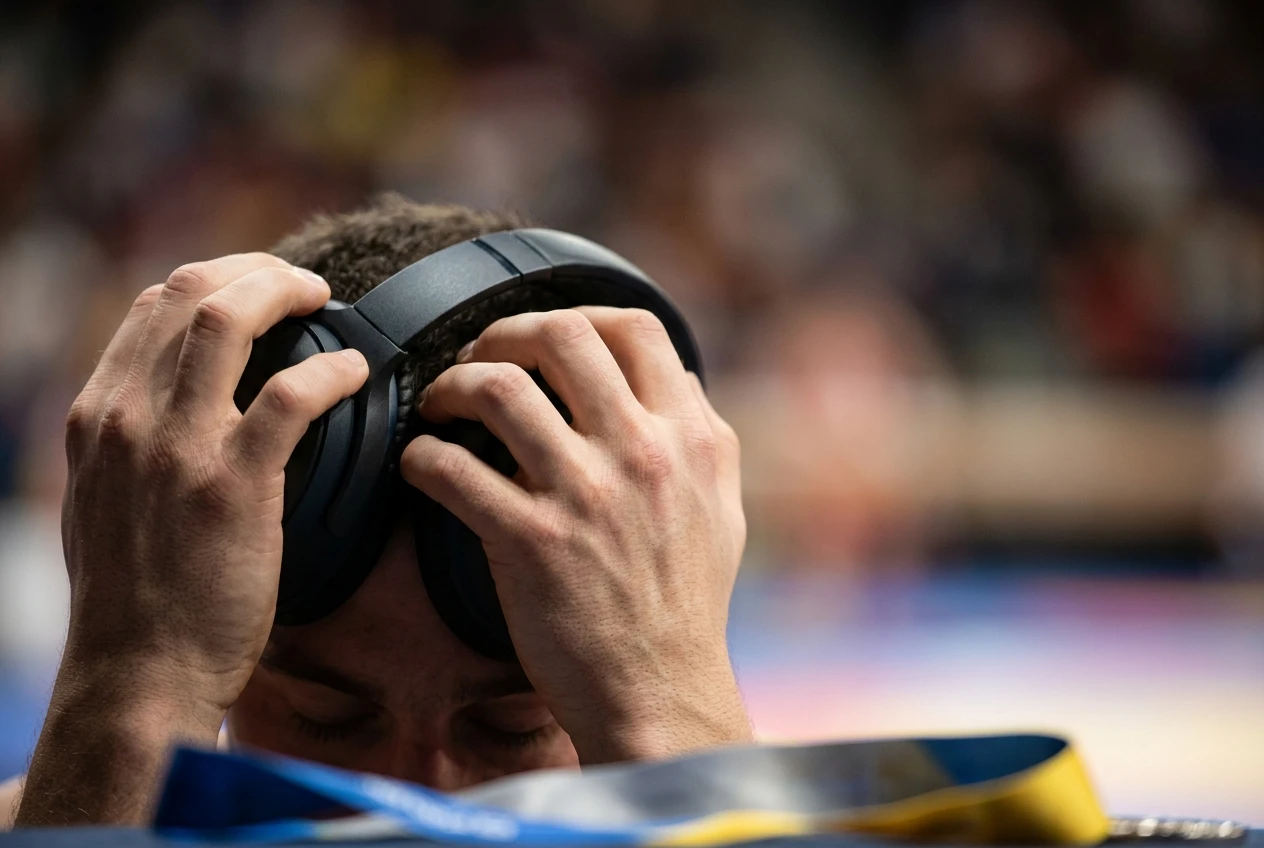
On May 28 in Varna, Bulgaria, Ukrainian gymnast Sofiia Krainska stood on a competition podium with a silver medal around her neck and put on headphones. Russia’s national anthem was playing. She covered her eyes with both hands. The 16-year-old was flanked by Germany’s Melissa Diete and Russia’s Yana Zaikina; the Russian Gymnastics Federation was the first to post the footage.
The photograph had a specific origin. On May 16-17, the executive committee of the International Gymnastics Federation (FIG) met in Sharm el-Sheikh, Egypt, and voted to lift all restrictions on Russian and Belarusian athletes across all five gymnastics disciplines, restoring flags, anthems, and national team designations in full. FIG was the third major sports body to reach the same decision within a single month. Russia’s invasion of Ukraine, now past its fourth year, had not paused between any of those votes.
A Sequence of Reversals
World Aquatics, the governing body for swimming, diving, water polo, and synchronized swimming, restored full Russian national symbols in April. United World Wrestling followed in early May, lifting restrictions across all age categories for freestyle and Greco-Roman competition. The international federations for taekwondo and judo had acted before that. Each decision arrived as a short administrative notice; the gymnastics federation’s announcement appeared as a single item among seven unrelated agenda points, with no published explanation of what conditions had changed to justify the reversal.
| Federation | Decision | What Was Restored |
|---|---|---|
| World Aquatics | April 2026 | Flag, anthem, national designation; all aquatic disciplines |
| United World Wrestling | Early May 2026 | Flag, anthem; all age categories |
| World Gymnastics (FIG) | May 16-17, 2026 | Flag, anthem, national designation; all five gymnastics disciplines |
| International Judo Federation, World Taekwondo | Before May 2026 | Flag, anthem |
The International Olympic Committee (IOC) still recommends that Russian athletes not use their own national symbols and has maintained its suspension of the Russian Olympic Committee. But those recommendations carry no binding authority over individual sports federations. World Gymnastics President Morinari Watanabe received a personal thank-you from Oleg Belozerov, the president of Russia’s Gymnastics Federation and also head of Russian Railways, for his “constructive approach” to the reinstatement. Russia’s Sports Minister Mikhail Degtyarev called the Varna results confirmation of “the high level of the Russian school of rhythmic gymnastics, its traditions and quality of preparation.” Those traditions include four years of international suspension; his statement did not address that detail.
The European Gymnastics Federation held an online executive committee meeting on May 21 and voted to follow. By the time the Varna championship opened six days later, Russia was listed under its national flag on the official participant page, competing with full national symbols at a European gymnastics event for the first time since 2022. On the same weekend, a confrontation between Ukrainian and Russian athletes was also playing out on the clay courts of Paris.
Headphones on the Podium
Zaikina, the gold medalist whose anthem Krainska refused to acknowledge, is also 16. She trains at Nebesnaya Gratsiya (Heavenly Grace in Russian), the rhythmic gymnastics academy in Krasnodar founded by Alina Kabaeva, the former Olympic champion widely described as Vladimir Putin’s companion. Thirteen of the 15 Russian gymnasts who competed at Varna trained at the same facility. Zaikina’s ribbon gold and Kseniia Savinova’s hoop silver were the first European championship medals for Russian athletes under full national symbols since the reinstatement, and both came from Nebesnaya Gratsiya athletes. The Russian delegation had nearly not arrived at all: Bulgarian authorities initially refused to approve the team’s charter flight, and the delegation entered the country via Istanbul, arriving one day before competition began.
The ribbon final was one of two medal ceremonies where Ukrainian gymnasts made the same gesture that week. In the ball final, Belarus’s Kira Babkevich won gold and Ukraine’s Varvara Chubarova won bronze; when the Belarusian anthem played, Chubarova put in earphones and covered her eyes. The Ukrainian Gymnastics Federation issued a statement: “We refuse to look at the state symbols or listen to the anthems of aggressive Russia and its proxies, whose involvement in this unjust war has caused immense destruction and suffering.” It referenced “hundreds of Ukrainian athletes and coaches who were killed in the war and will never compete again” and “thousands of sports schools that were completely destroyed.”
The federation followed with a campaign called #CloseYourEyesAndEars, calling on athletes worldwide to post videos of the gesture alongside the sound of Ukrainian air raid sirens, “so the world understands the sounds our athletes hear while training every day.” The appeal went out to coaches, athletes, and sports fans across all disciplines. At Varna, no other competitor joined it.
Roland Garros’s Most Charged Press Conference
The Receipts She Brought to Paris
Oleksandra Oliynykova arrived at her pre-match press conference at the French Open carrying printed photographs and screenshots on her phone. She was 25, ranked 65th in the world, and appearing in her first French Open main draw, having beaten Elena Pridankina in straight sets and Kimberly Birrell in three sets to reach the third round for the first time at a Grand Slam. She was about to play Russia’s Diana Shnaider. The photographs showed Shnaider competing at a Gazprom-sponsored exhibition in St. Petersburg, which she had attended in recent winters; the screenshots showed Shnaider’s social media activity, including likes left on posts from Russian propagandists.
Gazprom, the Russian state-controlled energy company, has historically contributed close to 10% of Russia’s federal budget. Oliynykova told the journalists in front of her at her Roland Garros press conference that competing at a Gazprom-funded event was equivalent to performing for the Nazis. “Playing in tournaments like this is the same as playing in Nazi Germany for Gestapo officers,” she said, “on the tournament organized by a company which built Auschwitz.”
My home is being attacked by Gazprom money. They are paying for drones attacking my city.
Oliynykova lives and trains in Kyiv, the only Ukrainian among the women ranked inside the WTA’s top 100 still based in the country. Her father serves in Ukraine’s drone corps; her partner does the same. Court 7 at Roland Garros, a small court that normally seats a few hundred spectators, was assigned eight extra security personnel for the match.
After the Last Point
Shnaider, ranked 23rd and 22 years old, said she had no idea what Oliynykova had said before they walked onto court. “I’m not seeing my family or my friends, and I have the only one opportunity to play in front of my family,” she said, defending her appearances at home. She declined to state any position on Russia’s invasion of Ukraine. “I don’t know anything about what she said,” Shnaider told journalists afterward. “Wasn’t interested at all.”
The match lasted barely an hour. Shnaider won 7-5, 6-1. There was no handshake at the net. Her post-match news conference opened with a prepared statement she read aloud before taking any questions. “I know that some people would prefer that I stay silent,” she said. “But what I do is not about politics. It’s about humanity.”
The WTA Tour has regulations allowing sanctions against players who compete in tournaments sponsored by betting companies; under those rules, a player can face penalties based on the sponsor’s category alone. She asked publicly why no similar review had been applied to players competing in events funded by a state energy company she described as financing the destruction of her city. The tour offered no response. Marta Kostyuk, who that same week became the first Ukrainian woman to reach the Roland Garros singles semifinals in the Open era before losing to Russia’s Mirra Andreeva with a 17-match clay-court winning streak snapped, has maintained a long-standing policy of refusing handshakes with Russian and Belarusian opponents throughout the season.
The Club Russia Built in Taganrog
Since Russia’s occupation of parts of eastern Ukraine began in 2014, displaced Ukrainian football clubs have found their names taken and deployed in Russian league tables. In October 2025, the Ukrainian Association of Football (UAF) wrote formally to UEFA identifying the situation. The letter cited Articles 10, 11, and 84 of the FIFA Statutes, designating the UAF as the only legitimate body authorized to organize football activities across Ukraine, including temporarily occupied regions. It documented multiple clubs now competing under Ukrainian football identities inside Russia’s pyramid, as reported by The Guardian and Liga.net:
- “Shakhtar Donetsk” (fake) plays in Russia’s second division from Taganrog while officially registered as headquartered in occupied Donetsk. Its website has appropriated the full history of the original Ukrainian club.
- “Zorya Luhansk” (fake) also competes from Russian cities, was promoted to Russia’s fourth division last year without sporting justification, and trains partly in occupied Ukrainian territory.
- Two additional clubs in Russia’s fourth division operate under Ukrainian identities, constituting roughly a quarter of that division’s 16 teams.
The UAF described the arrangement as “a direct violation of the territorial jurisdiction of the UAF” and warned it constituted an attempt to “legitimize the occupation and erase the identity of Ukrainian football.” UEFA has issued no formal response. The letter has sat unacknowledged for eight months.
The original Shakhtar Donetsk, in its 90th year, has won the Ukrainian championship 16 times and reached the UEFA Conference League semifinal this spring against Crystal Palace, hosting its home European matches at a stadium in Kraków because UEFA security protocols prohibit European competition inside Ukraine. The club won independent Ukraine’s first European trophy in 2009, defeating Werder Bremen 2-1 in the UEFA Cup final in Istanbul. It has not played a competitive home match in Donetsk since May 2, 2014.
What Silence Authorizes
The pattern extends further than what happened at Varna and Roland Garros this month. At the Milan 2026 Winter Olympics, Ukrainian skeleton athlete Vladyslav Heraskevych asked to race with a helmet depicting the faces of war victims. Officials disqualified him, citing technical regulations. He removed the helmet and raced without it. Russian athletes at the same Games competed under full national representation in the Paralympic events that followed.
Russia has historically attached sport to geopolitical legitimacy at a scale most states do not attempt. The energy crisis triggered by the war in Iran deepened global dependence on Russian exports through 2025 and into 2026, raising the economic cost of confronting Moscow across policy areas, including sport. Ukraine has formally accused Russia of using “pressure, bribery and blackmail” to win reinstatements across governing bodies. No federation has publicly acknowledged that pressure; the IOC recommendation against Russian symbols, its one remaining constraint, carries no binding authority over individual federations. None has explained what changed between 2022 and 2026 to make reinstatement appropriate while the killing continues.
Headphones appeared at Varna’s podium at the precise moment the gymnastics federation’s vote made the Russian anthem audible at a European championship for the first time in five years. Oliynykova brought printed screenshots to Paris because the WTA has no formal mechanism covering participation in state-energy-funded events. Chubarova covered her eyes because European Gymnastics voted to follow within four days of the Sharm el-Sheikh decision. The UAF’s letter went to UEFA because clubs playing under stolen Ukrainian names exist, officially, in a Russian league.
Russia’s flag flew in Varna for the first time since 2022. The fake Shakhtar leads its table in Taganrog. The UAF’s letter to UEFA, submitted in October 2025, has produced no response.