Cheung Kong Graduate School of Business opened its first permanent campus in Beijing on June 3, a 30,000-square-meter building in the city’s Ciqikou district that the school and its alumni paid to put up after 23 years of leasing space. The CKGSB Beijing campus took in 275 new Executive Master of Business Administration (EMBA, a degree built for working senior managers) students the same day. The building is a fixed, capital-heavy commitment to private business education in China, made at a moment when foreign investors have turned cautious about the country’s growth.
Here is the wager underneath the ribbon-cutting. A permanent home in the capital locks in cost and signals confidence just as China’s 2026 growth is forecast near 4.5%, the property slump grinds on, and foreign capital has pulled back. CKGSB is betting that appetite for elite executive education inside China keeps climbing even while the wider economy cools.
A 30,000-Square-Meter Bet on Beijing
For most of its life, CKGSB ran out of rented floors. The school was set up in November 2002, months after China joined the World Trade Organization (WTO, the body that opened the country’s trade to the world), and it grew into one of the country’s best-known graduate business schools without a building to call its own. Founding dean Xiang Bing has run it the whole way. The new campus ends the renting era and ties the institution physically to Beijing for the long haul.
The numbers behind the opening are the clearest read on the school’s confidence. This is a privately funded school putting permanent capital into bricks at a point in the cycle when plenty of multinationals are doing the opposite, trimming China exposure and waiting out the uncertainty that UBS, in its 2026 China outlook on resilience and rebalancing, expects to define the year.
- 30,000 square meters of permanent campus, the school’s first owned home in 23 years
- 17-meter central atrium, modeled on the ancient Greek agora
- 275 new EMBA students in the Spring 2026 cohort
- 25,000 alumni built up over two decades
A permanent campus is the kind of cost a school only takes on when it expects the demand to outlast the down cycle. That is the bet in one line.
Between the Forbidden City and the CBD
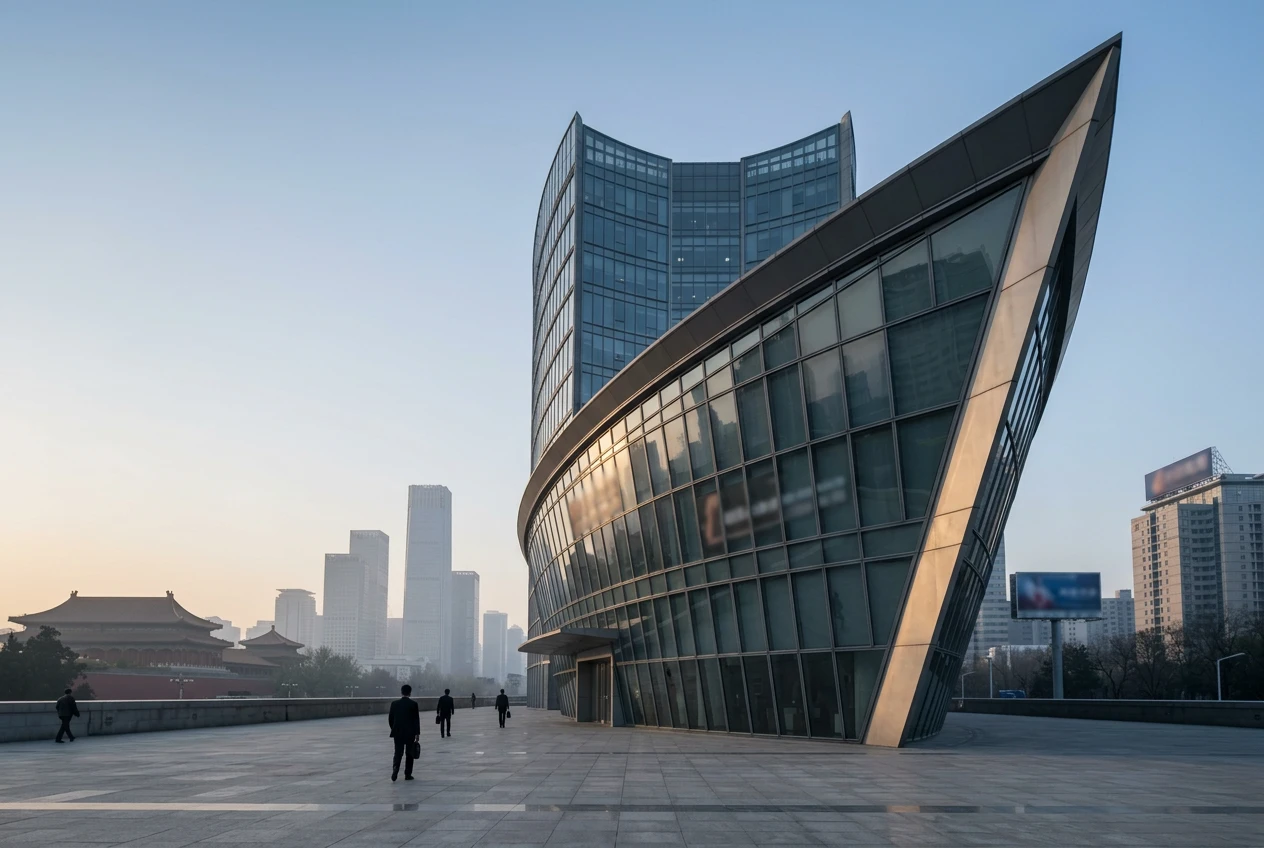
Location does a lot of work here. Ciqikou, which the school calls “China’s Gateway,” sits where old Beijing meets new money. On one side are the Forbidden City and the Temple of Heaven. On the other rises the capital’s central business district (CBD), the cluster of towers that houses much of China’s corporate and financial weight. The campus drops the school squarely between the two.
The architecture leans into the symbolism. The façade is shaped like a vessel setting sail, the school’s chosen image for steering leaders through uncertainty, and the agora-style atrium is built as a gathering hub for faculty, students, alumni, entrepreneurs and policymakers. Read past the design language and the message is plain: CKGSB wants to be a fixture in the capital, close to power and close to the firms its graduates run.
Placing that anchor in Beijing rather than in commercial Shanghai is itself a choice. It puts the school near the ministries that set policy and near the state-owned and private champions whose executives fill its classrooms.
Who Put Up the Money
The school credits its alumni community with funding the campus, and that community is the real asset on display. CKGSB was born from the fortune of Li Ka-shing, the Hong Kong billionaire whose Cheung Kong (Holdings) gives the school its name and whose foundation seeded it in 2002. Two decades on, the network it built is doing the giving.
The reach of that network is the figure worth sitting with. The school says 95% of its 25,000 alumni are business leaders, and that together they run one fifth of China’s most valuable brands. The composition of the base explains why a fundraising drive for a permanent home was even feasible:
- Roughly 95% of alumni are described as business leaders rather than mid-level managers
- That group collectively controls a fifth of the country’s most valuable brands
- The new EMBA intake skews to founders and chiefs, not corporate functionaries
That is a self-reinforcing model. The school trains operators, the operators get rich, and a slice of that wealth flows back as buildings and endowment. CKGSB markets itself as China’s first faculty-governed, privately funded, research-driven business school, and its full-tuition philanthropy scholarship and program lineup lean hard on the social-responsibility pitch that the alumni base buys into.
The Macro Backdrop Is Cooler Than the Ribbon-Cutting
The economy the campus is betting on is not the one from CKGSB’s founding years. Beijing has set a 2026 growth target in the 4.5% to 5% band, and the outside forecasts cluster at the low end. Goldman Sachs has put out a 2026 forecast of 4.8% growth driven by surging exports, while the World Bank’s lower projection sits at 4.4%. Either way, the era of high-single-digit expansion that made China the obvious place to study business is over.
Foreign money tells the sharper story. Foreign-invested fixed-asset investment fell 14.1% over a recent stretch, by a year-end review of official Chinese data, even as a modest first-quarter rebound followed. Consumer sentiment has hovered near pandemic-era lows, and the property downturn that has dragged on household wealth shows little sign of a clean bottom. This is the cycle into which CKGSB is committing permanent capital.
So the timing cuts two ways. A cooling economy makes the spending look bold, maybe reckless to a skeptic. It also makes the school’s product more valuable, because executives steering firms through a slowdown have a sharper need for the networks and management training a place like CKGSB sells.
Executive Demand Is Tilting East
The wider market is moving in the school’s direction. International enrollment at United States MBA programs fell about 17% in 2025, hit by visa friction and a colder political climate, and GMAC data shows application growth concentrating in Asia and continental Europe instead. The AACSB enrollment report describing business education as transforming, not shrinking, points to the same redistribution: demand is not vanishing, it is relocating.
That hands a tailwind to China’s home-grown schools, and it sharpens an old rivalry. The clearest comparison for CKGSB is China Europe International Business School (CEIBS), the Shanghai-based school that has dominated Asian rankings.
| Attribute | CKGSB | CEIBS |
|---|---|---|
| Founded | 2002 | 1994 |
| Funding model | Privately funded, faculty-governed | Chinese government and European Commission partnership |
| Home base | Beijing | Shanghai |
| FT 2026 Global MBA rank | Not ranked in the global list | #8 world, #1 Asia |
| Signature draw | Entrepreneur and owner network | Top-ranked EMBA, global brand |
CEIBS owns the rankings, with a Financial Times ranking record that includes a #1 global EMBA finish. CKGSB plays a different game, selling proximity to China’s founders and family-business owners rather than a ranking line. The permanent Beijing campus is its move to harden that identity into something physical and lasting.
What the Spring Cohort Has to Prove
The clearest test sits in the 275 students who walked in on day one. About 75% are either chairmen or CEOs, more than half run high-tech firms or so-called hidden champions, the specialist companies that quietly lead niche markets, and two of them head unicorn companies valued above a billion dollars. That is the buyer CKGSB needs to keep attracting if the building is to pay for itself.
The school plans to fill the new space in the coming months with lectures and conferences on artificial intelligence, leadership, China’s economic outlook and the future of global business. The programming is aimed at the same audience the campus is built to hold: senior operators looking for an edge as the easy-growth decade fades.
CKGSB has put permanent capital into Beijing on the wager that demand for its network outlasts the slowdown. The 275 chairmen and CEOs in the first cohort are the early evidence; the question of whether a 30,000-square-meter home pays off gets answered by how many follow them through the door over the next decade.