Cebu business groups want their lawmakers to stop fighting and start governing. The chambers of Mandaue and Talisay, joined by the wider Cebu business community, are urging the public and private sectors to pull together as a deepening crisis in the Philippine Senate begins to spill into an economy already running on 7.2 percent inflation and a peso near 60 to the dollar.
The timing is what worries them. Senators are tangled up in the arrest of one of their own and a looming vice-presidential impeachment, while small firms in Cebu say they are still trying to survive an oil shock and a currency that keeps weakening against the dollar.
Why Cebu’s Chambers Are Speaking Up Now
The appeal came from two of Metro Cebu’s local chambers and quickly found company across the country. The Mandaue Chamber of Commerce and Industry (MCCI, the business group for one of Cebu’s main manufacturing hubs) and the Talisay Chamber of Commerce and Industry both pushed for collaboration between the public and private sectors, according to statements given to CDN Digital (Cebu Daily News, the regional outlet that first reported the chambers’ remarks).
Carl Cabusas, president of the Talisay Chamber of Commerce and Industry, set out the priority plainly.
The business community is less concerned about politics and more concerned about economic stability, policy continuity, and measures that will help create jobs, encourage investments, and support economic growth.
That was Cabusas, speaking to CDN Digital. The MCCI made the same point in a separate statement, saying the Philippine economy needs unity across the public and private sectors to improve lives and communities nationwide.
The people running these chambers speak for thousands of small firms that have no cushion for a long stretch of political turmoil. When a chamber president says his members care more about jobs than about who controls the Senate floor, that is the sound of a local economy bracing for trouble it did not create.
The Senate Crisis Behind the Appeal
The trigger sits in Manila. On June 1, Senator Jinggoy Estrada surrendered to the Philippine National Police Criminal Investigation and Detection Group at Camp Crame after the Sandiganbayan, the country’s anti-graft court, ordered his arrest for plunder and two counts of graft tied to the national flood control scandal. The Office of the Ombudsman pointed to roughly 573 million pesos in alleged illicit payouts. Plunder is non-bailable when the evidence of guilt is found strong, which raises the prospect of detention for a sitting senator.
That arrest landed in the middle of an even bigger fight. The Senate convened as an impeachment court in mid-May to try Vice President Sara Duterte, with Senate President Alan Peter Cayetano presiding and senators sworn in as judges. The order of events explains why business is uneasy:
- May 18: The Senate convenes as an impeachment court; 23 senators take their oath as senator-judges.
- June 1: Estrada surrenders and is arrested over the flood control plunder case.
- July 6: The impeachment trial proper is scheduled to begin.
Malacanang has already flagged the cost. Palace Press Officer Claire Castro said the turmoil is starting to affect not just the passage of key legislation but investor confidence and the broader economy, while insisting the executive branch will keep working with the Senate whatever its leadership looks like. A week before the Cebu chambers spoke, the Makati Business Club had urged senators to drop personal and political interests as they prepare to sit as judges.
Inflation and the Peso Are Already Stretched
The macro backdrop is what makes the political timing dangerous. Price growth has snapped back hard, with headline inflation running at 7.2 percent in April, the fastest pace since March 2023, driven by a transport component that jumped to 21.4 percent. Food, housing and utilities all picked up in the same month. None of that helps a corner store or a small workshop trying to hold its prices.
Growth has cooled at the same time. The economy expanded by just 2.8 percent in the first quarter of the year as the oil shock and the corruption probe weighed on spending, and the International Monetary Fund (IMF, the Washington-based lender that reviews member economies) has trimmed its full-year forecast toward the low-4-percent range. The World Bank still pencils in a firmer 5.3 percent for the year, but it warns that governance risk could push that lower.
Here is the snapshot Cebu’s chambers are reading off:
| Indicator | Recent reading | What it signals |
|---|---|---|
| Headline inflation | 7.2% (April) | Highest since March 2023 |
| Peso vs US dollar | Near 60 / US$1 | Close to record-weak levels |
| Q1 GDP growth | 2.8% | Slowed sharply on oil and graft |
| Net foreign direct investment | Down about 40% year-on-year (Oct) | Investors in wait-and-see mode |
A peso this weak makes everything imported more expensive, from fuel to packaging, and a slowing economy means thinner sales to absorb those higher costs. Political instability sits on top of all of it.
MSMEs Are the Ones Carrying the Weight
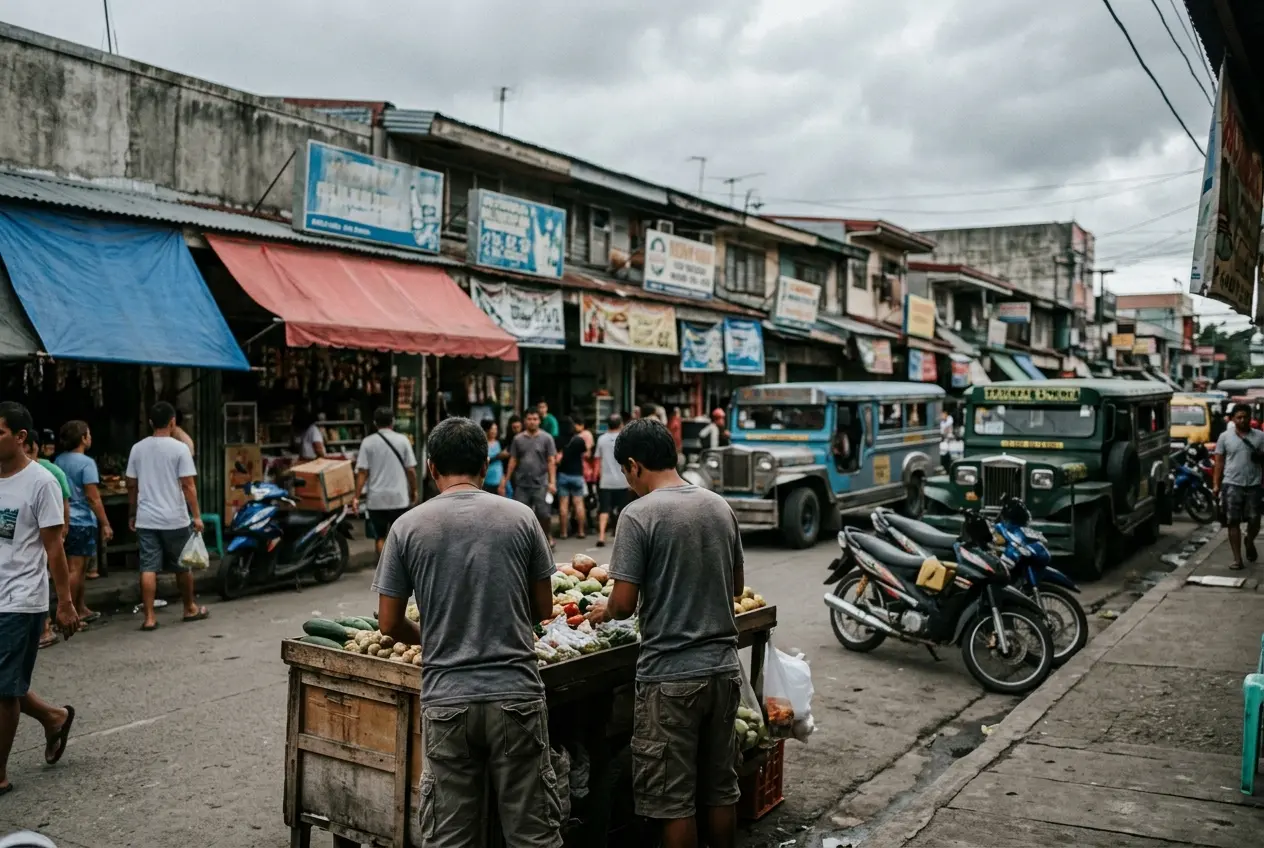
Strip the headline events away and the people most exposed are the ones with the least bargaining power. Micro, small and medium enterprises (MSMEs) make up the bulk of registered businesses in Cebu, and they have been absorbing several shocks at once. Cabusas pointed to the lingering damage from the conflict that drew in the United States, Israel and Iran, which pushed up global oil prices and rippled into local transport and production costs.
What a small Cebu operator is juggling right now reads like a stress test:
- Fuel and transport costs, with transport inflation running above 21 percent
- A weak peso that raises the bill on imported materials, a pressure the central bank tracks in its Philippine economic updates from the Bangko Sentral
- Soft consumer demand as households tighten spending
- Lenders and investors holding back while the politics stays unsettled
“Any prolonged political noise or institutional conflict can create additional uncertainty at a time when businesses are focused on survival, growth, and job creation,” Cabusas told CDN Digital. Cebu’s private sector has spent years trying to grow past exactly this kind of drag, the same instinct behind home-grown firms like the Cebu technology company built to solve real business pain for local enterprises. It is a story that repeats wherever small operators get squeezed; in the United States, owners are wrestling with their own version after Philadelphia’s small-business tax reckoning hit freelancers and microbusinesses.
The Corruption Bill Landing in the Economy
The scandal that put Estrada in a holding cell is also the thing draining the economy of cash and confidence. The Department of Finance (DOF) estimates that anomalous and ghost flood control projects cost the country as much as 118 billion pesos between 2023 and 2025, a sum it links to somewhere between 95,000 and 210,000 jobs that never materialized. Public and private capital has stalled as the probe widened, and government capital outlays were cut to about 1.7 percent of GDP.
Foreign money has reacted the way the chambers feared. Net foreign direct investment fell by close to two-fifths year-on-year in October as investors adopted a wait-and-see stance. The OECD made the channel explicit in its 2026 economic survey of the Philippines, warning that delays in governance reform translate into lost competitiveness and weaker investor sentiment. The 2026 budget already shows the caution, with flood-related allocations cut to 274.9 billion pesos from 346.6 billion a year earlier.
This is the second-order story the chambers are really talking about. The arrest and the impeachment are the visible drama. The quieter damage is a country that has shifted into a defensive crouch, with capital frozen and jobs going unfilled while the institutions sort themselves out.
What Business Wants Before the July Trial
For Cebu’s chambers, the ask is modest and specific: keep legislating while the trials run. They want a stable environment where entrepreneurs can invest, expand and hire, and they want it before more small firms run out of room. Estrada’s case will move through the Sandiganbayan on its own track, and the conviction of any senator on impeachment would require at least 16 of the 24 sitting members.
The impeachment trial proper begins on July 6. Until then, the Senate has a month of pretrial work, a colleague in custody, and an economy that is not waiting for the political calendar to clear.