Microsoft has confirmed that Project Helix, the codename for its next Xbox console, will not appear at the Xbox Games Showcase on Sunday, June 7. Xbox content chief Matt Booty said the show would stick to games rather than hardware strategy, telling listeners flatly that there would be no Helix news. The decision lands while a global memory shortage scrambles the timing and pricing of every next-generation console in the pipeline.
The headlines have fixed on a smaller drama, with Microsoft Gaming chief executive Asha Sharma publicly reversing course over PlayStation 5 logos after a handful of critical tweets. The force that will actually decide when the next Xbox ships, and what it costs, sits much further up the supply chain in the price of a single component.
Booty Drew a Line Around the Showcase
Speaking on the Official Xbox Podcast, Booty was careful to manage expectations days before the event. He framed the showcase as a celebration of studios and release dates, not a venue for the company to explain where its hardware roadmap is heading.
I can also say that there won’t be Helix news, so Helix will not be in this showcase. Again, we want to get everything about that right.
Booty, Xbox’s chief content officer, added that the company wants to make the right decisions rather than fast ones. That is a reasonable line for a platform holder with no firm launch window to defend. It is also a tell. You do not need to slow-walk a reveal you are confident about.
The show itself is stacked, according to Microsoft’s official Xbox Games Showcase 2026 announcement, which confirms a 10am Pacific start followed immediately by a dedicated Gears of War deep dive. Expected on the slate:
- Gears of War: E-Day, the prequel that anchors the post-show Direct
- Halo: Campaign Evolved, the remake of the franchise’s original campaign
- Fable, the reboot that has already slipped to February 2027
- Call of Duty: Modern Warfare 4, with a fresh update expected
Why Memory Costs Now Set the Console Calendar
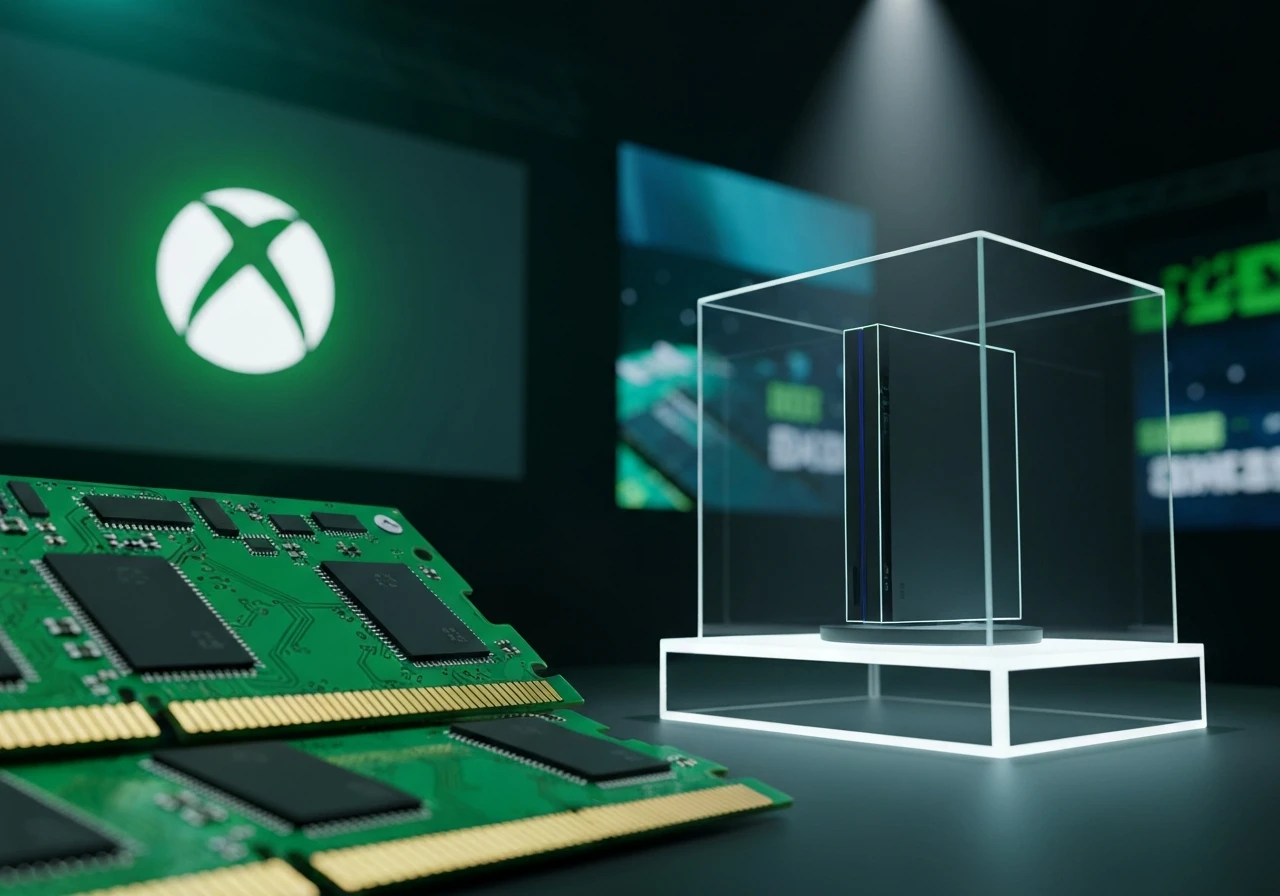
Strip away the showcase choreography and one number explains the caution: the cost of memory. Modern consoles lean on large pools of fast DRAM (dynamic random-access memory, the working memory a system uses to run games), and that component has become both scarce and brutally expensive over the past year.
The AI Demand Behind the Squeeze
The shortage is not a manufacturing accident. Samsung, SK Hynix and Micron have steered cleanroom capacity toward high-bandwidth memory for artificial-intelligence servers, where margins dwarf what a console maker will pay. The hyperscalers buying that silicon, including Microsoft’s own Azure division, are effectively bidding against the gaming hardware teams inside the same companies.
The price math is stark. Research firm IDC has tracked the squeeze rippling out from data centers into consumer devices, and TrendForce raised its forecast for the Q1 2026 jump in PC DRAM contract prices to between 90% and 95%, well above an earlier estimate near 55%. Spot prices for some DDR5 modules have more than doubled year over year. The Bloomsbury Intelligence and Security Institute has flagged the same supply crunch as a structural problem rather than a passing spike, in its analysis of the global RAM shortage and its outlook.
What Sharma Conceded About Price
Sharma has already said the quiet part out loud. Asked in a Game File interview about how the market would shape the next Xbox, she put memory at the center of the equation rather than treating it as a footnote.
“All of these things are an equation,” Sharma said. “Memory costs will impact pricing, will impact availability.” Analysts now float a price band of roughly $900 to $1,500 for the coming console generation, figures that read more like gaming PCs than the $499 to $599 launch tags buyers remember. IDC’s own read on the memory shortage and its device impact underlines how far the pain now reaches beyond servers.
- 90% to 95%: TrendForce’s revised forecast for the Q1 2026 rise in PC DRAM contract prices
- $900 to $1,500: the price band analysts now float for next-gen consoles
- Early 2027: when Project Helix dev kits are due to reach studios
- 2028: the year many analysts expect the memory market to ease
Sony and Microsoft Are Stuck in the Same Vise
This is not an Xbox-specific problem, which is part of why it gets so little airtime in the console wars. Sony faces the identical bill of materials pressure on the PlayStation 6, and reports suggest it is weighing a launch as late as 2028 or 2029. Both companies want next-gen designs that triple the memory of current machines, which makes the component math worse just as prices peak.
Here is how the two roadmaps line up on what is publicly known and what remains open.
| Detail | Project Helix (next Xbox) | PlayStation 6 |
|---|---|---|
| Status | Officially named, no date | Unannounced, widely reported |
| Dev kits | Due to studios early 2027 | Reported in studio hands |
| Earlier target | 2027 | 2027 to 2028 |
| Now floated | 2027 to 2028, slip possible | 2028 to 2029 |
| PC compatibility | Confirmed to run PC titles | Not confirmed |
| Price risk | Up to roughly $1,500 | $700 and up |
The shared exposure cuts against the usual framing of one platform out-executing the other. Whoever blinks first on a launch date is betting that memory prices, and consumer tolerance for a far higher sticker, move in their favor. Neither company controls that variable.
The Logo Reversal That Took the Headlines
While the hardware story brewed in the background, the discourse latched onto something far smaller. Booty confirmed Xbox would keep clearly labeling which games are coming to PlayStation 5 and Nintendo Switch 2, part of the company’s multiplatform push. A community figure posting as Klobrille argued the showcase should at least keep the focus on Xbox’s own platform during its own event.
Sharma, who took over Microsoft Gaming in February, responded directly to the complaint on X. “Seeing the feedback on logos,” she wrote. “It was a miss, and I own it. We are talking about how we adjust for future XBOX shows.” The reply read as accountable to some and as flip-flopping to others, because it fit a pattern of reactive decisions made under social pressure.
Recent moves in that pattern include:
- Signaling that exclusive games could return, despite the multiplatform strategy she inherited
- Capitalizing the brand to XBOX after an X poll drew roughly 19,000 votes, with 64% backing the all-caps form
- Retiring the “This is an XBOX” advertising campaign and trimming Game Pass prices
- Reversing the logo presentation approach within a day of fan pushback
Sharma’s responsiveness has its defenders, and brand-tracking firm YouGov has noted XBOX gaining ground with gamers since she took the helm, in its data on Xbox brand momentum under new leadership. The risk is that a strategy steered by the loudest replies looks agile up close and rudderless from a distance.
What a 2028 Xbox Would Cost Microsoft
The calendar is the real stakes here. Dev kits landing in early 2027 point to a console that is years, not months, from store shelves, and a memory market that may not ease until 2028 only widens that gap. Microsoft revealed the Xbox Series X at The Game Awards in late 2019, roughly a year before launch, so a similar reveal-then-wait cadence remains possible. So does silence into 2027.
Every extra quarter without new hardware is a quarter Microsoft leans harder on software and services, a pivot already visible in the cross-platform release plans for blockbusters like GTA 6 and in a first-party slate that now ships to rival consoles. That strategy has also come with hard costs, including the cancellation of Blizzard’s Odyssey project and deep gaming-division layoffs. A platform betting on reach over exclusivity needs that reach to keep paying off while the hardware stays parked.
If memory prices ease on schedule and Microsoft reveals a sanely priced console in 2027, the slow-walk reads as discipline. If the shortage drags into 2028 and the sticker lands near four figures, the absence at this showcase will look less like patience and more like a company waiting for a window that keeps moving.