Perplexity has started mailing Mac Minis to tech creators, and the unboxing posts arrived right on cue. The artificial intelligence (AI) search company confirmed it shipped a small number of Apple’s compact desktops to people it wanted putting Personal Computer, its always-on agent software, through real use. Apple’s $799 machine has quietly become the hardware that agent users covet.
Free gear for influencers is an old playbook. What sits underneath this round is newer: a wave of agentic tools that only make sense on a computer left running day and night, and Apple cannot build the little box fast enough to meet the rush.
Perplexity Mailed Mac Minis to the Tech Feed
The thank-you notes started landing in May. “Officially joined the Mac mini club. Thanks to @perplexity_ai for sending this over,” one creator captioned a photo of the device. Most of the recipients work in the tech-content space, the same crowd that turns a delivery box into a day of social posts.
Perplexity confirmed to Business Insider that it handed Mac Minis to a small group of people “interested in getting the maximum use case out of Personal Computer in the Perplexity Mac app.” Jesse Dwyer, Perplexity’s chief communications officer, said he runs his constantly, operating it from his other Apple devices wherever he happens to be. The approach mirrors the way Meta seeded its Ray-Ban smart glasses to creators for unboxing and review.
The software being demoed rolled out in mid-April to Perplexity Max subscribers. Personal Computer is an expansion of the company’s browser agent, Perplexity Computer, and it reaches across local files, native apps, and the open web. For now it lives only inside Perplexity’s Mac app, which is exactly why the giveaway came bundled with a desktop rather than a gift card. Perplexity’s leadership has been candid about the company’s limits; its chief executive recently admitting Google still wins everyday search, which makes the agent push its real bet.
Why an AI Agent Wants a Machine That Never Sleeps
An agent is not a chat window you open and close. It is a long-running process that has to stay alive, listen for instructions, and act on them while you sleep. That single requirement changes the hardware math. A laptop that shuts its lid every night cannot babysit a task that runs for hours, and a phone certainly cannot.
The Persistent-Process Problem
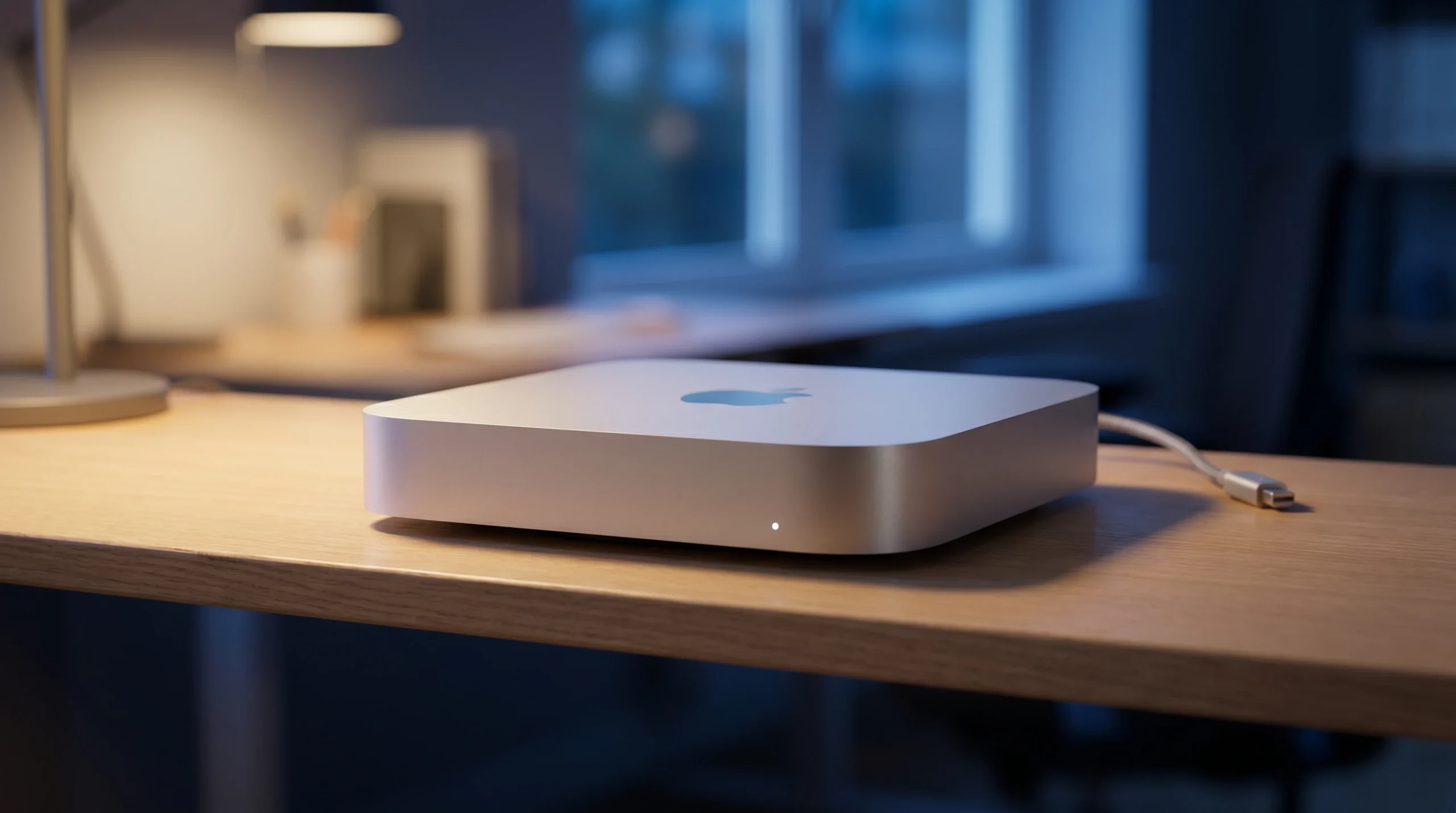
When tools like OpenClaw, software for running local AI agents, took off in early 2026, builders needed somewhere cheap to park a job that never stops. The answer turned out to be a desktop that is silent, sips power, and fits on a shelf. Apple’s M4 Mac Mini draws under 10 watts at idle and makes no audible noise, so it can sit in a closet or behind a monitor and run for weeks without anyone noticing it is there.
Perplexity makes the persistence pitch in plain terms. “On a mini, Personal Computer stays available 24/7 for work that needs a persistent machine or secure local access to your files and native apps,” the company wrote when it announced the agent in its April product blog. It called the mini “one of the best ways to experience Personal Computer.”
Local Files, Native Apps, and Privacy
The other draw is access. An agent that can open your spreadsheet, drive a native app, and reach a file without uploading it to a stranger’s server is more useful and easier to trust. Running that on a box you own keeps the sensitive parts inside your own walls. Here is why the small Apple desktop keeps winning that comparison:
- Power draw below 10 watts when idle, cheap to leave on around the clock.
- Silent operation, no fan whine in a home office or a server shelf.
- The M4 chip pairs a 10-core processor with a 16-core Neural Engine for on-device model work.
- A footprint small enough to hide, with the full M4 Mac mini specifications listing Thunderbolt, HDMI, and gigabit Ethernet for a fixed install.
Apple Became the Quiet Winner of the Agent Boom
Apple never marketed the Mac Mini as an AI server. The agent crowd decided that for itself, and the demand caught Cupertino flat. On Apple’s fiscal second-quarter 2026 earnings call on April 30, chief executive Tim Cook told analysts the company had simply underestimated how many people wanted the machine.
Both of these are amazing platforms for AI and agentic tools and the customer recognition of that is happening faster than what we had predicted, and so we saw higher than expected demand.
Cook said the Mac mini and Mac Studio could take several months to reach a healthy balance between supply and demand. The bottleneck is not memory, as some assumed, but the advanced manufacturing nodes that Apple’s system on a chip (SoC, the single piece of silicon that holds the processor and graphics) is built on, and those lines have long lead times.
The squeeze showed up at the checkout. In early May, the $599 base model with 256GB of storage disappeared from Apple’s site, leaving the 512GB version at $799 as the new entry point, a jump of $200. For a product line that built its reputation on being the affordable Mac, the price move is its own signal of how hard the demand hit. Apple’s interest in the agent layer runs deeper than hardware, too; reports of its quiet talks with Perplexity put the same startup on both sides of the story.
Mac Mini, the Cloud, or a Windows Box
The mini is not the only way to keep an agent running. A rented cloud server or an always-on Windows mini PC will both do the job. The reason power users keep landing on Apple’s desktop comes down to a specific mix of one-time cost, running cost, and local access.
| Option | Upfront cost | Ongoing cost | Idle power | Local files and apps |
|---|---|---|---|---|
| M4 Mac Mini | $799 (512GB) | Electricity only | Under 10 watts | Full, native Mac apps |
| Cloud VPS | None | Monthly rental, recurring | Not applicable | Remote only, no native desktop |
| Always-on Windows mini PC | Varies, often lower | Electricity, higher draw | Typically 15 watts or more | Windows apps, no Mac software |
For someone who wants native Mac apps, a fixed monthly bill of close to zero, and a machine they physically control, the math leans toward the mini. That is the same logic that has pushed Apple’s wider desktop and laptop range into the AI conversation, from the Studio up to the latest M5 MacBook refresh.
Where the Status Symbol Meets an Asterisk
The hype carries a few caveats worth saying out loud. The first is the word “local.” Perplexity’s agent is best described as a cloud-based system that runs on and through the Mac mini, not a model living entirely on the device. The desktop gives it a persistent home and secure reach into your files; the heavy thinking still happens on Perplexity’s servers.
The second is the price. The bargain hook that made the mini famous, that sub-$600 sticker, is gone for now, and a memory crunch across the industry is not helping anyone build cheaper machines quickly. The numbers behind the moment:
- $200 added to the starting price after the 256GB model was pulled.
- 10 watts roughly the idle draw that makes 24/7 operation cheap.
- Several months the wait Cook flagged before supply settles.
- April 16 the day Personal Computer began rolling out to subscribers.
None of that kills the appeal. It just frames the giveaway honestly. A free mini in a creator’s mailbox is marketing, and the status-symbol talk is froth on top of a real shift in how serious users run software. Strip the influencer layer away and the durable fact remains: the cheapest always-on Apple computer is now treated as personal infrastructure.
Frequently Asked Questions
Why is the Mac Mini in such high demand?
Demand surged because always-on AI agents need a cheap, silent machine that can run day and night. Tools like OpenClaw and Perplexity’s Personal Computer use the Mac Mini as a persistent host, and Apple’s Tim Cook said on the April 30 earnings call that demand outpaced the company’s forecasts.
Do I need a Mac Mini to use Perplexity’s Personal Computer?
Not strictly, but it is the setup Perplexity recommends. Personal Computer currently runs only inside Perplexity’s Mac app, and the company calls a continuously running Mac mini one of the best ways to keep the agent available 24/7 for persistent work and secure local file access.
How much does the Mac Mini cost now?
The starting price rose to $799 in early May for the model with 512GB of storage, after the $599 base model with 256GB was pulled from Apple’s site. That is a $200 increase over the previous entry point.
What is OpenClaw and why does it run on a Mac Mini?
OpenClaw is software for running local AI agents that stay alive and execute tasks continuously. Builders favor the Mac Mini for it because the M4 model draws under 10 watts at idle, runs silently, and is small enough to leave on a shelf around the clock.
Is Perplexity’s Personal Computer running entirely on the Mac Mini?
No. It is best described as a cloud-based agent that operates on and through the Mac mini. The desktop provides a persistent home and secure access to local files and native apps, while the core processing still happens on Perplexity’s servers.
Did Perplexity give away Mac Minis for free?
Yes, to a small group. Perplexity confirmed it sent Mac Minis to a limited number of people, mostly tech creators, who were interested in getting the most out of Personal Computer in its Mac app. It follows the influencer-seeding model that consumer tech brands have long used.
If the agent boom keeps pulling buyers toward an always-on box, the next signal to watch is simple: whether Apple brings back a cheaper entry model once supply settles, or lets $799 stand as the new floor for the machine power users now keep running in the corner.