Sixteen days before the United States Men’s National Team roster reveal, FOX Sports dropped an hour of Tom Brady and Zlatan Ibrahimović talking past each other about the same thing: what it sounds like inside a stadium when a fan was born into the club. The conversation, released May 27 on the network’s YouTube channel under the title Zlatan x Brady: GOATS on GREATNESS, is the most useful piece of pregame coverage FOX has put out for the expanded 48-team tournament kicking off June 11 at Estadio Azteca. It is also a warning shot to the eleven American host cities about to host 78 of the 104 matches.
Brady reached for college football to translate European club support for an American audience. Ibrahimović reached for Belgrade. Both were trying to describe the same thing from opposite ends of their own playing careers, and both were saying, in different words, that a lot of US ticket-holders are about to hear something they have not heard before.
The FOX Sports Clip That Set Up the Tournament
The format mattered. FOX Sports president Brad Zager told reporters the network asked Brady to talk with Ibrahimović rather than interview him, and the unscripted run produced the line FOX immediately turned into a promo: “We’d have been good teammates.” The clip dropped on YouTube the same morning USMNT manager Mauricio Pochettino was scheduled to announce his preliminary World Cup squad, which is not an accident of release strategy.
Ibrahimović was added to FOX’s World Cup studio lineup earlier in May, joining Thierry Henry and Alexi Lalas. Brady’s on-air role for the tournament is still loosely defined; he is expected to appear with James Corden’s planned late-night World Cup program rather than in the booth. The booth itself goes to John Strong and Stu Holden, working their third consecutive men’s World Cup together for the network.
What the Brady-Ibrahimović hour gives FOX is something its play-by-play teams cannot give it: two of the most globally recognizable athletes of the past quarter century arguing about the texture of supporting a team. That argument is most of what casual American viewers will be processing for six weeks starting June 11.
Brady’s College Football Parallel Holds Up
The seven-time Super Bowl winner’s framing was specific. “I always describe European soccer as more college fanaticism because if you go to that college, you love that college forever. You’re born into that,” Brady said. “You chose that college, you’ll forever support that college.”
He then drew the contrast with American pro sports. “In America, yeah, you’re with [a professional team] forever. But you also say, ‘Hey, I kind of like that team because I really like that player.’ And if you’re a LeBron James fan, wherever he went, you’re going to ultimately like that team.”
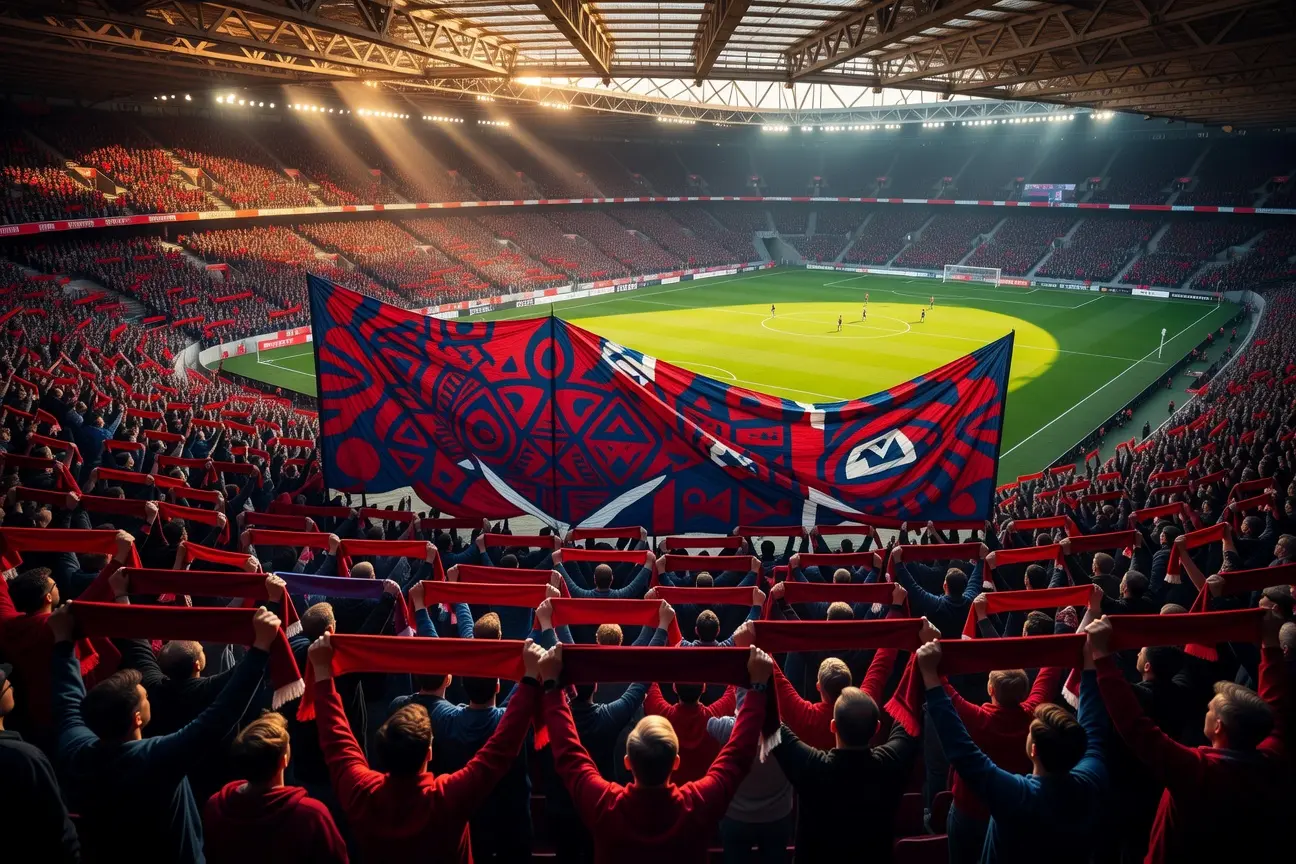
The college parallel is the right one for North American readers, and it is the parallel cultural anthropologists of soccer have been making for years. European clubs have ultras: organized supporter groups that buy a section, run the chants, hang the tifo, and treat results as identity rather than entertainment. The closest American equivalent is the student section at an SEC football stadium on a Saturday in October, where lifelong loyalty is built before a kid can read a depth chart. Pro franchises rarely produce that, because players move and fans cherry-pick, exactly as Brady said.
What is interesting about the framing is what it omits. American college football turns over its entire roster every four years and still generates inherited fandom; European clubs turn over rosters constantly and generate the same effect. Neither requires the athletes on the field at any given moment to be the source of the loyalty. That is the part of the comparison that lands hardest at a World Cup, where the on-field cast changes every match.
Belgrade, Stockholm, and the Volume Question
Ibrahimović, who spent the 2018 and 2019 MLS seasons with LA Galaxy and scored 53 goals in 58 matches there, was blunter about what an American athlete walks into in Europe.
I know basketball, you talk about LeBron with the Lakers fans and that I’ve been there, but I’ve been also in Belgrade and see a basketball game there. Whoa, that’s a little bit scary compared [to the NBA].
Belgrade is not a random reference. Partizan and Red Star derbies in EuroLeague basketball are routinely cited by visiting NBA players as the loudest sustained noise they have heard inside a sporting venue, and the same supporter groups that run the soccer ultra sections run the basketball ultra sections. The Swede was using basketball deliberately, because it lets an American reader compare like-for-like rather than mapping NFL to Premier League.
His description of his own duels in Europe was even more telling: “I know when I went in a duel with a player head-to-head, the fans wanted to come in and play one side vs. the other side.” That participatory dynamic, where the crowd treats a one-on-one battle as a personal stake, is not a feature of NBA, NFL, or MLB game presentation. It is the feature European travelers most often try to describe and most often fail to.
He gave Sweden a quieter compliment. “Our fans in Sweden were amazing. Win or lose, they were supporting you, which I find strange because when you lose, they shouldn’t support you.” The line is funny and revealing at once: the player who spent his career inside Serie A, La Liga, Ligue 1, and the Premier League finds unconditional support strange.
What 104 Matches and Record Ticket Demand Mean
The numbers behind the tournament are what give the Brady-Ibrahimović conversation its weight. This is the first 48-team World Cup, the first hosted by three nations, and by every measure the largest in the event’s 96-year history.
Ticket Demand at Unprecedented Levels
- Over 500 million ticket requests were logged across the various sales phases for roughly 7.1 million available seats, per FIFA’s official tally.
- 150 million requests came in the first 15 days of the Random Selection Draw phase alone, from fans in more than 200 countries.
- 30 times oversubscribed on verified individual credit card numbers, FIFA’s media relations team confirmed.
- 3.5 million total ticket sales is the working internal target, which would surpass the 1994 USA record of 3.59 million.
Match Distribution Across the Three Hosts
The 78 US matches include both semifinals (Dallas and Atlanta) and the final at MetLife Stadium on July 19. Canada hosts 13 matches across Vancouver and Toronto; Mexico hosts 13 across Mexico City, Guadalajara, and Monterrey. The Mexican capital draws the opener on June 11, when the host nation faces South Africa at a renovated Azteca, the first venue in history to stage three different World Cup openings.
FOX is broadcasting all 104 matches across FOX (69 games) and FS1 (35 games), with FOX One and the FOX Sports app carrying every match live. A record 40 of those matches, more than a third of the tournament, are scheduled in prime time on the US East Coast.
MLS Built the On-Ramp
The cultural transfer Brady and Ibrahimović are describing did not arrive at a closed border. Major League Soccer opened its 2026 season with the largest single-day crowd in league history, 75,673 at the Rose Bowl for LAFC against Inter Miami CF. Opening weekend pulled 9.7 million live viewers across linear and streaming, a 59% year-over-year jump.
Total league attendance topped 12 million in both 2024 and 2025. League valuations now sit around $23 billion. None of that came from chasing the NFL playbook; it came from copying the supporter-group model. Toronto FC’s arrival in 2007 is usually cited as the pivot point. Section 8 in Chicago, La Barra Brava in DC, the Emerald City Supporters in Seattle, the Inter Miami CF travelling section that descends on Yankee Stadium: these are American supporter cultures that watched European matches on Saturday mornings and translated.
For context on how Brady has moved into the broader sports-business conversation in his post-playing years, his memorabilia auction at Sotheby’s earlier this spring cleared around $9 million across his career-defining items, and his post-retirement competitive plans had to be reshuffled when his flag football classic relocated from Riyadh to Los Angeles in March. The FOX role is the natural extension: a global sports figure attaching himself to the global sports event.
Where the Atmosphere Lands First
The first 48 hours of the tournament will set the public perception template for the rest of it. Three openers, three host nations, three very different baselines of local atmosphere.
| Date | Match | Venue (City) | Capacity |
|---|---|---|---|
| June 11 | Mexico vs South Africa | Estadio Azteca (Mexico City) | ~87,500 |
| June 12 | USA vs TBD (Group D) | SoFi Stadium (Los Angeles) | ~70,000 |
| June 12 | Canada vs TBD (Group B) | BMO Field (Toronto) | ~45,500 |
| July 19 | Final | MetLife Stadium (East Rutherford) | ~82,500 |
Azteca will not be a cultural puzzle for anyone. It will be the loudest opening match in living memory and roughly 87,000 Mexicans will make sure of it. SoFi and MetLife are the question marks. American NFL stadiums have outstanding acoustics and a well-rehearsed gameday presentation, but the FIFA Fan Festival program will move much of the supporter-group activity outside the venues into city squares, with all 16 host cities running free public viewing sites for the full 39-day window. Centennial Olympic Park in Atlanta, Hastings Park in Vancouver, the Zócalo in Mexico City, and a converted Rockefeller Center ice rink in New York are confirmed.
What Brady and Ibrahimović were really saying is that American sports presentation is built around the moment, the broadcast, the highlight, while European club support is built around the season, the songbook, the inheritance. The World Cup is the rare event where the two systems share a stadium for six weeks. In February, Brady joined Ibrahimović in the stands for an AC Milan match at the San Siro and looked genuinely surprised at the sustained volume from a midweek Serie A fixture that meant nothing in the title race. That moment, in different form, lands on US soil starting June 12, and how American fans choose to answer it will shape what FIFA writes in its post-tournament report about whether the country is ready to host another one in the next twenty years.