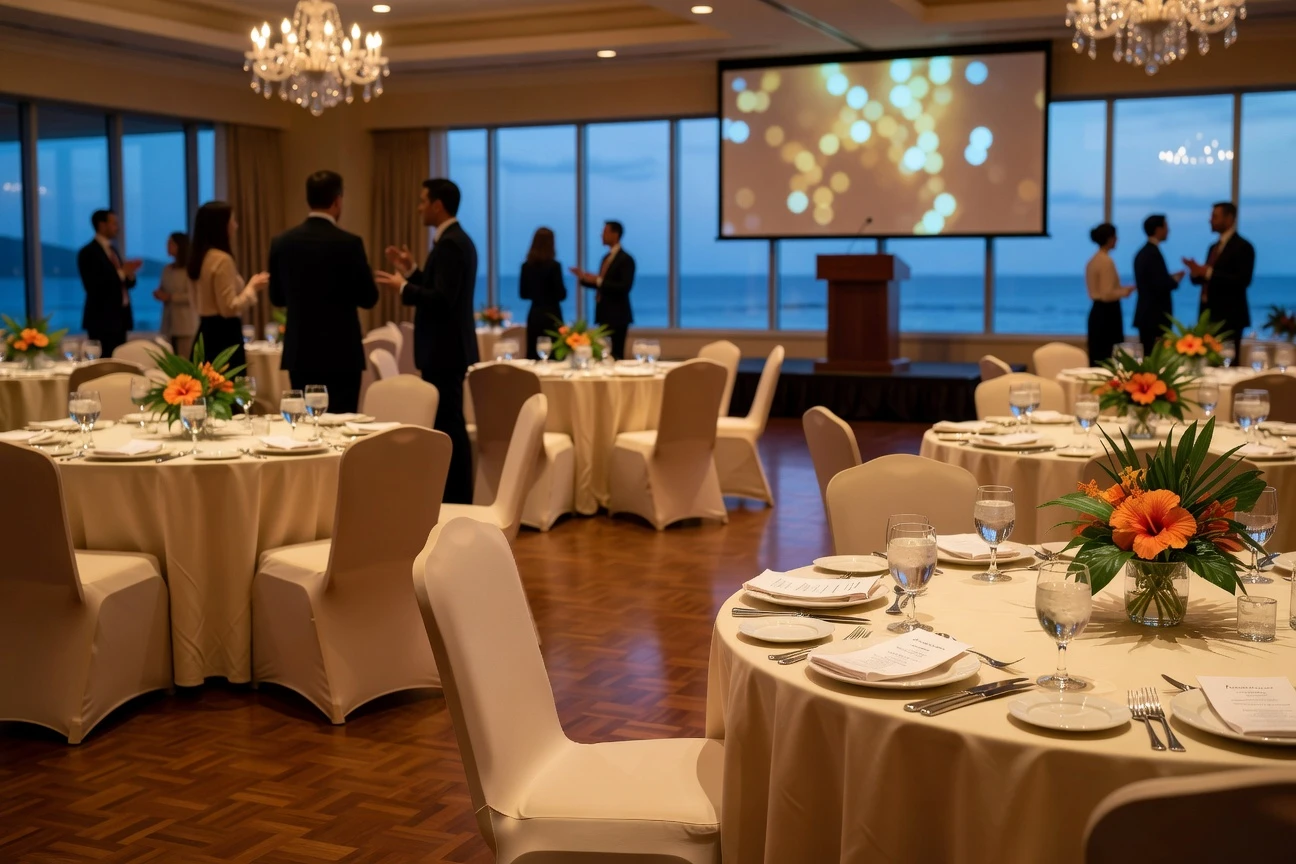
Shidler College of Business closed its 65th annual Business Night on May 7 with more than $122,500 in scholarship awards distributed to outstanding undergraduate and graduate students at the Sheraton Waikīkī. The event, organized by a student committee, drew roughly five hundred attendees across a networking reception, dinner program and awards ceremony anchored on the theme “First Spark: Igniting Potential.” First Insurance Company of Hawaii (FICOH, the state’s largest property and casualty insurer) returned as title sponsor for the 21st consecutive year.
That sponsorship streak sits inside a window in which more than half of Hawaiʻi’s bachelor’s-degree graduates have moved to the mainland for work. The local employer base now treats the gala as an annual recruiting muster as much as a scholarship ceremony, and the sponsor roll reads like a checklist of the firms most exposed to the state’s chronic talent leak.
Fifty-One Awards Across the Ballroom Floor
The gala ran from 5 to 9 p.m. on Thursday at the Sheraton Waikīkī’s main ballroom, drawing students, alumni and executives into the same room for four hours. Fifty-one sponsored awards were spread across Shidler’s six academic divisions and the Travel Industry Management program, with individual prizes ranging from $2,000 to $3,500.
Eileen Liu, executive director of this year’s student committee, coordinated the night. Business Night has been planned and run by Shidler students since its founding in 1961, with the committee handling seating, sponsor logistics and the mentor pairing matrix that gives each undergraduate a working professional across the dinner table.
Sponsors fund the named awards through endowed accounts held at the University of Hawaiʻi Foundation. Each prize carries the sponsor’s logo and a fixed dollar amount that vests directly with the recipient, with no intermediate scholarship committee. The student keeps the cash.
Five hundred attendees puts this year’s room at the upper bound of recent program history, roughly double the headcount Business Night was drawing in the mid-2000s before FICOH stepped into the title slot. The growth tracks the broadening of the college’s Fall 2024 enrollment to 1,605 students and an alumni network now at 45,000.
First Insurance Company of Hawaii’s 21-Year Bet
FICOH has held the Business Night title-sponsor slot since 2006. Read alongside the company’s other Shidler commitments, the 21-year streak looks less like corporate philanthropy and more like a deliberate talent funnel.
The insurer seeded a $35,000 Endowed Scholarship for Excellence in spring 2012, then topped the corpus up to $100,000 inside the same year. In 2007 it funded a $1 million First Insurance Company Distinguished Professorship to recruit risk-management faculty. A second $1 million matched professorship in insurance followed. A $150,000 capital-campaign gift funded the corporate interview rooms inside Shidler’s main building, and a $130,000 contribution went to the Pacific Asian Center for Entrepreneurship in 2016. The cumulative FICOH commitment to Shidler programs runs into the millions.
That spending is structured around three sequential points of contact with the student: scholarship cash in the first two years, faculty exposure during the upper division, and physical interview real estate when they go on the market. A 21-year-old who picks up a FICOH-branded scholarship, sits in a FICOH-funded interview room, and meets a FICOH actuary across the dinner table at Business Night is harder for a Bay Area underwriting recruiter to peel away at graduation.
Hawaii Business Magazine, the night’s media sponsor for the ninth straight year, completes the corporate scaffolding. Its yearly Business Night coverage gives the sponsor roll a second print cycle inside the islands’ executive readership.
The Brain Drain the Pipeline Is Built to Fight
The economic math underlying Shidler’s mentorship calculus is unforgiving. A 2021 study from the Hawaiʻi Department of Business, Economic Development and Tourism (DBEDT, the state’s economic agency) mapped the structural pattern: the more educated a Hawaiʻi resident, the more likely they leave.
- 51.4% to 54.5% of Hawaiʻi-born bachelor’s-degree earners eventually move to the mainland
- 59.2% to 62.8% of graduate-degree earners relocate
- 15% of Hawaiʻi-born mainland residents hold a bachelor’s degree or higher, against 7.7% of those who stay
- 57% of residents told a 2025 statewide survey they planned to leave the islands within five years
DBEDT’s follow-up reporting identified the principal driver as job mix rather than housing or pay. Hawaiʻi-born adults living on the mainland disproportionately work in science, technology, engineering, finance and corporate management roles, the same fields Shidler funnels its graduates toward. Civil Beat’s 2024 reporting traced the cause to roles, not wages: leavers gain only $2,000 to $5,000 in annual income, a differential that is statistically insignificant once Hawaiʻi’s cost of living is corrected. What pulls graduates east is the presence of mainland positions in their specific discipline.
Shidler’s own student composition compounds the pressure. Sixty-three percent of undergraduates are local; the cohort that ships east after graduation represents a leak in the islands’ middle-management pipeline that no amount of in-state hiring can quickly replace. The Business Night ballroom is engineered to plug that leak one mentor pairing at a time.
Where the $122,500 Went, by Department
The awards split tracks Shidler’s six academic divisions plus the Travel Industry Management program. Accounting drew the deepest sponsor list. Travel Industry Management drew eight individual awards, the largest single-discipline count.
| Department | Sponsor Anchors | Award Range |
|---|---|---|
| Accounting | Accuity LLP, KPMG LLP, Spire Hawaii LLP | $2,000 to $3,500 |
| Finance and Real Estate | Bank of Hawaii Corporation, Hawaii State Federal Credit Union | $2,000 to $3,500 |
| Management and Operations | Central Pacific Bank Foundation, Matson | $2,000 to $3,500 |
| Marketing | Southwest Airlines, Y. Hata and Co. Limited | $2,000 to $3,500 |
| Travel Industry Management (8 awards) | Marriott Waikiki Complex, SKAL International Hawaii | $2,000 to $3,500 |
| General College Awards | Shidler College of Business Alumni Association | Variable |
Among the named recipients: Eric Sun, Aiden Cheung, Tyler Guard and Donovan Tablit took accounting honors. Hannah Sheveland was recognized for financial analysis; James Whitworth received the senior finance award. Eileen Liu, who also chaired the student committee, was named a distinguished management student under the Central Pacific Bank Foundation banner. Logan Bartnick took the Matson-sponsored operations management award. Marketing recipients included Kristyn Yasui for sustainable marketing and Phuong Doan for distinguished sales performance.
The complete 2026 award recipient roster sits on the Shidler website. The sponsor lineup leans heavily toward Hawaiʻi-headquartered firms, with mainland brands such as KPMG, Marriott and Southwest filling out the list.
Mark Tawara on Igniting the First Spark
Mark Tawara, BBA ’91, principal of consulting firm Manageability and chief executive of Bright Light Digital, delivered the keynote. His message asked students to treat uncertainty as the medium they work in rather than the obstacle they engineer around.
Each year, Business Night showcases what is possible when talent, mentorship and community come together. Our students bring curiosity, ambition and drive, and it is through the support of our partners and alumni that those qualities are developed into meaningful careers and leadership pathways.
That framing came from Vance Roley, Shidler College Dean and First Hawaiian Bank Chair of Leadership and Management, in remarks to the room. Tawara’s keynote built on it with four practical asks for the graduating cohort:
- Treat one strong conversation as career-defining, not as a networking footnote
- Lean into ambiguity rather than waiting for certainty before acting
- Build relationships actively and across disciplines, not only within one’s major
- Create opportunities rather than waiting to be selected for them
The four-point structure echoes a broader push by community programs to formalize mentorship as a career-launch tool, including free mentorship programs running in other regional economies. Tawara’s framing positioned the night’s mentor pairings as the actual deliverable, with the $2,000 to $3,500 cash awards functioning more as ceremonial vehicles than as the substantive transfer.
What the Class of 2027 Tells Local Employers
Roughly 280 students will graduate from Shidler’s BBA program in spring 2027. The sponsor roll at this year’s Business Night reads like a roster of the firms that will be competing for them.
First Insurance Company of Hawaii, Bank of Hawaii Corporation, Central Pacific Bank Foundation, Matson, Hawaii State Federal Credit Union and Marriott Waikiki Complex collectively employ tens of thousands across the islands. Each one paid into the awards pool. Each one also runs a Honolulu recruiting calendar that begins, in practice, the moment a Shidler junior steps into the Sheraton Waikīkī ballroom and shakes hands with a hiring manager.
Jennifer Lieu at the University of Hawaiʻi Foundation now coordinates sponsorship outreach for next year’s program. The committee is already accepting sponsor commitments for the 66th edition, scheduled provisionally for spring 2027.
If FICOH’s theory of change works, the students celebrated last week will read their names back to those sponsors in interview rooms within twelve to eighteen months. If DBEDT’s brain-drain trajectory holds, more than half of them will be reading the same names on a mainland résumé.