
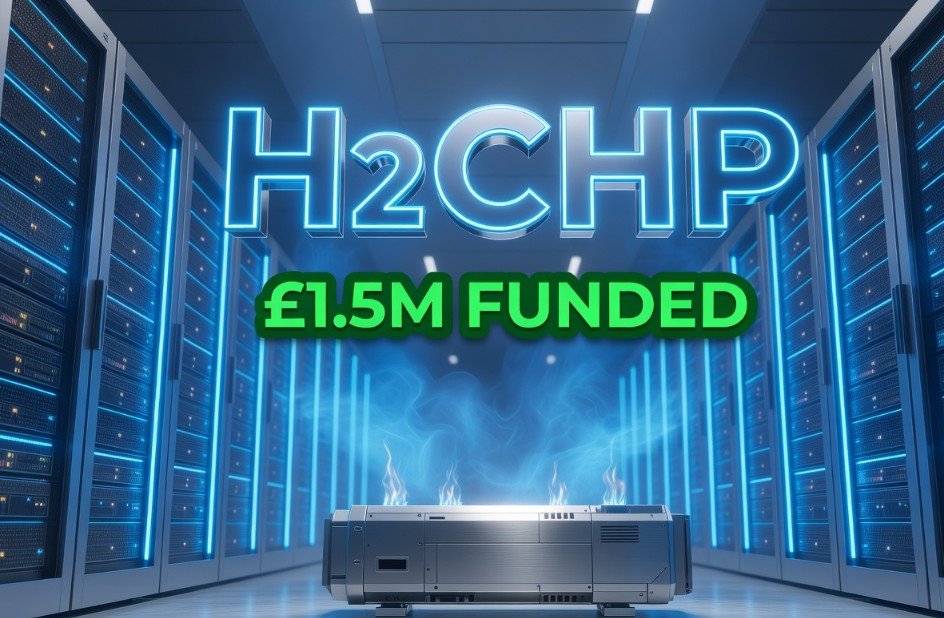
A small startup from the North East of England just secured £1.5 million to take on one of the tech industry’s most urgent problems: how to power data centres without wrecking the planet. H2CHP, a Durham University spinout, has built a generator that runs on clean fuels like hydrogen and ammonia, and investors are betting it could reshape how the AI era gets its electricity.
The Problem That Made Investors Take Notice
The numbers are hard to ignore. Electricity demand from data centres rose by 17% in 2025 alone, far outpacing the 3% growth in overall global electricity demand, according to the International Energy Agency. AI-focused data centres grew even faster, surging 50% in that same period.
The IEA now projects that global electricity consumption from data centres will roughly double, from 485 TWh in 2025 to around 950 TWh by 2030. Power use from AI-specific data centres is set to triple over the same period.
That is an enormous amount of electricity. And for an industry that is under growing public pressure to clean up its carbon footprint, finding a reliable, low-emission power source is no longer just a nice idea. It has become a business survival question.
What H2CHP Has Built and Why It Is Different
H2CHP’s answer is a free-piston linear generator. It sounds technical, but the core idea is straightforward. Strip out the crankshaft, flywheel, and every mechanical linkage found in a conventional engine, and replace them with a system where electricity is produced directly from the piston’s motion, controlled entirely by software.
The result is a generator that is faster, cleaner, and far more flexible than anything traditionally used at data centres or industrial sites. Here is what makes the technology stand out:
- Fuel flexibility: Can switch between hydrogen, ammonia, biofuels, and e-fuels even while running
- Size advantage: 60% smaller and 25% lighter than a conventional internal combustion engine generator
- High efficiency: Research from Durham Energy Institute shows prototype systems have demonstrated a potential thermal efficiency of up to 55%
- Software-controlled: Variable compression ratio and fuel settings can be adjusted without any physical changes to the machine
- Future-proof design: Built to be robust against variations in fuel quality and changes in supply availability
That last point matters more than it might seem. One of the biggest risks in building a hydrogen-powered future is supply-chain uncertainty. A generator that can run on multiple fuels means operators are not locked into one option if prices spike or supplies dry up.
The Team Behind the Technology
H2CHP was co-founded by Professor Tony Roskilly, who holds the Chair of Energy Systems at Durham University and serves as Co-Director of the Durham Energy Institute. The technology builds on more than a decade of advanced research he led in free-piston engine systems.
Roskilly also represents the UK in the European Energy Research Alliance, giving him a front-row seat to what is happening across clean energy development globally. His co-founder, Stephen Hampson, brings a different but equally important skillset: 20 years of venture capital expertise in the energy sector.
“From the outset, H2CHP has been about translating advanced research in free-piston engine systems into a commercially meaningful power generation technology,” Roskilly said. He described the funding as “a strong endorsement of the progress the company has made.”
Hampson added that the company sees “a major opportunity for high-efficiency, low-emission and fuel-flexible local power generation” in sectors where resilience, cost, and decarbonisation all matter at the same time. That description fits the data centre market almost perfectly.
Where the £1.5 Million Came From
The investment round drew backing from three distinct sources, each bringing something different to the table.
| Investor | Amount | Type |
|---|---|---|
| Innovate UK (Investor Partnership Programme) | £700,000 | Grant funding |
| Blackfinch Ventures | £500,000 | Private venture capital |
| North East Spinout Inspire Fund (Northstar Ventures) | £300,000 | University-backed regional fund |
The North East Spinout Inspire Fund is a £22.5 million initiative backed by five North East universities, including Durham, Newcastle, Northumbria, Sunderland, and Teesside, as well as the North East Combined Authority. H2CHP is the first Durham University spinout to receive backing from the fund.
Tom O’Neill, investment manager at Northstar Ventures, said the firm had been “consistently impressed” by the founding team as they tackle “a growing and serious challenge in supplying clean, flexible power to a rapidly expanding market.” He specifically called out data centres, driven by AI growth, as one of the key sectors the company is positioned to serve.
What the Data Centre Market Means for H2CHP’s Future
The timing for H2CHP could hardly be better, or more urgent. Data centres want two things that are increasingly hard to deliver at the same time: constant, reliable power and a credible path to net zero. Grid connections in the UK are already under severe strain.
H2CHP is not building just for data centres. Its technology has clear applications across microgrids, EV charging infrastructure, ports, and construction sites where diesel generators are still the norm. Each of those markets is under growing pressure to cut emissions and reduce fuel costs, making a fuel-flexible generator an attractive proposition across multiple industries.
The free-piston design is also well-suited to the specific challenge of off-grid and backup power. Data centres want consistent, high-quality electricity, and many are now investing heavily in on-site generation to reduce reliance on a strained national grid.
From a research lab in Durham to investors writing six and seven-figure cheques, H2CHP has quietly moved from experiment to real-world contender. The company now has the financial backing to push its prototype generators into full demonstration, with a technology that could be exactly what an energy-hungry, carbon-anxious world needs. Whether the AI boom becomes the catalyst that finally makes clean distributed power generation mainstream is the question the next few years will answer, and H2CHP is now in a strong position to help write that story.
What do you think about fuel-flexible generators as a solution to the data centre energy crisis? Share your thoughts in the comments below.