
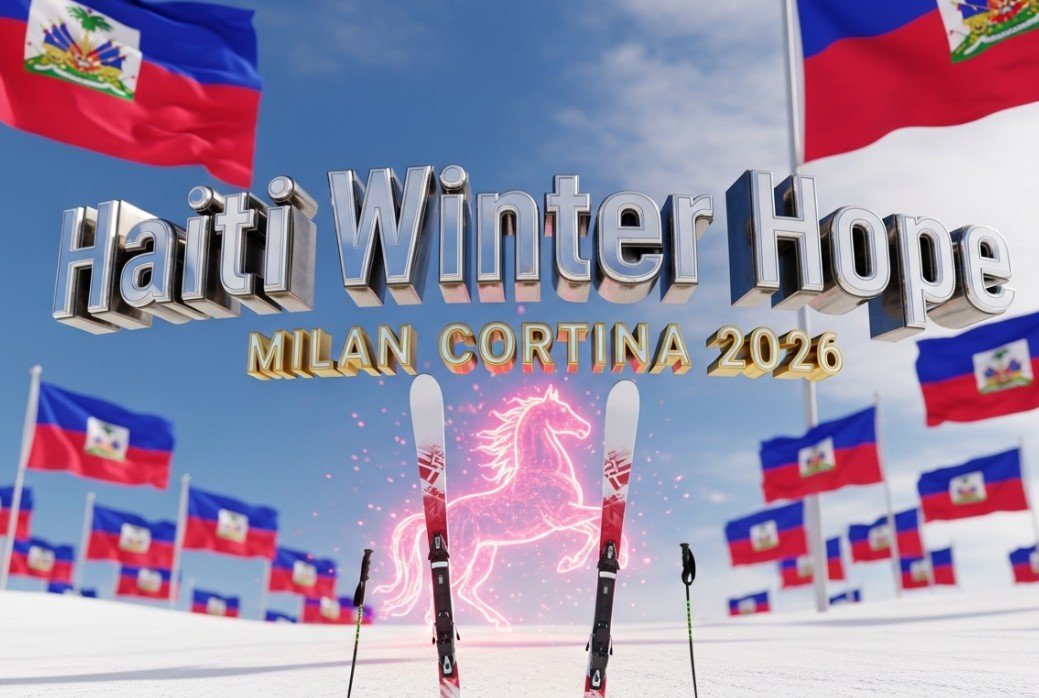
MILAN, Italy Haiti’s participation in the 2026 Winter Olympics in Milan and Cortina d’Ampezzo is emerging as one of the most inspiring stories of this year’s Games. For a country long defined by hardship, its two winter athletes are capturing global attention and offering a message of resilience and pride that goes far beyond their performance results.
Even before the opening ceremony, these athletes and their journey to the world’s biggest sporting stage have sent a powerful message about identity, perseverance, and national spirit. Despite coming from a tropical nation without snow or winter sports tradition, they are rewriting what it means to represent Haiti on ice and snow.
Haiti Makes Historic Winter Games Debut With Two Athletes
For the first time in its history, Haiti is represented by two male athletes at the Winter Olympics. The team includes Richardson Viano, competing in alpine skiing, and Stevenson Savart, the country’s first Nordic (cross-country) skier.
-
Richardson Viano was Haiti’s first Winter Olympian at the 2022 Beijing Games and competes in slalom and giant slalom.
-
Stevenson Savart takes on cross-country skiing, a discipline rarely associated with tropical nations, and carries the hopes of his homeland onto the snowy trails.
Neither athlete grew up in Haiti’s snowy mountains. Both were adopted by families in Europe at a young age, found their way into winter sport circuits, and chose to represent Haiti on the Olympic stage. Their paths reflect personal journeys as much as they do national representation.
Their participation under the Haitian flag is historic and symbolic. For a country grappling with political instability, gang violence, and economic challenges, this milestone highlights a different side of Haiti — one focused on aspiration and international representation.
Uniforms Blend Heritage and Contemporary Art
Another compelling element of Haiti’s Olympic story this year lies in the uniform design, crafted by Italian-Haitian designer Stella Jean. Originally, Jean’s design incorporated a historic portrait of Haitian revolutionary leader Toussaint Louverture on horseback — a powerful symbol of freedom and national identity. However, the International Olympic Committee determined this imagery violated rules against political symbolism at the Games and requested changes.
Jean responded with a creative adaptation. The revised uniform retains the striking image of a charging red horse from the painting that inspired her — a visual tribute to Haiti’s fight for liberty and cultural pride — while adhering to Olympic regulations.
Jean’s designs also include cultural elements such as traditional Haitian tignons (headwraps) and golden hoop earrings for the delegation, nodding to Haiti’s rich history and vibrant identity. These aesthetic choices carry meaning and connect the athletes with their roots even on a global stage.
A Symbol of Resilience for a Struggling Nation
Haiti’s presence at these Winter Games transcends athletics. The Caribbean nation has suffered ongoing political and social turmoil, particularly since the 2021 assassination of President Jovenel Moïse, which led to escalations in gang violence and widespread instability at home. Gangs now control vast portions of the capital, Port-au-Prince, impacting daily life with kidnappings, violence, and limited access to basic services.
In this context, Haiti’s athletes represent hope rather than escape, challenging stereotypes about the country’s struggles. They are ambassadors of a different narrative — one that celebrates human spirit, determination, and the possibility of achievement against the odds.
Ambassador Gandy Thomas, Haiti’s representative to Italy, expressed the significance of the team’s presence, noting that Haiti may not be a winter country, but it refuses to be confined by expectation. His words underline the emotional weight of this Olympic story.
Support, Challenges, and Community Response
While the athletes are celebrated, their journeys have not been without challenges. Training, qualifying, and preparing for winter sport requires resources that are often limited for athletes from nations without winter sports infrastructure. Both Viano and Savart received support from the International Olympic Committee’s Olympic Solidarity program, which helps cover costs for training, equipment, and travel to qualification events.
The story has resonated deeply with the Haitian diaspora, especially communities in the United States and Europe. Haitian-Americans have taken pride in following the athletes’ stories, seeing in them reflections of broader cultural resilience and identity. One such supporter described Haiti’s Olympic representation as a moment of cultural capital, creating visibility and connection at a global sporting event.
What Haiti’s Winter Olympics Journey Means Going Forward
Haiti’s participation in Milan Cortina 2026 is more than a footnote in Olympic statistics. It is a testament to creative adaptation, cultural expression, and the power of sport to reshape narratives. Though the athletes are not expected to contend for medals, their presence on snow and ice sends a message that success is not measured solely by podium finishes but by the courage to represent one’s country against cultural and climatic odds.
Their journey also brings attention to broader conversations about inclusion and diversity in global sport. Winter Olympics have historically been dominated by countries with cold climates and substantial winter sports infrastructure. Haiti’s story challenges that norm and highlights the evolving nature of global athletic participation.
Haiti’s winter Olympians may be few in number, but their impact is significant — reminding the world that pride, identity, and hope can thrive even when conditions seem inhospitable.