Japan is leaning on a stack of digital tools to teach Japanese to foreign-background children whose numbers have outpaced the country’s supply of specialist teachers. The pivot shows up in three places: a hub-and-spoke remote teaching pilot in Fukuoka, a tablet-based app that personalizes lessons for each learner, and a multilingual messaging system that translates school notices for parents who do not yet read Japanese. Foreign residents in Japan numbered roughly 3.96 million as of June 2025, with the school-age population also growing. In January 2026 the central government placed ICT and generative AI at the center of its new policy framework for foreign residents.
The document marks the first time Japan has set out to deliberate on a national program that teaches Japanese language and social systems to newcomers, including children, before and after their arrival. Schools in areas with sparser foreign populations remain the hardest to staff, and remote tools are one of the few options that can reach them quickly. The technology fills gaps the school system cannot plug alone, and it is not being framed as a replacement for in-person teaching.
The Shortage Behind the Pivot to ICT
Japan’s Ministry of Education, Culture, Sports, Science, and Technology, known as MEXT, recommends one Japanese language teacher for every 18 students who need language support in the public school system. The guideline has not been raised under the new January 2026 framework, even as the population of foreign-background children continues to rise. In Fukuoka, Japan’s third-largest city, the shortfall is concrete: JFL teachers were assigned to 12 of the city’s 146 elementary schools and 6 of its 72 junior high schools in the 2025 school year. Schools in less urban areas have long struggled to meet the standard at all.
Enrollment spikes make the gap worse. Foreign students in Fukuoka numbered 527 as of May 1, 2025, then jumped to 744 by the end of December, as children transferred in from school calendars that differ from Japan’s. MEXT sets teacher numbers based on the May 1 count, a month into the academic year, so districts scramble to recruit part-time staff when later arrivals push class sizes up. Fukuoka’s institutional Japanese language support framework, run through the city’s international foundation, layers additional classes for the highest-density neighborhoods on top of that effort.
The numbers line up with a national picture. About 8,000 foreign-background children stopped attending school in Japan in 2024, according to figures cited in the government’s own policy review, and academic progression among those who do attend school lags behind the average for Japanese students. Without steady instruction, the risk is that newcomers retreat into linguistic enclaves and lose access to the broader school system. ICT is being pushed as a partial fix because it can stretch a single qualified teacher across multiple schools, multiple grades, or multiple languages at once.
How Three ICT Tools Reach Foreign-Background Children
Three distinct ICT programs sit at the center of Japan’s current effort. A public-sector remote teaching pilot in Fukuoka connects multiple elementary schools to a single hub instructor. Surala Nihongo, a tablet-based application developed by Surala Net, combines lessons, drills, and tests with multilingual subtitles and an AI engine that adjusts question difficulty. E-Tra Note, conceived by a Utsunomiya University researcher and built with a major Japanese printing company, translates routine school-to-home messages into the parents’ registered language. Each tool targets a different part of the problem: classroom access for the children, individualized practice outside the classroom, and daily communication with the family.
Together they form a layered response that addresses different parts of the problem. The Fukuoka pilot is run by the municipal Board of Education and is moving from a January to March 2026 trial toward full implementation in the 2026 school year. Surala Nihongo is already in use at vocational high schools, universities, and caregiver-training programs in Japan and abroad. E-Tra Note was put into practical use in April 2019 and now operates in schools across the country.
| Tool | What it does | Where it runs | Deployment stage |
|---|---|---|---|
| Fukuoka remote classes | Live online Japanese lessons taught from a hub school | 4 elementary schools linked from Haruyoshi Elementary School | Trial January to March 2026; full rollout planned for 2026 school year |
| Surala Nihongo | Tablet app with AI-adapted lessons and multilingual subtitles | Vocational high schools, universities, and caregiver-training programs in Japan and abroad | Continuous operation; subtitles in English, Indonesian, and Khmer |
| E-Tra Note | Multilingual school-to-home messaging log | 160 schools across Japan | In practical use since April 2019 |
Fukuoka’s Hub-and-Spoke Trial Goes Live
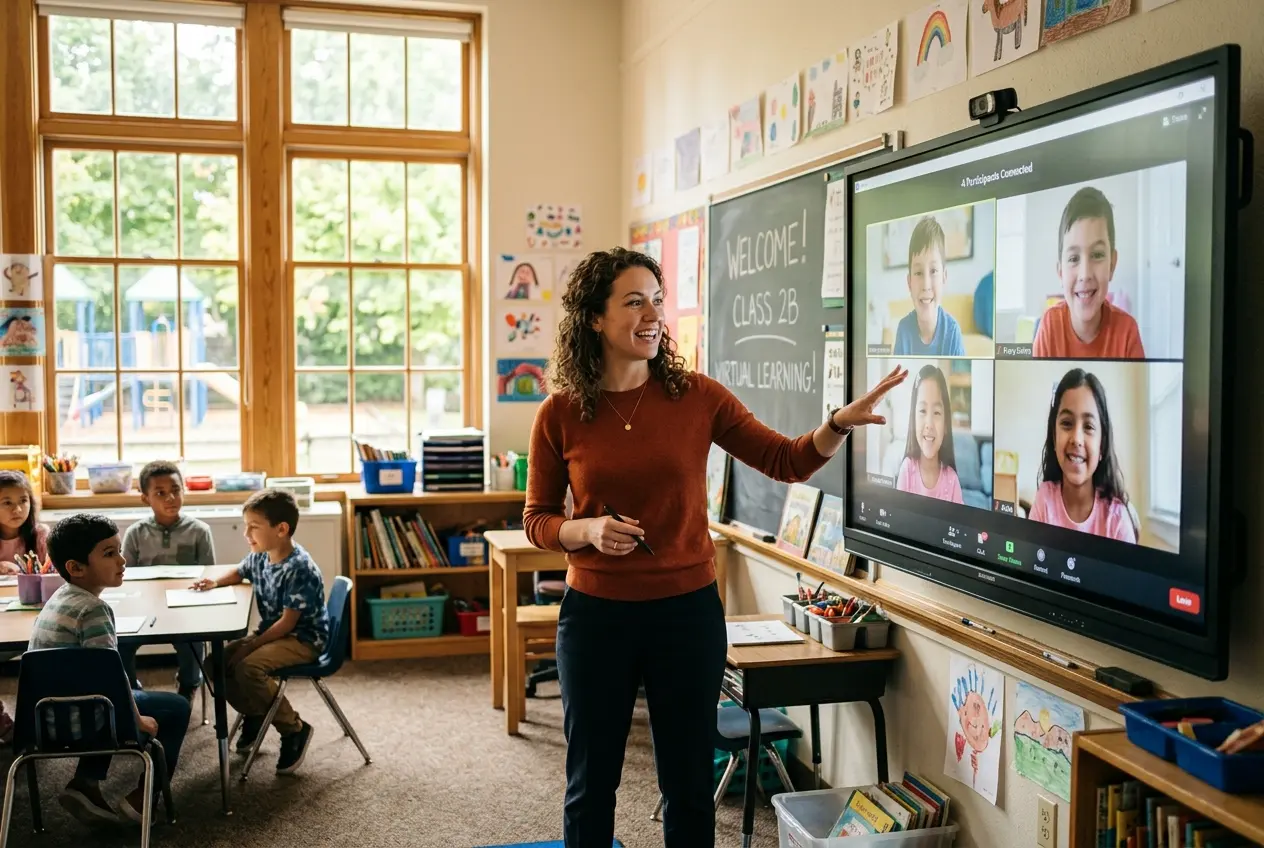
The clearest live example sits in Fukuoka. From January to March 2026, the Fukuoka Municipal Board of Education ran a pilot in which four elementary schools were linked online through Fukuoka Municipal Haruyoshi Elementary School. Lead teacher Etō Rieko taught vocabulary for everyday school objects to four students from China, Korea, and Indonesia, all in grades one through four. The Board had been looking for a way to deliver Japanese language support to schools that did not have their own specialist teacher.
Abe Mayuko, the chief supervising instructor in the School Planning Division of the Guidance Department, helped design the program. She explained that under the city’s previous arrangement, students needing JFL support had to travel to one of the schools that had a teacher on staff, with commutes sometimes running over an hour. Online classes cut that travel and let the Board serve new arrivals without waiting for additional hires. Two groups were formed: grades one through four, and grades five through nine. Each group received ten 45-minute lessons over the trial period.
The format differed from in-person teaching in ways the trial highlighted. When students used paper and pencils, on-site adults adjusted the cameras so the lead teacher could see their work and give real-time feedback. The lead teacher kept students engaged with large gestures and animations, including timers and visual cues built with the free design tool Canva. She also struggled with the simplest mechanic of all: looking at the camera meant looking away from the children’s faces on her screen, and the children noticed. The lessons were observed by Abe, by other JFL teachers, by coordinators, and by Sawada Hiroko, an associate professor at Tsukuba University who researches Japanese language instruction. One observer noted that the children rarely smiled during the opening 15 minutes and only became engaged once the lesson moved to real objects.
The Board has now committed to a wider rollout. The 2026 school year will introduce remote classes taught from a network of hub schools still being selected, with the curriculum built around daily “survival Japanese” for school life. Students will be able to join at the start of one of eight rolling enrollment periods during the year, depending on when they transfer in. Teachers have already been equipped with AI voice translation devices, and the Board is exploring how to weave students’ native languages into the lessons alongside Japanese.
Tablet Lessons That Adapt to Each Learner
The classroom side of the problem is only half the story. Even when a child reaches a school with a JFL teacher, the gap between their Japanese and the level of instruction around them can be wide, and a single classroom can hold students at very different proficiency levels depending on when they arrived in Japan. Surala Nihongo is a tablet-based program designed for that unevenness. It combines lessons, drills, and tests with narration by voice actors, animation, and subtitles in the learner’s native language.
The current subtitle languages are English, Indonesian, and Khmer, with Surala Net listing additional languages as coming. An AI engine inside the program diagnoses each learner’s individual weaknesses and adjusts question difficulty to match, while flagging weak points for review and reinforcement. A teacher’s dashboard tracks study history, accuracy, and progress in real time. Surala Nihongo’s all-in-one learning system is already in use at vocational high schools with limited JFL staff, at a Cambodian university focused on Japanese-language technology, and in caregiver-training programs for the Specified Skills visa track.
- 12 of 146 Fukuoka elementary schools had a Japanese language teacher in 2025
- 6 of 72 Fukuoka junior high schools had a Japanese language teacher in 2025
- 527 → 744 students needing JFL support in Fukuoka between May and December 2025
- About 3.96 million foreign residents in Japan as of June 2025
Surala Net points to specific classroom results. In one Indonesian vocational school with more than 1,000 students per grade and a chronic shortage of Japanese teachers, the company reports that the number of students taking the JLPT tripled in a single year after the tablet program was introduced. Trainees at a Japanese company using the same system achieved JLPT N4 certification while studying in their free time before and after shifts. The pattern echoes how AI classrooms and virtual labs are rewiring schools abroad: one instructor’s reach, multiplied by software.
Translating the School-Home Channel
Daily school life runs on smaller text than a classroom lesson: a note about what to bring tomorrow, a request for a health questionnaire, a reminder about a parent-teacher meeting. When parents do not read Japanese, those notices become a barrier between home and school, and a child’s education can stall over a missed permission slip. E-Tra Note is a multilingual school-to-home messaging system built to close that gap.
The system was conceived by Wakabayashi Hideki, a visiting associate professor at Utsunomiya University, and developed with a major Japanese printing company. Teachers compose messages by selecting from 500 preregistered templates, phrases, and words in Japanese; families then receive the messages translated into their registered language. The first version went into practical use in April 2019, and the system now runs in 160 schools across Japan. That same year, the system’s approach earned Wakabayashi the top prize at the telecommunications ministry’s Multilingual Speech Translation Contest. The school-side workflow matters: a teacher types by selecting from a fixed library, so translation accuracy does not depend on the teacher’s own skill in a second language.
I wish to turn ‘special’ into part of the ‘ordinary.’ I hope teachers will face non-Japanese children and their households without using the language barrier as an excuse.
Wakabayashi, the system’s developer and a visiting associate professor at Utsunomiya University, spoke about the project with the Asahi Shimbun in a 2019 profile. The conversation that pushed him out of the English-teaching classroom and into research at Utsunomiya at age 47 was a visit to the home of a Brazilian student, conducted in broken Portuguese with a dictionary in hand, that ended with the boy calming down in class the next day. The system, in his telling, is the practical version of that instinct, designed to take the language barrier off the list of reasons a teacher might hesitate to call a family. E-Tra Note is one of the few pieces of the ICT toolkit aimed squarely at the family rather than the child.
Coverage is still narrow by national standards, a small slice of Japan’s public school system. The system fits squarely into the January 2026 playbook, where one of the four language priorities is expanded support for municipalities that want to deploy translation tools. The story behind E-Tra Note’s creation is one of the clearest accounts of why the framework expects wider rollout.
The Government’s January 2026 Playbook
On January 23, 2026, the administration of Prime Minister Takaichi Sanae published its Comprehensive Measures for Acceptance and Orderly Coexistence of Foreign Nationals, a cross-ministerial package that puts language education for foreign-background children near the top of the agenda. The document was approved at a Ministerial Meeting on Accepting Foreigners and Realizing an Orderly Coexistence Society, and it explicitly names ICT and generative AI as part of the solution. It also marks the first time Japan has set out to deliberate on a national program that teaches Japanese language and social systems to foreign residents, including children, before and after their arrival. The policy frames digital tools as a way to reach children in areas too sparse in foreign residents to justify a dedicated teacher.
The policy’s near-term language priorities for foreign children are four, and they fit the three existing tools closely. Schools would gain national guidelines for using IT and generative AI in the classroom, a step that would set a common floor for the kind of work Fukuoka is already running. The package also calls for expanded support to municipalities that run model programs and stronger support for Japanese language instruction assistants, the staff who handle day-to-day language work in classrooms without a dedicated JFL teacher.
- Consider school readiness programs that teach basic Japanese and rules of school life before enrollment
- Present guidelines for IT and generative AI usage in classrooms
- Enhance support for municipalities running model programs in Japanese language education
- Enhance support for Japanese language instruction assistants
The full package ranges well beyond education, with stricter permanent-residency reviews, tighter screening for unpaid medical expenses, and stronger measures against illegal employment. The MEXT staffing benchmark of one teacher per 18 students has not been raised under the new framework, and the government’s own policy review concedes that current systems are not keeping pace with a foreign-background population growing by about 10% a year. An English-language analysis of the January 2026 measures frames the language items as an attempt to fill gaps while the teacher pipeline catches up. The policy review itself notes that using these materials requires teacher proficiency in the IT involved and considerable effort, and that schools without an understanding of why they are needed will struggle to make them effective.
What the Screen Cannot Replace
The Fukuoka trial is also a candid accounting of what ICT cannot yet do. Online classes were harder than in-person teaching for keeping younger learners focused, and the problem compounded for children just beginning to learn Japanese. Etō Rieko, the lead teacher in the pilot, told observers that the lessons were ‘totally different from in-person classroom lessons’ and that keeping students engaged required her to use large gestures and animations. She also struggled with eye contact: looking at the camera meant looking away from the children’s faces on her screen, and the children noticed. One observer noted that students rarely smiled during the opening 15 minutes of a lesson and only became engaged when real objects were brought into the explanation.
For all three tools, the same ceiling shows up. Surala Nihongo can personalize difficulty and free teachers from routine drilling, but it cannot replace the human work of explaining a tricky cultural concept or calming a frightened child. E-Tra Note can ensure a parent receives a translated message, but it cannot ensure the parent reads it, responds, or feels welcome to push back. The Fukuoka hub-and-spoke model can stretch one qualified teacher across multiple schools, but the lessons still need an adult beside each child to keep the screen from becoming wallpaper. The pattern is consistent: digital tools change the shape of the teacher’s job, they do not shrink it.
The government’s own policy review acknowledges as much. It notes that online teaching materials require teacher proficiency in the underlying IT and considerable effort to deploy, and that without an understanding of why they are needed, schools will struggle to make them effective. The new framework is explicit that face-to-face interaction, direct instruction, and attentive staff support remain essential. The question is how to broaden ICT use without making it a substitute for staffing.
For families and educators watching the rollout, the practical question is where ICT will land first. The hub-and-spoke model is most useful where JFL teachers are scarce, the tablet apps where classrooms hold students at very different proficiency levels, and the multilingual messaging systems where parent engagement is the bottleneck. The three conditions overlap in the same districts, mostly the ones with the smallest specialist workforces. The technology is being put to use where the need is sharpest, and the policy framework is now pointing it at the same places.
Frequently Asked Questions
What is MEXT’s 1-to-18 teacher-to-student rule for Japanese language instruction?
Japan’s Ministry of Education, Culture, Sports, Science, and Technology, known as MEXT, recommends one dedicated Japanese language teacher for every 18 students who require Japanese language instruction in the public school system. The benchmark has not been raised under the January 2026 framework, even as the foreign-background student population keeps climbing. Fukuoka, where demand rose from 527 students needing JFL in May 2025 to 744 by the end of December, had JFL teachers assigned to 12 of its 146 elementary schools and 6 of its 72 junior high schools during the 2025 school year.
How does the Fukuoka hub-and-spoke model work in practice?
The Fukuoka Municipal Board of Education ran a three-month trial from January to March 2026 that linked four elementary schools through Fukuoka Municipal Haruyoshi Elementary School, with lead teacher Etō Rieko delivering lessons to four students from China, Korea, and Indonesia in grades one through four. Each group attended ten 45-minute lessons over the trial period, with on-site adults sitting beside younger students to keep them focused and to adjust the cameras when the children used paper and pencils. The Board plans to choose its network of hub schools before launching full implementation in the 2026 school year, with eight rolling enrollment periods tied to the dates students transfer in.
What is Surala Nihongo, and who is it designed for?
Surala Nihongo is a tablet-based Japanese program built by Surala Net that combines lessons, drills, and tests with multilingual subtitles in English, Indonesian, and Khmer, with additional languages listed as coming. An AI engine inside the program diagnoses each learner’s individual weaknesses and adjusts question difficulty in real time, while feeding progress to a teacher’s dashboard. Surala Net reports use cases ranging from a Japanese vocational high school with more than 1,000 students per grade and few JFL teachers, to a Cambodian university focused on Japanese-language technology, to caregiver-training cohorts preparing for the Specified Skills visa, where one Indonesian technical trainee group reported that JLPT test-taking tripled within a year of introduction.
What does E-Tra Note actually do?
E-Tra Note is a multilingual school-to-home messaging system conceived by Wakabayashi Hideki, a visiting associate professor at Utsunomiya University, and developed with a major Japanese printing company. Teachers compose messages by selecting from 500 preregistered Japanese templates, phrases, and words; families receive the messages translated into their registered language. The system was put into practical use in April 2019, earned its team the top prize at that year’s telecommunications ministry Multilingual Speech Translation Contest, and is now deployed in 160 schools across Japan.
What does the January 2026 policy package include for foreign children?
The Comprehensive Measures for Acceptance and Orderly Coexistence of Foreign Nationals, formulated under Prime Minister Takaichi on January 23, 2026, list four near-term language education priorities for foreign children: school readiness programs that teach basic Japanese and school-life rules before enrollment, national guidelines for IT and generative AI use in classrooms, expanded support for municipalities running model programs, and stronger backing for Japanese language instruction assistants. The package does not raise the MEXT staffing benchmark of one teacher per 18 students, and the government’s own policy review concedes that current systems are not keeping pace with a foreign-background population growing by about 10% a year. The broader document also includes stricter permanent-residency reviews and tighter screening for unpaid medical expenses, sitting alongside the education items rather than replacing them.