
The tablet world could be on the brink of a rare turning point as a new modular Android tablet is quickly gaining ground among tech enthusiasts and privacy advocates around the globe. Brax’s open_slate, a 12‑inch tablet designed to be easily repaired and upgraded by owners with just a Phillips screwdriver, has stormed past its crowdfunding goal, fueling excitement and debate about what true device ownership can look like. But the journey has not been smooth and now comes with a higher price tag that highlights the challenges of building a truly open, sustainable tablet in today’s market.
Early support for the open_slate shows there is demand for a device that bucks the trend of sealed‑in hardware and software lock‑in. Yet the price surge and mixed reactions from the tech community add new layers to the story that every potential backer should know before deciding whether this tablet can truly reshape the industry.
Crowdfunding Success and Price Hike Sends Ripples Through Tech Community
Brax’s open_slate recently launched its crowdfunding campaign, and it has already raised close to one million dollars, a significant milestone for a device that promises to reinvent user control in tablets. This funding milestone shows strong interest from early adopters who want a device that values longevity and privacy over planned obsolescence.
However, the trek to this point has been rocky. Originally, Brax planned early‑bird pricing starting at $399 for the base model and $529 for the pro model. Rising component costs, particularly for memory, have forced the company to increase prices to $469 and $629 respectively for backers. Retail prices once the product ships are expected to be even higher.
The higher price tag has triggered mixed emotions online. Some backers are thrilled to support a project that prioritizes repairability and privacy. Others are concerned that the value proposition is slipping when compared to mainstream tablets that offer more powerful chips and polished software ecosystems.
What Makes Open Slate Truly Different From Other Tablets
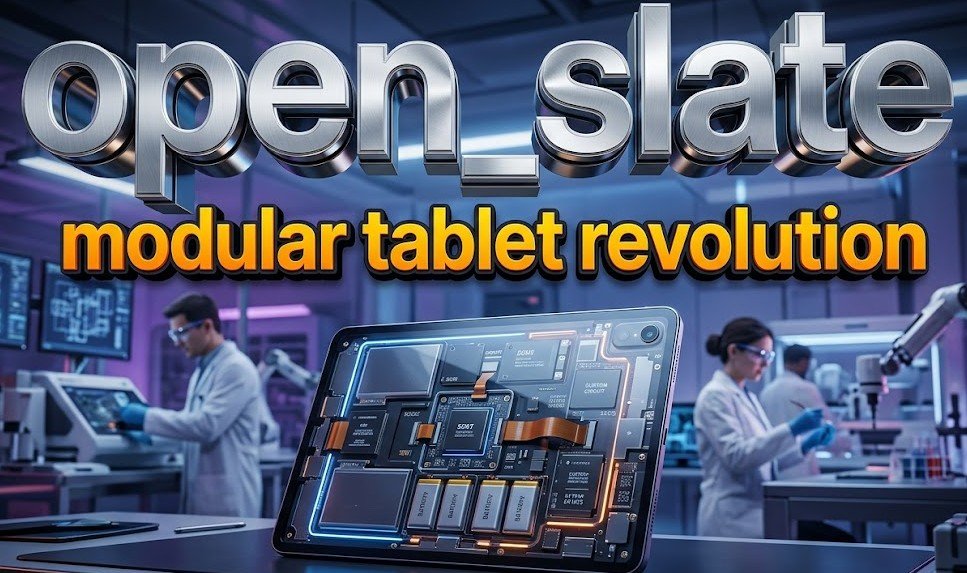
What sets the open_slate apart from most mainstream tablets is its modular, user‑servicing design. Instead of sealed hardware, owners can open the back with a simple screwdriver to replace or upgrade parts like storage and battery. A true user‑replaceable battery and an M.2 slot for NVMe storage are uncommon features in most tablets today, where batteries and storage are normally soldered to the motherboard.
The tablet runs on a MediaTek Genio 720 processor, paired with options for 8GB or 16GB of RAM and 128GB or 256GB of storage, all expandable via the M.2 slot. Dual USB‑C ports, a USB‑A port, display output, and even pogo pins for accessories make it feel more like a hybrid device than a typical slab tablet.
But the open_slate pushes beyond hardware flexibility. It is built with privacy‑focused hardware switches that allow users to cut power to cameras, microphones, wireless radios, and sensors at a physical level. This hardware privacy design is a rarity in the tablet landscape, especially at this kind of price range.
The device is meant to ship with BraxOS, a stripped‑down, de‑Google‑ified version of Android, but it also supports traditional Android and a range of Linux distributions like Ubuntu, Ubuntu Touch, Debian, and others according to Brax’s promises. This flexibility is a core part of its mission: to give users control over both hardware and software environments.
Rumors and Community Reactions: Real Power or Just Hype?
While many backers are excited about the open_slate’s promise, Reddit threads and tech forums show a mix of enthusiasm and cautious skepticism. Some potential buyers say the tablet feels like a step toward the kinds of devices users truly own, instead of temporary gadgets designed to be discarded. Others argue the chosen chipset is not powerful enough for serious productivity or demanding tasks, especially when compared with Snapdragon or Apple silicon devices.
One user noted that while the tablet’s specs are decent for everyday tasks like browsing and media playback, they might fall short on performance‑heavy tasks. Critics online are especially vocal about the MediaTek Genio 720 chip, suggesting it may struggle to match the performance and GPU power seen in high‑end tablets. Some in the Linux community also say that while multiplatform support is admirable, real mainstream Linux performance on ARM tablets remains a challenge.
Despite this, there remains a strong contingent of users who believe the open_slate represents a new kind of computing ethos — one where users can maintain, repair, and upgrade their devices far beyond what most tech companies allow.
A Real Test for the Right to Repair Movement
The open_slate arrival is more than just another tablet launch. It has become a litmus test for the right to repair movement, user privacy, and open‑source hardware design. Tablet makers typically glue batteries inside, solder memory and storage shut, and lock down software updates. In contrast, open_slate’s transparent glass back revealing the motherboard and its easy‑access internal components make a bold statement about ownership.
For consumers frustrated by the throwaway culture of modern electronics, open_slate may be a breakthrough. But the price hike and performance concerns are reminders that translating idealistic concepts into commercially viable products is never simple.
The real world test will come when the device starts shipping, expected in September 2026, and real user reviews hit the internet. If Brax can deliver a stable, flexible, and truly modular experience, open_slate could inspire other manufacturers to rethink how tablets are designed and sold.
What This Means for Consumers and the Tablet Market
Today’s tablet market is dominated by a few major players offering sealed devices that emphasize design and integration over repairability. The open_slate’s modular approach challenges this norm and places user choice front and center.
If it succeeds it could convince more tech companies to adopt repair‑friendly designs and embrace open‑source software parity. But if it struggles to meet expectations in price or performance, it might remain a niche product for enthusiasts and privacy advocates.
Whether you are a tech professional, privacy‑minded user, or a casual buyer tired of sealed electronics, the open_slate campaign is one to watch closely as the crowdfunding story unfolds and the first devices reach hands later this year.