
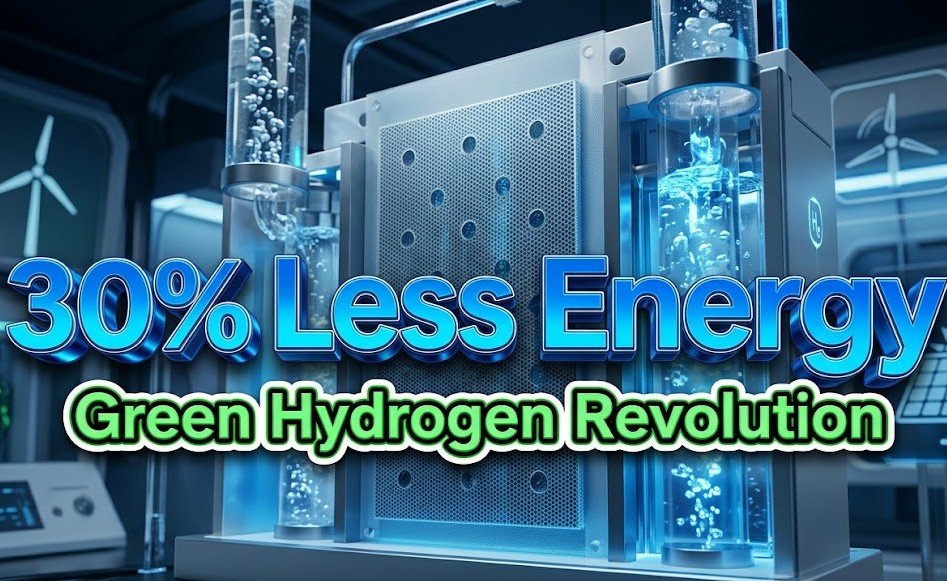
A startup spun from MIT research just unveiled a boron-based membrane that cuts the energy needed to make green hydrogen by 30 percent. This breakthrough could finally push green hydrogen into the mainstream by making it far more affordable to produce at scale.
The innovation comes from 1s1 Energy, which says its technology also promises big drops in operating costs for electrolyzer operators. Green hydrogen, made by splitting water with renewable electricity, has long struggled with high costs compared to dirtier methods that rely on natural gas or coal.
This new membrane changes the game by improving both performance and durability in proton exchange membrane electrolyzers.
The Science Behind the Boron Breakthrough
Traditional electrolyzers use membranes to shuttle protons from one side of the cell to the other while splitting water molecules. 1s1 Energy attaches specially tailored boron to polymer materials to create these membranes.
Boron receives a negative charge that lets protons bond and move more quickly. The result is faster ion exchange without poisoning the valuable catalysts inside the system. Boron-based materials also resist corrosion better than many current options, which means the equipment lasts longer under tough operating conditions.
In partner tests, electrolyzers equipped with these membranes needed only 70 percent of the usual energy to produce each kilogram of hydrogen. The company reports it already hits efficiency levels that match the U.S. Department of Energy’s 2031 target for proton exchange membrane systems.
The membranes avoid some of the drawbacks of legacy materials, including high costs and environmental concerns around certain fluorinated compounds. 1s1 Energy is also developing non-PFAS versions to give manufacturers more sustainable choices.
Big Savings That Attract Real Customers
Cost remains the main hurdle for green hydrogen. Many industrial buyers want clean fuel but cannot afford the current price premium. 1s1 Energy says potential customers see around 60 percent lower operating costs with its technology.
The savings come from multiple directions. Less electricity is needed per kilogram of hydrogen. The stacks themselves should cost less to build and maintain. Higher current density allows smaller, more compact systems that take up less space on site.
Company leaders point to targeted conversations with future users rather than broad decarbonization pitches. This approach helped them build a pipeline of interested parties who see clear economic value today, not just environmental benefits years down the road.
Green hydrogen currently costs more to produce than gray hydrogen made from fossil fuels. Bringing that price down closer to parity could unlock massive adoption in steelmaking, chemical production, heavy transport, and long-duration energy storage.
- 20 to 30 percent lower electricity consumption
- Up to 50 percent reduction in capital costs for stacks
- Stack lifetimes potentially reaching nine years
- Smaller overall system footprint
- Environmentally friendlier component choices
These gains add up quickly for large-scale projects where energy bills and equipment replacement drive major expenses.
Dan Sobek’s Path From Argentina to MIT Innovation
Co-founder Dan Sobek grew up in Argentina before spending more than a decade at MIT earning degrees in aeronautics, mechanical engineering, and electrical engineering and computer science. His PhD work focused on measuring properties of biological cells, but lessons in microfabrication and materials chemistry proved surprisingly relevant to energy tech.
After leaving MIT, Sobek built experience in microelectronics and microfluidics. He founded an imaging technology company before turning his attention to electrolysis challenges around 2013. A conversation with co-founder Sukanta Bhattacharyya led to a simple but powerful idea: boron.
The company officially launched in late 2019. It has since raised seed funding and begun pilot work with industrial partners, including projects tied to a major steel company in Brazil. 1s1 Energy is also collaborating with a large materials firm to ramp up membrane production capacity.
Sobek emphasizes focus in these early stages. While the team sees potential in multiple areas, the immediate priority is proving the technology in hydrogen production before expanding.
Technology With Potential Far Beyond Hydrogen
The same boron chemistry that boosts electrolyzers could improve fuel cells that convert hydrogen back into electricity. Early trials are also exploring uses in solid-state batteries and other electrochemical systems.
One particularly interesting application involves extracting critical metals from mining waste. The process could recover materials like niobium for high-strength steel and batteries while using far milder chemicals than traditional methods. Sobek, who still feels connected to Argentina, sees this as a way to support responsible mining practices that avoid toxic pollution.
The company has also received grants to combine its membranes with other innovations for green ammonia production, a key chemical used in fertilizers and potentially as a shipping fuel.
By 2030, 1s1 Energy hopes to have established businesses across electrolyzers, mineral extraction, and partnerships with bigger players. For now, the team stays disciplined to deliver results in its core hydrogen mission first.
Why This Matters for the Clean Energy Transition
Global demand for green hydrogen is rising as countries and companies set ambitious net-zero targets. Sectors like aviation, shipping, and steelmaking have few other viable paths to deep decarbonization. Yet scaling production remains expensive without major technology improvements.
This boron membrane addresses the heart of that challenge by making the core component of electrolyzers work better and cheaper. If the technology scales as hoped, it could accelerate projects that were previously on the edge of economic viability.
The timing feels right. Renewable electricity costs continue to fall in many regions, and governments offer incentives for clean hydrogen. A more efficient way to turn that power into hydrogen multiplies the impact of those investments.
Challenges remain, of course. Supply chains for other electrolyzer components, permitting for large projects, and building out hydrogen transport infrastructure all need attention. But lowering the cost of the core production step removes one of the tallest barriers.
This development shows how focused materials science can deliver practical solutions to climate problems. It combines deep technical insight with real-world customer needs in a way that feels grounded rather than hype-driven.
The road to a hydrogen-powered future just got a little smoother. Cleaner industrial processes, reduced emissions from heavy transport, and more resilient energy systems could all benefit if this technology reaches full potential.