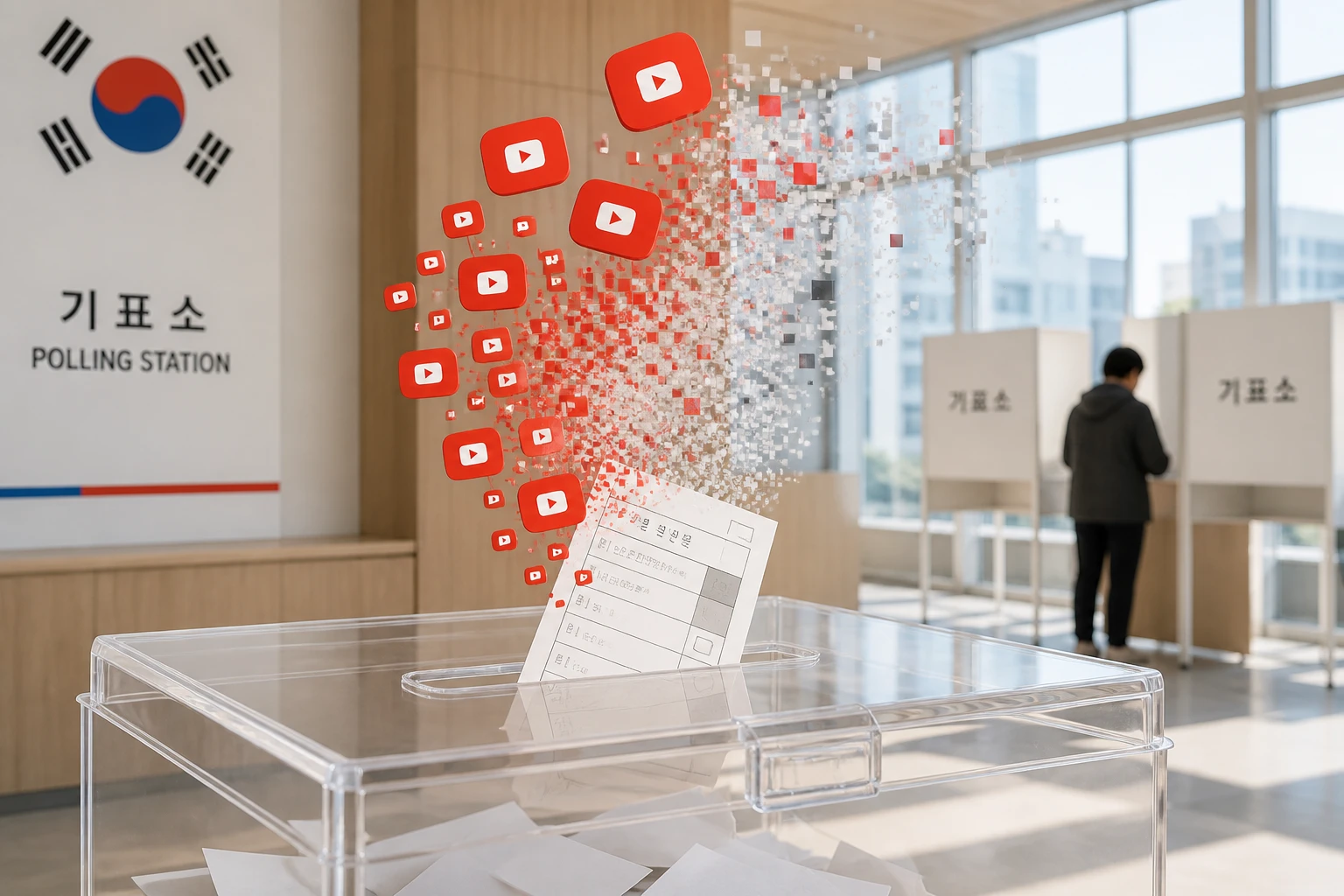
Google terminated 449 Korean-language YouTube channels in the second quarter of 2026 for coordinated political content, according to its Threat Analysis Group bulletin. The bulk, 367 channels, vanished in May, weeks before South Korea’s June 3 local elections.
The actions ended a year-long stretch with zero Korean terminations and applied the same coordinated-influence rules usually associated with foreign state campaigns to domestic networks that backed or attacked the government, parties and figures.
The bulletin did not frame the Korean clusters as a single operation. It logged them as separate campaigns that shared a method: coordinated posting about South Korean politics, delivered in Korean, at a scale that tripped the same thresholds used against state-linked networks elsewhere.
The May Spike Ahead of the Ballot
April saw just 22 channels removed. June added 60. May’s 367 formed the clear peak. Yonhap reported the concentration landed immediately before voters chose governors, mayors and councilors across the country.
Turnout hit 61 percent, the highest since local autonomy returned in 1995. The ruling Democratic Party under President Lee Jae-myung took 12 of 16 major races while the People Power Party held four, including Seoul.
- April: 22 channels
- May: 367 channels
- June: 60 channels
- Q2 total: 449 channels
That monthly pattern belongs to the larger Q2 bulletin that also logged thousands of China- and Russia-linked removals. May alone accounted for the large majority of the Korean total, compressing most of the quarter’s enforcement into the final stretch of campaigning.
The April figure looks almost residual by comparison. The June figure looks like a residual cleanup after the vote. May is the month that defines the story.
What the Bulletin Logged
Google’s terminated 22 YouTube channels sharing content in Korean that supported South Korean political figures and criticized a political party in April. May and June entries multiply the same pattern without attributing the networks to a foreign government.
| Month | Channels | Sample Content Focus |
|---|---|---|
| April | 22 | Supportive of figures, critical of a party |
| May | 53 | Critical of parties and government |
| May | 43 | Supportive of government, critical of a party |
| May | 37 | Supportive of a party and government |
| May | 142 | Critical of the government |
| May | 51 | Supportive of the government |
| June | 22 | Critical of a party and government |
| June | 25 | Critical of government and a party |
Additional May and June clusters of 21, 20 and 13 channels covered mixed or single-direction support and criticism. The bulletin lists them as separate coordinated campaigns rather than one network.
Reading the table as a set of campaigns, not a single dump, matters. Supportive and critical batches appear side by side in the same month. Mixed batches appear as well. The common thread is coordination, not a shared partisan script.
The smaller June clusters continue that split after election day. Enforcement did not stop when ballots closed; it tapered.
Both Directions Drew the Same Sanction
Some tallies circulating after the report put roughly 255 channels in the critical column and 151 in the supportive column. Exact splits vary by how overlapping campaigns are counted, yet the direction is clear: Google did not pick one side.
One May batch of 142 channels criticized the government. Another of 51 supported it. A third mixed both. June continued the pattern. The enforcement targeted coordination and inauthenticity signals, not the partisan slant of the videos themselves.
On X, some accounts framed the wave as help for the Lee administration against critics. The raw bulletin entries undercut that reading. Networks amplifying the government and specific parties disappeared alongside those attacking them.
If the standard had been viewpoint, the 142-channel critical batch and the 51-channel supportive batch would not share a fate. They did. That is the clearest signal in the Korean entries: method over message.
A Full Year Without Korean Removals
Google recorded no Korean YouTube terminations from the second quarter of 2025 through the first quarter of 2026. In that same window it removed 9,173 channels linked to China and 2,083 linked to Russia.
Q2 2026 flipped the Korea line from zero to 449 while China again led overall volume. April alone included 1,763 PRC-linked channels; May added 5,090; June another 2,320. Russia campaigns continued in smaller batches across languages and targets.
| Actor or language set | Period | Channels removed |
|---|---|---|
| Korea (Korean-language) | Q2 2025-Q1 2026 | 0 |
| Korea (Korean-language) | Q2 2026 | 449 |
| China-linked | Q2 2025-Q1 2026 | 9,173 |
| China-linked | April 2026 | 1,763 |
| China-linked | May 2026 | 5,090 |
| China-linked | June 2026 | 2,320 |
| Russia-linked | Q2 2025-Q1 2026 | 2,083 |
The sudden Korean appearance after twelve quiet months marks a shift in detection or in the volume of coordinated activity that met the threshold. Prior prior TAG quarterly enforcement patterns had focused heavily on the usual foreign-linked clusters.
Even at 449, the Korean total remains a fraction of a single strong China month. Scale still favors the foreign-linked rows. What changed is presence: Korea moved from an empty line to a documented set of campaigns in one quarter.
Domestic Networks Meet the Foreign Playbook
TAG’s public bulletins traditionally highlight operations “linked to” China, Russia, Iran or other states. The Korean entries omit that phrasing. They simply describe content in Korean about South Korean politics that showed signs of coordination.
YouTube’s own elections materials state that TAG works to identify coordinated influence operations on YouTube and terminate the channels involved. The same machinery now sweeps domestic amplifiers that behave like the foreign ones.
Platform standards research has long noted the difficulty of drawing clean lines between genuine political organizing and coordinated inauthentic behavior. When real users operate multiple accounts to push a message, automated and human review still flag the coordination. Korean political operators who scaled like influence campaigns received the influence-campaign remedy.
The missing “linked to” clause is therefore the point, not a gap. Domestic origin did not create a safe harbor once the coordination signals matched the playbook written for foreign work.
Coordination Rules Now Reach Domestic Operators
The Korean cases show the enforcement logic stripped of a state sponsor. Content language, target audience and political subject were local. The violation category was not.
That matters for anyone building rapid distribution around an election. A cluster that looks like organic enthusiasm from the outside can still present as coordinated inauthenticity to the systems that score channel behavior, upload patterns and cross-promotion.
- Separate campaigns, not one merged network, in the bulletin’s own listing
- Supportive, critical and mixed batches removed under the same rules
- No foreign-government attribution attached to the Korean rows
- Peak volume timed to the weeks before a national local vote
None of those points requires a new claim about who ran the channels. They follow from how the bulletin already groups and describes the takedowns.
Operators who treated multi-channel amplification as ordinary campaign craft met a standard built to catch influence operations. The remedy was the same: termination of the channels involved.
China and Russia Still Lead Removal Totals
Context on volume keeps the Korean spike in proportion. China-linked removals in April, May and June alone run into the thousands each month. Russia’s tally across the prior year already exceeded two thousand channels.
Korea’s 449 is large against its own recent baseline of zero. It is modest against the foreign-linked totals that still dominate the same bulletin.
- Q2 2025 through Q1 2026: no Korean-language terminations recorded
- April 2026: 22 Korean channels removed; 1,763 PRC-linked channels removed
- May 2026: 367 Korean channels removed; 5,090 PRC-linked channels removed
- June 3, 2026: local elections held nationwide
- June 2026: 60 further Korean channels removed; 2,320 PRC-linked channels removed
- Q2 2026 close: 449 Korean channels total for the quarter
The timeline shows a quiet year, a sharp May cut, an election and a smaller June follow-through. It also shows why foreign operations remain the bulletin’s main volume story even in the quarter Korea reappeared.
Local Elections as the Immediate Context
The June 3 vote was the ninth simultaneous local election since 1995. Voters filled 16 metropolitan and provincial executive seats, hundreds of mayoral posts and thousands of council seats. The Democratic Party’s sweep of 12 major races and strong council showings confirmed its post-presidential momentum. The People Power Party held its southeastern base and Seoul.
Whether the channel removals changed any race is unknowable from public data. What is visible is the timing. The largest single-month cut landed in the final weeks of campaigning. Creators and operators who had built coordinated clusters lost their primary distribution overnight.
Studies of how platforms address influence operations in standards show most major companies now treat coordinated amplification as a distinct violation regardless of whether a foreign government sits behind it. Google’s Q2 Korean actions put that principle into practice at scale inside one of Asia’s most wired democracies.
High turnout and a decisive executive map give the political backdrop its shape. The channel numbers give the platform backdrop its shape. The two timelines overlap without a public measure of cause.
The bulletin closed the quarter with the usual mix of global campaigns. For Korean political YouTube, the lasting fact is simpler: after a year of silence, 449 channels that pushed coordinated messages about the government and parties are gone, most of them just before voters went to the polls.
Supportive and critical networks alike were swept in. Foreign-linked totals still towered over the Korean line. The rule set that produced those outcomes is the same one TAG has long applied to coordinated influence work, now visible on a domestic election calendar.