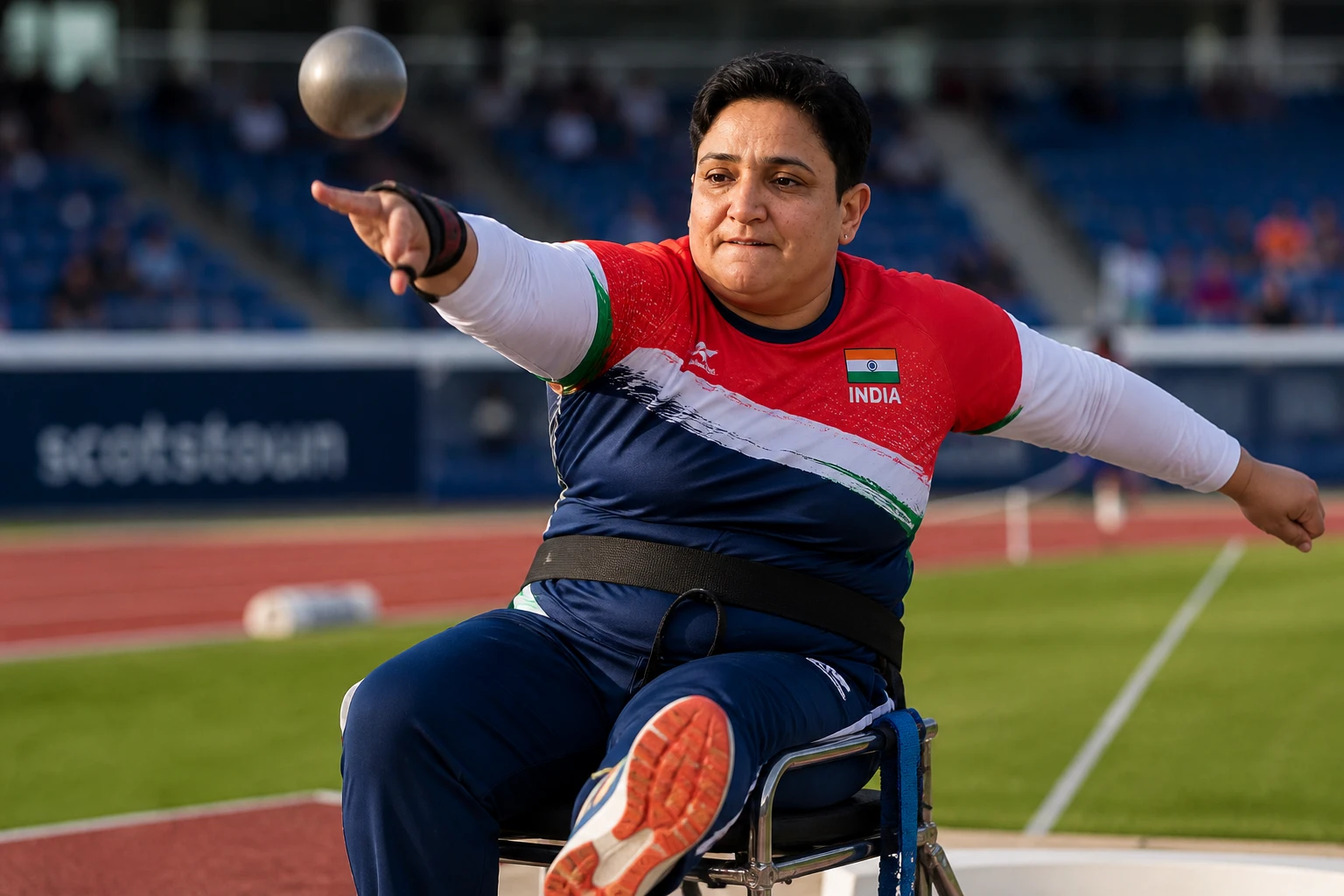
Sharmila Dhankar threw a season-best 9.81 metres to win women’s F57 shot put gold at the Glasgow 2026 Commonwealth Games, becoming India’s first para-athletics champion at the Games and ending a 20-year medal drought in the discipline.
The 39-year-old from Haryana opened with 9.48m, improved to 9.58m, then locked in the winning mark on her third attempt. Ghana’s Zinabu Issah took silver with 8.65m. Compatriot Shilpa Shyla claimed bronze at a personal-best 7.26m after Nigeria’s Eucharia Iyiazi was reduced to no mark.
The result carried weight beyond one final. It closed a long gap in Indian para-athletics at the Commonwealth Games and placed two athletes from the same nation on the same podium on the same night. The margin, the series consistency and the review that reshaped the bronze order all formed part of a single, decisive evening at Scotstoun.
9.81 Metres Clears the Field at Scotstoun
Competing from a fixed seated position in the F57 class for athletes with limb impairments or reduced muscle power, Dhankar showed control across six throws at Scotstoun Stadium on 27 July. Her series stayed above nine metres on five attempts.
| Rank | Athlete | Nation | Best Throw | Notes |
|---|---|---|---|---|
| 1 | Sharmila Dhankar | India | 9.81 m | SB |
| 2 | Zinabu Issah | Ghana | 8.65 m | SB |
| 3 | Shilpa Shyla | India | 7.26 m | PB |
| 4 | Christel Robichaud | Canada | 6.69 m | PB |
| 5 | Ellie-Mae Bowen | Wales | 6.48 m | PB |
The full women’s F57 shot put series confirmed the margin. Issah never threatened after her opening 8.65m. Shyla’s elevation to bronze followed a review that cancelled Iyiazi’s only valid throw, giving India a double podium on the same night.
Dhankar’s opening 9.48m already sat clear of every other best in the field. The second-round 9.58m widened that gap. The third-round 9.81m removed doubt. Five of six attempts stayed above nine metres, a level none of her rivals reached even once.
| Round | Dhankar Mark | Field Context |
|---|---|---|
| 1 | 9.48 m | Already ahead of eventual silver |
| 2 | 9.58 m | Gap grows past one metre |
| 3 | 9.81 m | Season-best, winning throw |
| Later rounds | Above 9 m on five of six | Issah stuck on 8.65 m |
The silver mark of 8.65m and the bronze mark of 7.26m underline how far the winner pulled clear. Canada’s Christel Robichaud and Wales’s Ellie-Mae Bowen both set personal bests yet finished more than three metres behind the gold throw. Distance, not a single lucky effort, decided the order.
Dhankar later said she felt proud and happy. “It is a historic achievement. It is encouraging to see the government recognising and supporting athletes by honouring us and rewarding our achievements. This motivates us to work even harder.”
Polio at Two, First Throw at Thirty-Four
Born 15 August 1986 in Chitrauli village, Mahendragarh district, Haryana, Dhankar contracted polio at age two. The illness left lasting damage to one leg. She grew up in a farming family that included a visually impaired mother and limited resources for treatment.
Married at 19, she endured domestic abuse and returned to her parents with two daughters, Anju and Lakshmi. A second marriage to Ajit Singh brought encouragement to try sport. She picked up the shot put for the first time around age 34 and trained under coach Tek Chand in Rewari.
- 2022 Birmingham CWG: fourth place, then national record 8.43 m
- 2025 World Para Athletics Championships New Delhi: fifth with 10.03 m
- 2026 Fazza International Dubai: gold in shot put F57, bronze in discus
- National Para Championships: national record 9.52 m
- Glasgow 2026: gold, season-best 9.81 m
After finishing fourth in Birmingham she considered quitting. Her mother urged her to continue and offered to sell land to fund the dream. Crowd reaction on X and in airport videos later framed the Glasgow win as fulfilment of that family bet.
She has spoken of selling the family home to keep training. The daughters, both young athletes themselves, remain her stated motivation to open doors she never had.
The path from first throw to Commonwealth gold ran through steady national and international steps rather than a single leap. Birmingham fourth place produced a national record of 8.43m soon after. The New Delhi world championships fifth place at 10.03m showed she could reach double digits. The Fazza International gold in Dubai and the national record of 9.52m kept the curve rising into the Glasgow season.
Starting the event in her mid-thirties left little room for long plateaus. Each season had to move the mark. The mother who offered land, the husband who pushed her toward sport, and the coach in Rewari formed the practical support that turned a late start into a podium career. The daughters’ own athletic lives gave the work a forward direction beyond one Games.
India’s Para Contingent Matches Twenty-Four Years of Medals
Dhankar’s gold formed part of a record seven-medal haul by India’s 28-member para contingent: three gold, two silver, two bronze. That total equals every para medal India had won across all previous Commonwealth Games combined since the programme began in Manchester 2002.
Para track and field supplied six of the seven medals. The last para-athletics medal before Glasgow came from Ranjith Kumar Jayaseelan’s seated discus in Melbourne 2006. Twenty years of silence ended in one Games.
Para medal snapshot Glasgow 2026
- 3 gold, Soman Rana (men’s F57 shot put), Sharmila Dhankar (women’s F57 shot put), Dilip Mahadu Gavit (men’s 100 m T47, Games record)
- 2 silver, Shubham Juyal (men’s F57 shot put), Mohammed Basil (men’s 100 m T47)
- 2 bronze, Shilpa Shyla (women’s F57 shot put), Jhandu Kumar (para powerlifting)
Three events produced Indian one-two finishes. Overall India finished fourth in the medal table with 39 medals. The para results sat alongside strong boxing and judo nights that included several already-secured medals for the broader contingent.
Paralympic Committee of India president Devendra Jhajharia had predicted a half-dozen medals before departure. The team exceeded it after camps at SAI Bengaluru (athletics) and SAI Gandhinagar (powerlifting).
The arithmetic is stark when set beside the previous two decades. One Games produced as many para medals as the entire span from Manchester 2002 through the cycles that followed. Six of the seven came from track and field, the same discipline that had gone quiet after Melbourne 2006. The F57 shot put alone delivered gold and silver for the men and gold and bronze for the women.
- Manchester 2002: para programme begins for India at the Commonwealth Games
- Melbourne 2006: Ranjith Kumar Jayaseelan wins seated discus, the last para-athletics medal before the long gap
- Birmingham 2022: Dhankar finishes fourth, the near-miss that nearly ended her career
- Glasgow 2026: seven para medals, three of them gold, drought over in a single week
Camps at SAI Bengaluru for athletics and SAI Gandhinagar for powerlifting gave the 28-member group a shared base before travel. Jhajharia’s pre-Games forecast of a half-dozen medals proved conservative once the finals began. The wider Indian team’s fourth place on the overall medal table, with 39 medals, framed the para haul inside a broader successful campaign that also featured boxing and judo.
Two Indians Share the F57 Podium
The women’s F57 final gave India both gold and bronze on the same night. Dhankar’s 9.81m and Shyla’s personal-best 7.26m bookended the top three after the review that left Iyiazi without a valid mark. The men’s F57 shot put produced a matching one-two through Soman Rana and Shubham Juyal. One classification, two genders, four medals.
That concentration matters for a programme that had waited twenty years for any para-athletics colour. The seated throws, long a technical corner of the schedule, became the clearest Indian strength in Glasgow. Fixed-position delivery rewards repeatable technique under the F57 rules for limb impairment or reduced muscle power. Dhankar’s five throws above nine metres showed that repeatability in real time.
Shyla’s bronze also carried a personal-best stamp. Rising onto the podium after a review is a different kind of pressure from leading throughout. The double presence on the women’s stand, paired with the men’s one-two in the same class, turned a single discipline into the spine of the seven-medal total.
Across the wider para contingent the pattern held. Three events in all produced Indian one-two finishes. The 100 m T47 supplied gold for Dilip Mahadu Gavit with a Games record and silver for Mohammed Basil. Depth, not a lone champion, defined the week.
Late Starts Still Reach the Top Step
Dhankar’s first contact with the shot put came around age 34. By 39 she was a Commonwealth champion. The compressed timeline offers a clear case that para throwing careers can accelerate when coaching, family backing and national camps align.
Birmingham 2022 supplied the first major benchmark and the first crisis. Fourth place hurt enough that retirement felt near. The national record of 8.43m that followed reframed the result as a platform. New Delhi 2025, fifth at 10.03m, proved she could throw with the world’s best on home soil. Dubai 2026 added international gold in the shot and bronze in the discus. The national record of 9.52m kept the domestic standard moving. Glasgow’s 9.81m season-best closed the arc.
None of those steps required a childhood in the sport. They required a coach in Rewari, a husband who encouraged the attempt, a mother willing to put land on the line, and daughters who treated sport as normal. The same support network that kept her in the circle after Birmingham appeared again in the airport videos and public posts that greeted the gold.
Her own words after the final tied the medal to longer careers for others. Government recognition and timely reward, she said, motivate athletes to keep working. The personal story and the policy point landed together: a late starter who stayed long enough to finish first, and a system now paying winners before they leave the airport.
The Airport Welcome and the Cheque in Hand
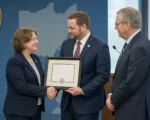
Athletes landed around 2 a.m. and received an immediate warm reception. Union Minister for Youth Affairs and Sports Mansukh Mandaviya later personally felicitated medalists from boxing, judo and para-athletics. Cash awards followed at once: Rs 30 lakh for gold, Rs 20 lakh for silver, Rs 10 lakh for bronze.
Since the athletes arrived yesterday around 2 am, I have never witnessed such a warm welcome at an airport. Sports Minister Mansukh Mandaviya personally welcomed the athletes today, and it was a truly special moment. I remember when I won a medal at the Paralympics in 2014, I had told the Prime Minister that athletes often had to wait four to five years to receive cash awards. The Prime Minister had said that when an athlete wins a medal, they should be able to go home to their parents with a cheque in their hands. Today, seeing athletes being honoured and receiving their rewards on time, I feel deeply grateful.
Jhajharia, a two-time Paralympic javelin champion himself, credited the Prime Minister and Mandaviya for ending the old lag. Dhankar’s own comments linked the recognition directly to motivation for longer careers.
The scale of the overnight awards matched the scale of the haul. Three gold payments at Rs 30 lakh, two silvers at Rs 20 lakh and two bronzes at Rs 10 lakh moved money to athletes within hours of wheels-down. Jhajharia’s memory of multi-year waits after the 2014 Paralympics set the contrast. The policy shift he described, from delayed files to cheques in hand, became visible on the same day the team returned.
Public posts amplified the shift. One high-engagement clip quoted her saying she had fulfilled her mother’s dream and now aimed at Los Angeles and Asian Games gold. Another captured the national anthem moment and her hope that children would draw inspiration.