Arizona State University has hosted Hollywood film crews since 1962, and this year the state backing that habit is worth up to $125 million a year. The money comes from a refundable Arizona tax credit built to keep film and television productions coming, and a university that once counted itself lucky to land a Jerry Lewis comedy now runs its own LED soundstage and a three-city film school built for the industry it used to just host.
The wager is not finished. A Phoenix-based watchdog group is fighting that tax credit in court, arguing Arizona’s constitution bars the state from handing public money to private film studios. The case is now with the Arizona Court of Appeals, and nobody has said when it will rule.
A Six-Decade Run of Cameos
Jerry Lewis brought an 80-person crew to the Tempe campus in November 1962, filming classroom and lab scenes for “The Nutty Professor” at Discovery Hall and the Matthews Center library. Paramount paid about 150 ASU students $10 a day to fill the frame as extras.
More than a dozen productions followed over the next six decades, turning Mountain America Stadium (known as Sun Devil Stadium for most of that run) into everything from a rock arena to a fictional Cardinals playoff site.
| Production (Year) | ASU Setting | Defining Detail |
|---|---|---|
| “The Nutty Professor” (1963) | Discovery Hall, Matthews Center library | 150 student extras paid $10 a day |
| “A Star Is Born” (1976) | Sun Devil Stadium, ASU Gammage | 43,000 fans paid $3.50 to double as concert extras; soundtrack hit No. 1 for six weeks |
| “Used Cars” (1980) | Mesa, Scottsdale, Tempe, Sun Devil Stadium | Robert Zemeckis directed on an $8 million budget; extras earned $25 a day |
| “Let’s Spend the Night Together” (1983) | Sun Devil Stadium | Rolling Stones concert film from a tour that grossed about $50 million |
| “Raising Arizona” (1987) | Tempe, Phoenix, Scottsdale, Carefree | Coen brothers shot it for $2.5 million after pitching it to Tempe’s council as wholesome family entertainment |
| “U2: Rattle and Hum” (1988) | Sun Devil Stadium | $5 tickets drew 60,000 fans, mostly ASU students, over two nights |
| “Jerry Maguire” (1996) | Sun Devil Stadium | Grossed nearly $275 million; Cuba Gooding Jr. won the Best Supporting Actor Oscar |
| “The Kingdom” (2007) | ASU Polytechnic campus | Universal built a full dormitory complex set on a $70 million budget |
| “Car Dogs” and “Postmarked” (2016) | Off campus, ASU crews | 85 and 30-plus ASU students interned on the two indie features |
By the time “Postmarked” wrapped in 2016, ASU had stopped treating a film crew on campus as a novelty. What it did not yet have was a facility built to run productions instead of just hosting them.
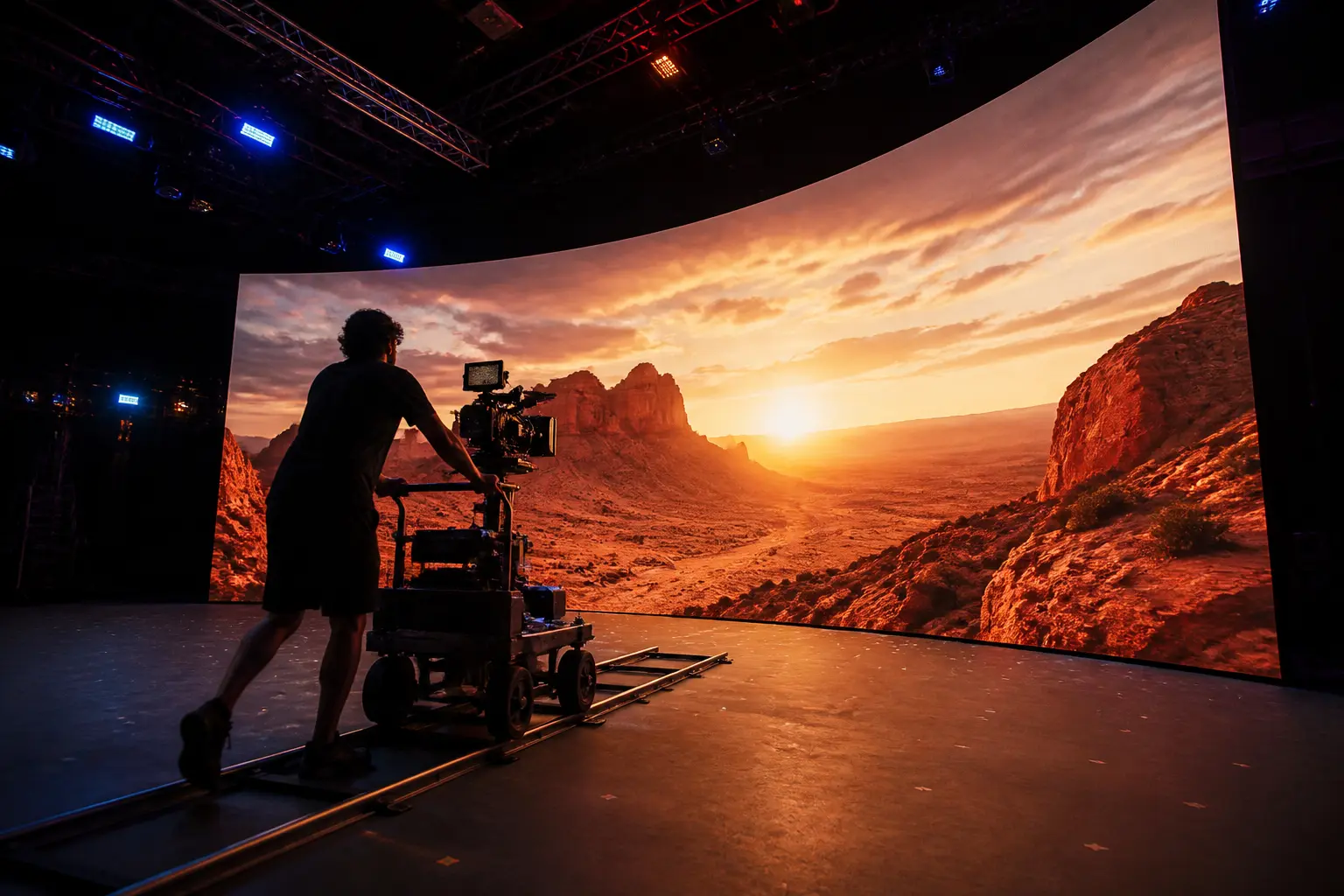
Mesa’s Curved Wall Replaces the Backlot
That changed in fall 2022, when ASU opened the Media and Immersive eXperience Center, a 118,000-square-foot building in downtown Mesa, seven miles from the Tempe campus. Inside sits the Volume, a virtual production LED stage with a 30-foot curved wall and a 15-foot deep LED floor, running on Unreal Engine alongside Disguise and Pixera media servers with real-time camera tracking.
Our connection to the film industry isn’t just part of ASU’s history, it’s part of our future.
Calvin Jude Stanley, the MIX Center’s video systems technical director, said students on the Volume learn more than software. They learn “what it takes to plan, collaborate and shoot in a professional environment,” he said, preparing them to be the storytellers who “define the next era of filmmaking.”
Arizona Puts $125 Million a Year on the Table
The Volume did not appear in a vacuum. Arizona’s Motion Picture Production Program has offered a refundable tax credit since January 1, 2023, run by the Arizona Commerce Authority for productions that shoot more than half their project in the state at an approved facility or location.
- 15 to 20 percent base refundable credits on qualified production spending, scaled to how much a project spends in Arizona
- Plus 2.5 percent for wages paid to Arizona resident crew, pushing the richest deals to 22.5 percent
- $250,000 minimum in-state spend required to qualify
- $125 million yearly cap on how much the state will refund productions, allocated first come, first served
Arizona’s legislature wrote the rates and the cap into the state’s motion picture tax credit statute, which is what a Phoenix-based watchdog group is now trying to unwind.
A Watchdog Calls It an Unconstitutional Gift
The Goldwater Institute, a Phoenix-based libertarian policy and litigation group, sued in Maricopa County Superior Court to block the credit. Its argument rests on the state constitution’s gift clause, which the group says bars government from handing public money to private companies without a direct public benefit in return. Because the credit is refundable, Goldwater argues, a production could collect more from the state than it owed in taxes, turning a tax break into a cash payment funded by other taxpayers.
- Jan. 15, 2025: Goldwater Institute files suit in Maricopa County Superior Court seeking to void the film tax credit.
- Nov. 17, 2025: A trial judge rules the credits legal, rejecting Goldwater’s gift clause challenge.
- May 27, 2026: Goldwater Institute presses its unconstitutional subsidies challenge at the Arizona Court of Appeals.
No hearing date has been set. Until the appeals court rules, the credit stays in effect, and so does every dollar of the $125 million cap.
Poitier’s Film School Trains the Next Crews
ASU named its film program the Sidney Poitier New American Film School in 2021, honoring the actor and director. The school enrolled close to 700 students at launch, with plans to roughly double that within a few years, and now runs across three sites: Tempe, the MIX Center in Mesa, and a renovated Herald Examiner building in downtown Los Angeles.
The school has stitched itself into the industry it studies. Students get access to the film school’s degree program list spanning both coasts, plus a set of working partnerships.
- Dreamscape Immersive – a virtual reality production company giving students access to VR filmmaking tools
- Los Angeles Center Studios – a 20-acre production lot used in more than 4,000 productions, opened to ASU students in spring 2024
- John Hughes Institute – an industry partnership exposing students to working screenwriters and producers
None of that infrastructure shows up on screen the way Sun Devil Stadium did in “Jerry Maguire.” It shows up in whether Arizona has a trained crew base when a production takes the tax credit and shows up to shoot.
Does Arizona’s Film Bet Pay Off?
Arizona won’t know for certain until the Court of Appeals rules on Goldwater’s challenge, and no timeline exists for that decision. If the credit survives, ASU’s Volume stage and film school inherit a state-funded stream of productions to train against and work for. If the court strikes it down, Arizona loses the financial edge that has separated the last four years from the prior six decades of one-off cameos.
The physical bet does not disappear either way. The MIX Center is built, the Volume is running, and the film school already spans three cities. What is still undecided is whether the state keeps paying to fill that building’s calendar.
For now, the cameras Arizona pays to attract are still rolling, and the Court of Appeals has not set a date to hear the state’s case.
Frequently Asked Questions
What Was the First Hollywood Movie Filmed at ASU?
“The Nutty Professor,” Jerry Lewis’s 1963 comedy, holds that distinction. Lewis Productions and Paramount filmed classroom and laboratory scenes at Discovery Hall and the Matthews Center library over three days in November 1962, years before any of ASU’s other credits.
How Is ASU’s Volume Stage Different From a Green Screen?
A green screen is a blank backdrop that gets replaced with digital imagery after filming. The Volume’s curved LED wall displays a rendered background in real time during the shoot, so actors and camera operators see and react to actual light and imagery on set instead of imagining it against a blank fabric wall.
What Is Arizona’s Constitutional Gift Clause?
It’s a provision in the Arizona Constitution that bars state and local governments from giving public money or credit to private businesses unless the public receives a direct benefit in return. It sits at the center of the Goldwater Institute’s suit against the film tax credit.
Can Outside Filmmakers Rent ASU’s Volume Stage?
Yes. Since May 2025, ASU has opened the stage’s new community rental program to outside projects, including immersive art installations, music videos, commercials and independent films. It is one of only two virtual-production facilities in the state.
Why Is ASU’s Film School Named After Sidney Poitier?
ASU chose the name in 2021 to honor Poitier, who in 1964 became the first Black actor to win the Academy Award for Best Actor. The school he lent his name to now enrolls students across Tempe, Mesa and Los Angeles.