Amazon’s business-to-business marketplace crossed $60 billion in annualized gross sales in the second quarter, the company said Tuesday. AMZN shares slipped about 0.75% anyway. Amazon Business now counts more than 11 million organizations as customers across 11 countries, including 97 of the Fortune 100, and has delivered more than 500 million orders so far this year.
The gap between that number and the stock reaction is not a coincidence. Amazon reports the $60 billion as gross sales volume, a figure with no line item on its income statement, which leaves Wall Street with nothing concrete to price even though the underlying business keeps getting bigger.
Eleven Million Organizations, One $60 Billion Marketplace
More than 1.8 million new organizations joined Amazon Business in the first half of 2026, on top of a base that already spans hospitals, schools, factories and hotels. Named customers cited in the announcement include Citi, the United Service Organizations, Marriott International and Carnival Corporation, whose logistics team has credited the platform with cutting the time spent on routine procurement.
The product catalog grew by nearly 30% worldwide this year. New categories include repair equipment, fresh groceries and office furniture, and Amazon says most of the added grocery inventory comes from third party sellers rather than its own warehouses.
Discounts built specifically for business accounts saved customers more than $1 billion worldwide in 2025. Prime Business members separately saved more than $880 million on shipping the same year, on top of everyday pricing that starts at quantity discounts of just two units of the same item.
Shelley Salomon, worldwide vice president of Amazon Business, said organizations trust the platform for its “vast selection, everyday value, and fast, reliable delivery,” and that the trust shows up in its growth. “As organizations look to do more with less, we’re inventing new ways to help them save time and money, and reinvest in growing their business,” she said.
Gross Merchandise Value Is Not Amazon’s Revenue
Amazon calls the $60 billion a figure for “annualized gross sales,” shorthand for gross merchandise value, or GMV, the total dollar amount spent through the marketplace before Amazon takes any cut. Trade publication Modern Distribution Management put the distinction plainly: gross sales “measures the total value of purchases transacted through the marketplace and should not be interpreted as Amazon Business revenue.”
Amazon reports its results in three public segments: North America retail, International retail and Amazon Web Services. Amazon Business revenue is folded into the first two, blended with everything else Amazon sells to consumers, with no separate disclosure of what the unit actually contributes to profit.
Neil Saunders, managing director at GlobalData Retail, has pointed to the same pattern for years when asked about Amazon’s approach to disclosing this business.
They really don’t want people dissecting their business.
Saunders, speaking to trade outlet Modern Retail, said that regardless of the limited disclosure, the marketplace keeps taking share, which is why he considers it one of Amazon’s stronger growth engines.
Who Loses When Amazon Business Keeps Growing?
W.W. Grainger and Fastenal, the two largest publicly traded industrial distributors, are the clearest answer. Both compete directly with Amazon Business for maintenance, repair and office supply spending, and both are now growing slower than the marketplace eating into their addressable market.
Grainger reported $17.9 billion in total 2025 revenue, up 4.5%, according to its annual report filed with securities regulators. Its legacy High-Touch Solutions division, the relationship-driven side of the business that most resembles a traditional distributor, grew just 2.0%. Its lower-touch Endless Assortment unit, closer in spirit to a pure online marketplace, grew 15.7%, a sign that even Grainger’s own growth is drifting toward the model Amazon popularized.
Grainger’s flagship North American business, despite more than $14 billion in sales, holds only a high single digit market share in a fragmented MRO distribution market, Morningstar’s own research found, leaving plenty of room for a bigger rival to keep gaining ground.
Fastenal, the Minnesota based fastener and industrial supply distributor, posted $2.39 billion in net sales for the second quarter, up 14.7% year over year, according to trade outlet Industrial Distribution. That is solid growth by industrial standards. It is a rounding error next to Amazon Business’s pace.
| Company | Latest Reported Sales | Growth Signal |
|---|---|---|
| Amazon Business | $60 billion annualized gross sales (Q2 2026) | Up about 71% from roughly $35 billion in 2023 |
| W.W. Grainger | $17.9 billion total revenue (fiscal 2025) | Total sales up 4.5%; core High-Touch unit up just 2.0% |
| Fastenal | $2.39 billion net sales (Q2 2026) | Up 14.7% year over year |
Grainger alone still generated $2.0 billion in operating cash flow last year and returned $1.5 billion to shareholders, hardly a company on the ropes. But the trend line is hard to miss. A marketplace growing in the tens of billions is now expanding against distributors growing in the low to high single digits, and Amazon has already pushed into territory once reserved for specialized distributors, launching a vendor managed inventory service in 2024 that sends its own technicians to restock supplies at customer sites.
Amazon Adds AI Tools, Trucks and Software Perks to the Pitch
Amazon has leaned on new technology to keep the growth curve climbing. AI powered tools now help business accounts track spending, flag unusual transactions and surface savings opportunities in real time, features Amazon rolled out over the past year.
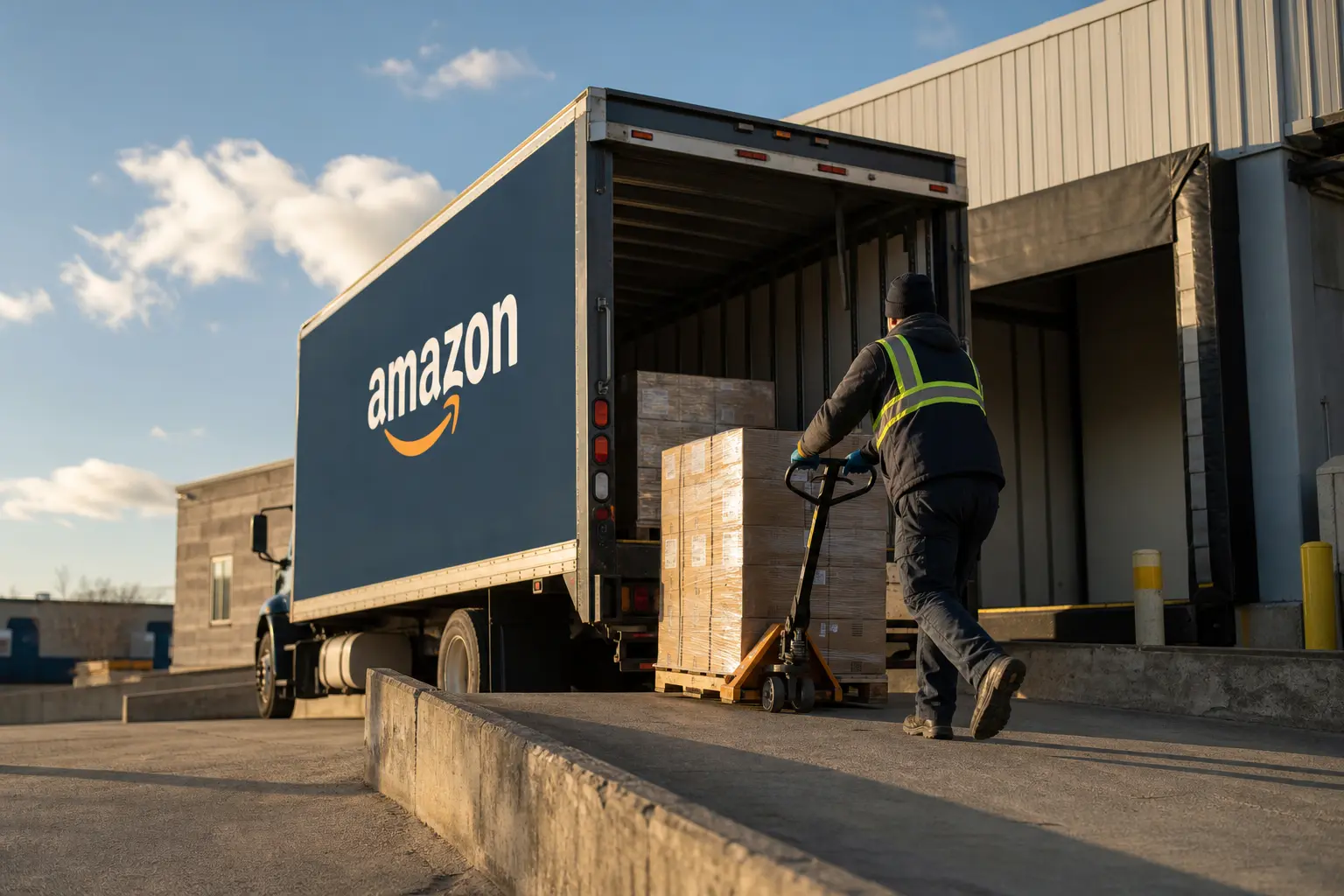
On delivery, Amazon runs dedicated commercial fleets across 13 U.S. states using compressed natural gas trucks built specifically for business orders. The vehicles handle scheduled delivery appointments and palletized freight dropped directly at loading docks and receiving areas, a different operational setup than the vans dropping packages on residential porches.
Prime Business membership picked up new software partnerships this year, too.
- CrowdStrike – discounted cybersecurity coverage for small and mid-sized business accounts.
- Gusto – preferential pricing on payroll and HR administration tools.
- QuickBooks – procurement and accounting software bundled into the membership.
Combined, Amazon estimates those software deals can save a small or mid-sized business up to $1,100 a year, on top of a newly discounted Amazon Quick access built into the enhanced membership tier.
From a Quiet 2012 Launch to a $60 Billion Run Rate
Amazon Business did not start as a headline growth story. It traces back to a low profile 2012 launch called AmazonSupply, an online storefront for industrial, scientific and commercial products that most shoppers never noticed.
- 2012: Amazon quietly launches AmazonSupply, an early storefront for industrial, scientific and commercial products.
- 2015: Amazon retires that brand and relaunches the marketplace in the U.S. as Amazon Business, adding approval workflows and multi user accounts.
- 2020: The unit reports $25 billion in annualized gross sales, more than half of it from third party sellers.
- 2023: CEO Andy Jassy’s shareholder letter puts the figure at roughly $35 billion, with about 6 million organizations buying through the platform.
- August 2025: Amazon Business marks a decade of operation serving more than 8 million organizations worldwide.
- Q2 2026: Annualized gross sales cross $60 billion across more than 11 million organizations in 11 countries.
That is a jump of roughly $25 billion in about three years. Bloomberg pegged the increase at about 71% from the 2023 figure, a faster climb than the one from $25 billion to $35 billion that came before it.
The Real Test Lands July 30
Amazon’s own earnings, due July 30 after markets close, will be the real test of investor appetite this summer. Wall Street models roughly $196 billion in revenue and $1.82 in per share earnings for the quarter, helped by Prime Day’s shift into the April to June window, continued acceleration at AWS and a record advertising business, the lines analysts actually build price targets around.
Amazon is not the only megacap reporting that week. Apple posts its own fiscal third quarter results the same day, part of a stretch where Wall Street braces for a big tech earnings storm while Asian markets climb into it. Big tech names have a habit of wobbling into results regardless of the underlying numbers, which is exactly why some investors have grown wary of buying Microsoft stock before earnings in years past.
Whatever Amazon Business adds between now and then gets folded into North America and International again, off the scoreboard investors actually watch.
Frequently Asked Questions
What Is Amazon Business Used For?
Hospitals, schools, factories, hotels and other organizations use Amazon Business to buy everyday and specialized supplies at business only pricing, with quantity discounts available starting at just two units of the same item.
How Much of Amazon Business’s Sales Come From Third Party Sellers?
More than half, and the share has been rising for years, according to Amazon’s own past disclosures. Much of the new grocery and fresh food inventory the platform added this year also comes from third party merchants rather than Amazon’s own warehouses.
Which Other Companies Compete With Amazon Business?
W.W. Grainger and Fastenal are the largest publicly traded rivals in industrial and MRO supply, alongside MSC Industrial. Analysts covering all three have flagged Amazon Business as a source of pricing and fulfillment pressure across the sector.
When Does Amazon Report Second Quarter 2026 Earnings?
Amazon is scheduled to report full second quarter results on July 30, 2026, after markets close. Consensus estimates call for about $196 billion in revenue and $1.82 in earnings per share.
What Is Prime Business Rewards?
Launched in the United States in 2024, Prime Business Rewards lets members earn points on eligible purchases and account actions, then redeem those points as a payment method at checkout.
Disclaimer: This article is for informational purposes only and does not constitute investment advice. Stock prices and company figures are accurate as of publication and can change quickly, so consult a licensed financial professional before making investment decisions.