Spain beat Argentina 1-0 in extra time on Sunday to win the 2026 World Cup. Ferran Torres, on as a substitute, scored the only goal in the 106th minute at MetLife Stadium in East Rutherford, New Jersey, sending a 10-man Argentina team home without the repeat title it wanted.
The number that will outlast the score line belongs to the Spanish federation. The win made Spain the first country in history to hold the men’s and women’s World Cup titles at the same time, a distinction no Golden Ball vote or farewell tour can touch.
Ferran Torres Ends It in the 106th Minute
Enzo Fernández saw red in the third minute of stoppage time, leaving Argentina to play the last stretch of regulation and all of extra time with 10 men. The additional 30 minutes settled into the grind everyone expected from two exhausted sides. Then, 39 seconds into the second period of extra time, substitute Nico Williams slipped a pass to fellow substitute Torres, who finished from close range.
Argentina never found a rhythm. Lionel Messi’s team did not manage a shot of any kind until deep into extra time, while goalkeeper Emiliano Martínez made save after save at the other end just to keep the score at nothing.
- 20 shots to 2, Spain’s total attempts on goal against Argentina’s, with 12 on target to zero.
- 60 percent to 32, the possession split that turned the final into a training-ground scrimmage for long stretches.
- 11 saves from Martínez, the most by any goalkeeper in a World Cup final, in a losing effort.
- 90+3, the minute Fernández was sent off for a challenge on Pau Cubarsí.
Torres and Williams had both started the tournament as squad depth. By the final whistle, Spain’s manager, Luis de la Fuente, had used his bench to settle a match his starters could not finish. Argentina’s manager, Lionel Scaloni, stepped in afterward to break up a shoving match between players from both sides, a sour end to a night his team never controlled.
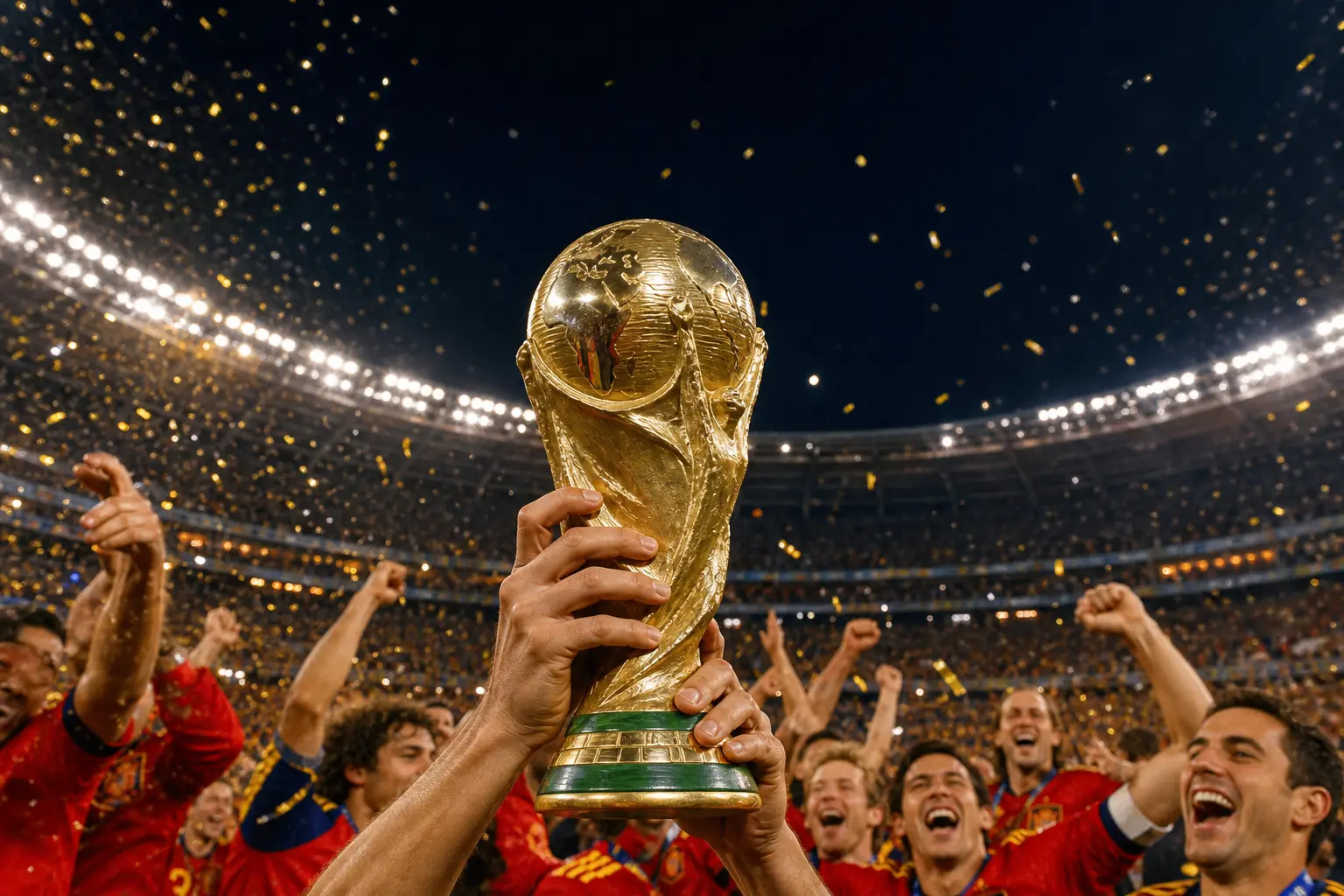
Spain Now Holds Both Trophies at Once
Only two countries have ever won both the men’s and women’s World Cup: Germany and Spain. Germany did it at separate points, decades apart. Spain is the first to hold both trophies on the same calendar day, a fact FIFA’s own channels highlighted within minutes of the final whistle.
That run traces back to a single first-half strike in Sydney. Olga Carmona beat England goalkeeper Mary Earps with a first-half goal in the 2023 final to give Spain its first Women’s World Cup, a title the team still holds heading into next year’s tournament in Brazil. Three years later, the men followed with a second men’s title of their own.
Five countries have won the Women’s World Cup since it began in 1991: the United States, Germany, Norway, Japan and Spain. Only Germany and Spain managed the double at all, and neither had ever carried both crowns in the same window until this weekend.
The Federation That Almost Lost the Plot
The depth on display this weekend wasn’t some tidy, inevitable outcome of smart planning. Spain’s women’s program spent years under coach Ignacio Quereda, whose leadership dating back to 1988 drew repeated accusations from players that the Royal Spanish Football Federation simply didn’t care about the women’s side.
Then came the moment that nearly swallowed the 2023 title whole. After that Sydney final, federation president Luis Rubiales forcibly kissed forward Jenni Hermoso on the podium, an incident that triggered a player revolt and calls for both Rubiales and then-coach Jorge Vilda to go. Members of the men’s squad, including striker Borja Iglesias, publicly refused to play for the federation until Rubiales was removed.
That history matters because it complicates the easy version of this weekend’s story. Spain’s double didn’t happen because a federation quietly bankrolled two genders equally for twenty years. It happened because a generation of players, coaches and academy staff kept producing talent faster than the people running the sport could get out of its way.
Rodri Beats Messi to the Golden Ball
Individual honors from the tournament read like a scouting report on Spanish depth across two generations. Rodri, already the reigning 2024 Ballon d’Or winner, took the adidas Golden Ball as the tournament’s best overall player, an award Messi had won twice before and hoped to claim a third time in his likely final World Cup.
| Award | Winner | Detail |
|---|---|---|
| Golden Ball | Rodri | Reigning Ballon d’Or winner, anchored Spain’s midfield |
| Golden Boot | Kylian Mbappe | Top scorer despite France’s semifinal exit to Spain |
| Golden Glove | Unai Simón | Spain conceded once across seven matches |
| Young Player Award | Pau Cubarsí | 19-year-old center back, first World Cup appearance |
Before the tournament, betting markets and outlets like pre-tournament Golden Ball rankings favored Messi, Kylian Mbappe and teenage winger Lamine Yamal. A defensive midfielder who rarely scores winning the award instead says something about how Spain actually wins games.
Cubarsí and Yamal, both teenagers, started the final together. FIFA noted before kickoff that only a handful of players have started and won a World Cup final as teenagers, a list that previously included Pelé and Mbappe himself. Both Barcelona academy products now belong to it too.
A Decade and a Half in the Making
None of this arrived overnight. Spain’s current run sits on top of a title cycle that first showed up sixteen years ago and has now repeated itself across both national teams.
- 2010: Spain beats the Netherlands in Johannesburg for its first men’s World Cup.
- 2012: Spain adds the European Championship to complete its first international treble.
- 2023: Spain’s women win their first World Cup, beating England 1-0 in Sydney.
- 2024: Spain beats England 2-1 in Berlin for a record fourth European men’s title.
- 2026: Spain beats Argentina in extra time for a second men’s World Cup, and its first concurrent hold of both global trophies.
Mikel Oyarzabal is the thread running through the men’s side of that timeline. He scored the winner off the bench in the 2024 Euro final, then finished as Spain’s top scorer at this World Cup before de la Fuente substituted him in the 62nd minute of Sunday’s final.
These players have made history and they still have a long way to go.
De la Fuente said that after the 2024 Euro final in Berlin. Two years later, at MetLife Stadium, the same core of players proved him right again.
What’s Next for Messi and Argentina?
Messi has said this was his last World Cup, and he will be 43 by the time the 2030 tournament kicks off, effectively ruling him out. He said the same thing about the 2022 tournament in Qatar and still played in 2026, so a farewell appearance at the 2028 Copa América isn’t out of the question.
Argentina came into the final trying to become the first team to win four straight major tournaments, having taken the 2021 and 2024 Copa América titles around its 2022 World Cup win. That bid ended with the loss to Spain, and by one count, Messi still finished the tournament with a hand in 12 goals, more individual output than the player who beat him to the Golden Ball.
Argentina’s coaching situation looks unsettled too. Fox Sports reported that Lionel Scaloni hinted at stepping away from the national team after the final, though nothing has been confirmed by the Argentine federation. Whoever takes over inherits a squad built almost entirely around a 39-year-old who has now said goodbye to the World Cup stage twice.
Frequently Asked Questions
How much prize money did Spain earn for winning the 2026 World Cup? FIFA set the winner’s purse at $51 million for this tournament, with $34 million going to runner-up Argentina, out of an $871 million total pool shared among all 48 participating teams.
Could Lionel Messi still play for Argentina again? He has ruled out the 2030 World Cup, when he’ll be 43, but has not closed the door on the 2028 Copa América. He also called 2022 his final World Cup before playing in 2026, so any retirement claim from him carries some history of being revised.
Did Lionel Scaloni step down as Argentina’s head coach? Not officially. Fox Sports reported he hinted at a possible exit after the final whistle, but Argentina’s federation had not announced any coaching change as of publication.
When and where is the next World Cup? FIFA has already awarded the 2030 tournament jointly to Spain, Portugal and Morocco, with three centenary matches also set for Uruguay, Argentina and Paraguay. Spain would get a chance to defend its title on home soil.