IBM shares fell roughly 25% on July 14, 2026, the worst single trading day in the company’s history. A preliminary revenue warning did the damage: $17.2 billion for the second quarter, missing Wall Street’s $17.86 billion estimate. Chief Executive Arvind Krishna’s explanation was simple. Corporate clients had stopped buying what IBM sells.
The panic reads like a fresh AI story. It is actually an old one. IBM spent 2014 and 2015 selling off the exact hardware businesses, x86 servers and chip manufacturing, that enterprise clients are now scrambling to fund. That choice, made for entirely different reasons a decade ago, is a big part of why IBM has no seat at the table during the largest infrastructure spending wave in tech history.
IBM’s Worst Trading Day Since Records Began
The trigger arrived before dawn on July 14, in a letter detailing a $660 million revenue miss that Krishna posted to the SEC. Second-quarter revenue would land at $17.2 billion, up just 1% year over year, against a consensus near $17.86 billion. Adjusted earnings of $2.93 a share missed the $3.01 analysts expected, according to FactSet data cited by CNBC.
Krishna told investors clients had reprioritized spending in the final weeks of June, redirecting money from IBM’s software and infrastructure lines toward their own servers, storage and memory chips. He said the company simply “faltered” as that shift hit late in the quarter.
The segment detail explains why the market reacted so violently. Software revenue actually rose 5%. Consulting was flat, up 1% at constant currency. Infrastructure, the hardware and systems business, fell 7%. Large deals investors expected to close in the quarter did not materialize.
It was the worst single session in IBM’s recorded trading history, with data tracked back to 1968, surpassing the 23.7% drop logged on October 19, 1987. HSBC responded by cutting its rating on the stock to Reduce, with a price target of $191.
| Date | One Day Move | Trigger | Market Impact |
|---|---|---|---|
| October 19, 1987 | Down 23.7% | Black Monday market crash | Previous record for IBM’s steepest single session drop |
| February 23, 2026 | Down 13.2% | Anthropic’s Claude Code COBOL tool | About $31 billion in market value erased |
| July 14, 2026 | Down about 25% | Q2 revenue guidance miss | New all time worst single session drop |
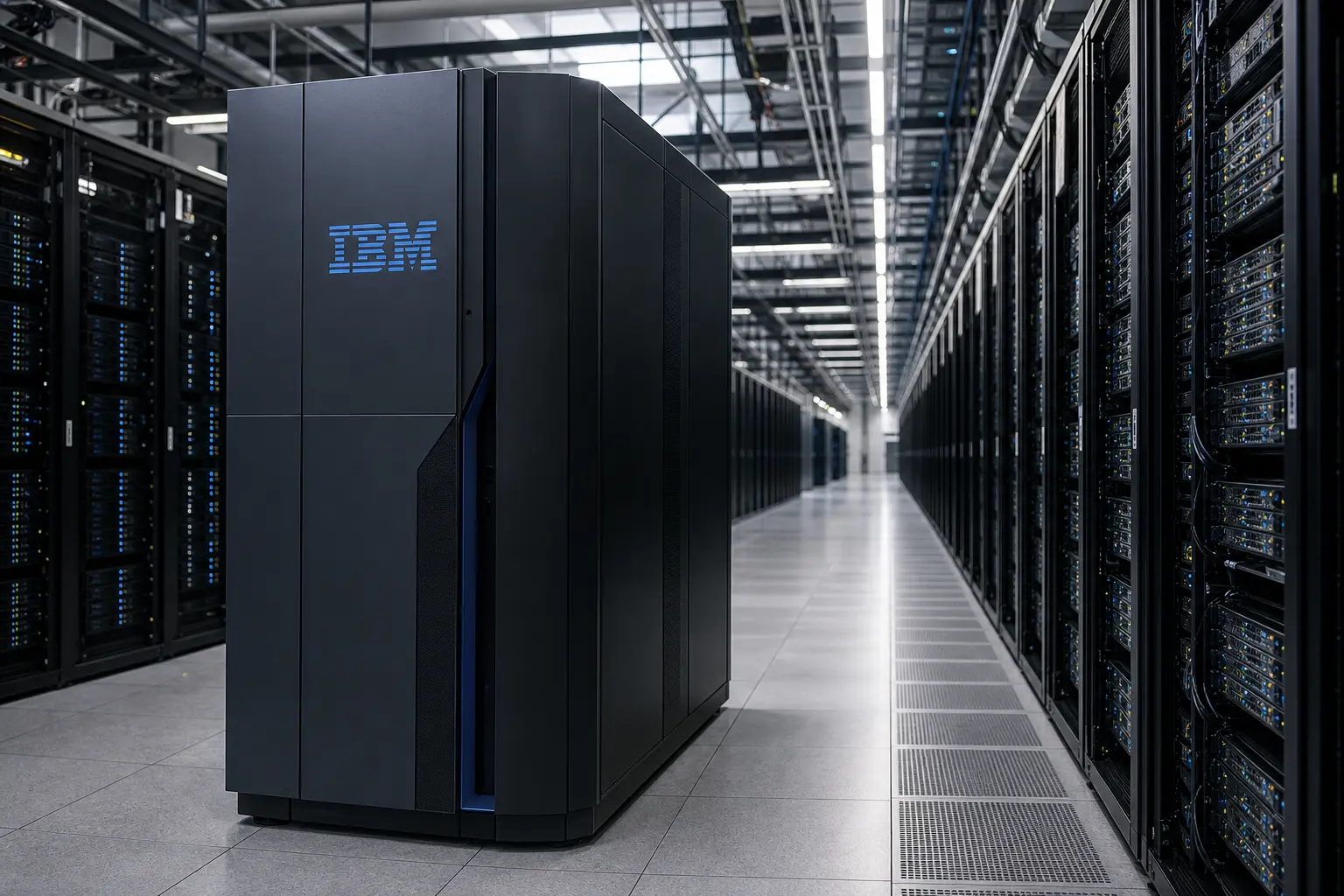
The 2014 Bet That Set Up the Squeeze
IBM’s exit from computer hardware did not happen by accident. In January 2014, IBM agreed to sell its x86 server line, System x, BladeCenter and the rest, to Lenovo for $2.1 billion, a deal that completed its x86 server sale to Lenovo that October.
IBM said the divestment would let it focus on “system and software innovations that bring new kinds of value to IBM clients,” pivoting toward cognitive computing, big data and cloud instead of commodity boxes. A year later, IBM went further and paid GlobalFoundries $1.5 billion to exit chipmaking, handing over its own semiconductor plants entirely.
Trade press at the time called it one of the divesting moods IBM periodically gets into. Twelve years later, the categories it walked away from, servers, memory and chips, are exactly what its clients are buying instead of IBM’s software and infrastructure lines, by Krishna’s own account of the Q2 shortfall.
The full arc, laid out by date, shows how directly the past connects to July 14:
- January 2014: IBM agrees to sell its x86 server business to Lenovo for $2.1 billion.
- October 2014: IBM pays GlobalFoundries $1.5 billion to take over its chip manufacturing plants.
- 2021: IBM introduces the Telum processor, its first mainframe chip with a built in AI accelerator.
- October 27, 2025: IBM launches Digital Asset Haven with Dfns for institutional crypto custody.
- October 28, 2025: The Spyre Accelerator becomes generally available for IBM z17 mainframes.
- February 23, 2026: Anthropic’s Claude Code COBOL tool triggers a 13.2% one day IBM stock drop.
- July 14, 2026: A Q2 revenue miss triggers a 25% crash, the worst single session in company history.
COBOL’s Consultants Meet Their Replacement
Five months before the July crash, IBM got a preview of what AI disruption looks like up close. On February 23, 2026, its shares dropped 13.2%, closing at $223.35, after Anthropic said its Claude Code tool could automate the hardest parts of COBOL modernization. The move erased about $31 billion in market value in a single session.
COBOL, short for Common Business Oriented Language, dates to the late 1950s and still runs an estimated 95% of ATM transactions in the United States, along with large parts of banking, insurance and government computing.
“Hundreds of billions of lines of COBOL run in production every day, powering critical systems in finance, airlines, and government,” Anthropic wrote in the blog post announcing the tool.
The company added that the pool of engineers who understand the language shrinks every year, and that “AI excels at streamlining the tasks that once made COBOL modernization cost-prohibitive.” Claude Code, Anthropic said, could map dependencies and document workflows across old codebases, work that once required teams of consultants billing by the hour. That work has long been one of IBM’s most dependable revenue streams.
Why Did Accenture and Cognizant Fall Too?
IBM was not alone on July 14. Shares of ServiceNow, Salesforce, Accenture and Cognizant Technology Solutions all fell the same day, because investors read IBM’s warning as evidence that AI budget pressure is hitting the whole enterprise software and consulting industry, not one company.
- ServiceNow, the workflow software vendor, dropped nearly 7%
- Salesforce, the customer relationship management giant, fell about 5%
- Accenture, the consulting firm, slid 8%
- Cognizant Technology Solutions, an IT services provider, fell 7%
GuruFocus reported those declines the same afternoon IBM’s warning hit the wires. Each of those companies shares a piece of IBM’s model: subscription software, consulting labor, or both, competing for budget that clients are now steering toward AI hardware instead.
IBM’s Other AI Bet
IBM is not without an AI hardware story of its own. Its mainframes, which by carry roughly 70% of world transactions by value, now ship with the Telum II processor and an optional Spyre Accelerator built for large language model inference.
The Spyre Accelerator reached general availability for IBM z17 systems on October 28, 2025. Together, the chips can process up to 450 billion inference operations a day for tasks like real time credit card fraud detection.
Steven Dickens, chief technology advisor at the research firm The Futurum Group, called the work “just about as innovative and important as it gets for enterprise customers.”
But Spyre and Telum II run inference on data that never leaves an existing IBM Z system. That is a different wager than the one enterprises made in June. Spyre serves customers who already run IBM Z. It was not built to capture the broader shift toward general purpose AI servers and memory, the exact category Krishna said clients funded instead of IBM last quarter.
The Blockchain Pitch Lands at an Awkward Moment
IBM’s other forward looking bet sits in crypto custody. On October 27, 2025, IBM launched Digital Asset Haven, built with wallet infrastructure firm Dfns, giving institutions a way to manage custody, transactions and settlement across a platform spanning more than 40 blockchains.
Tom McPherson, general manager of IBM Z and LinuxONE, said the platform gives clients “the opportunity to enter and expand into the digital asset space backed by IBM’s level of security and reliability.” Clarisse Hagège, chief executive of Dfns, said the two companies built something that “goes beyond custody to orchestrate the full digital asset ecosystem.”
The pitch targets real demand. Traditional banks are moving assets on chain and need compliance tools built for regulators, not crypto natives. But Digital Asset Haven is nowhere near generating revenue that offsets a $660 million quarterly miss, and IBM is selling a forward looking blockchain and AI story to investors at the exact moment its core business is shrinking in full view.
The Bill Comes Due July 22
IBM is scheduled to report full second-quarter results and hold an earnings call on July 22, 2026, eight days after the preliminary warning. The company cautioned that final figures could still differ slightly once the quarter fully closes.
The cash flow math raises the stakes. IBM’s prior guidance implied roughly $15.73 billion in free cash flow for 2026, about $1 billion more than 2025 delivered. Hitting that number now requires close to $10.97 billion in the second half, roughly 10% more than IBM generated in the same stretch a year earlier, based on one analysis of the preliminary figures.
Whatever the July 22 numbers show, they will be measured against a stock that lost a quarter of its value in a single afternoon, the worst day IBM has logged since Wall Street started keeping score.
Frequently Asked Questions
Did IBM Stock Recover After the February 2026 Selloff?
Partially. The day after the 13.2% drop, IBM shares rebounded 4.42% to $233.22. The stock still finished February down 27%, its worst month on record with data going back to 1968.
Is IBM’s Digital Asset Haven Platform Live Yet?
Yes. IBM Digital Asset Haven arrived as a SaaS and Hybrid SaaS product in the fourth quarter of 2025. A version built for clients running IBM Z or LinuxONE hardware on premises is planned for the second quarter of 2026.
Does IBM Make Its Own AI Chips?
Yes. The Spyre Accelerator carries 32 AI accelerator cores and up to 1 terabyte of memory on a single PCIe card, manufactured on a 5 nanometer process, and it plugs into IBM Z and Power11 systems.
How Big Was Dfns Before Partnering With IBM?
Dfns, the wallet infrastructure firm IBM built Digital Asset Haven with, had completed a $16 million Series A funding round in January 2025, led by Further Ventures, before the two companies announced their partnership.
What Other Companies Offer Blockchain Services Like IBM’s?
Oracle runs its own Blockchain Platform, Microsoft offers Azure Web3 solutions, and Amazon operates Managed Blockchain. IBM’s push into institutional crypto custody enters a market where every major cloud provider already competes.
Disclaimer: This article is for informational purposes only and is not investment advice. Stock and digital asset markets carry risk, and figures are accurate as of publication on July 20, 2026.