Coimbatore-headquartered LMW Ltd is accelerating investment in artificial intelligence and enterprise-wide digitisation to ride out a prolonged slowdown in its textile machinery business. (1) Chairman and Managing Director Sanjay Jayavarthanavelu set out the technology-first strategy in the company’s 2025-26 annual report, even as the flagship textile division posted another weak year. (2)
The annual report splits FY26 into two stories: a textile-machinery business weighed down by weak export demand, tariff uncertainty and cotton supply, and a machine tool division that the CMD now calls the company’s principal growth engine. (1)
The Numbers Behind a Split FY26
FY26 was a year of two divisions inside LMW Ltd. (1) The textile machinery division sold 1,902 machines and reported revenue of ₹1,675 crore. (2) Weak export demand, tariff uncertainty and cotton availability issues delayed fresh investments by spinning mills across India and the company’s export markets. (3) The annual report names each factor in its account of the year the textile business endured. (4) The result was a division that is no longer carrying the larger share of FY26 growth. (5)
The machine tool division sold 4,231 machines and generated ₹1,033 crore in revenue, operating at 70-75 per cent capacity utilisation. (1) The annual report calls it the principal growth engine of FY26. (2) Demand was pulled in from automotive, electronics manufacturing services (EMS), aerospace and defence buyers under the Atmanirbhar Bharat push. (3)
The foundry division reported ₹115 crore in revenue on sales of 5,593.7 tonnes. (1) Capacity utilisation was lower because of the textile slowdown, the annual report notes. (2) Operational efficiency improved through inventory rationalisation, energy optimisation and higher in-house production. (3) Foundry is the smallest of LMW’s three businesses by revenue, but it feeds the castings and heavy parts that go into the other two. (4)
| Division | FY26 machines sold | FY26 revenue | Output metric |
|---|---|---|---|
| Textile machinery | 1,902 | ₹1,675 crore | Not stated |
| Machine tool | 4,231 | ₹1,033 crore | 70-75% capacity utilisation |
| Foundry | Not stated | ₹115 crore | 5,593.7 tonnes sold |
AI Sits at the Centre of the Reset
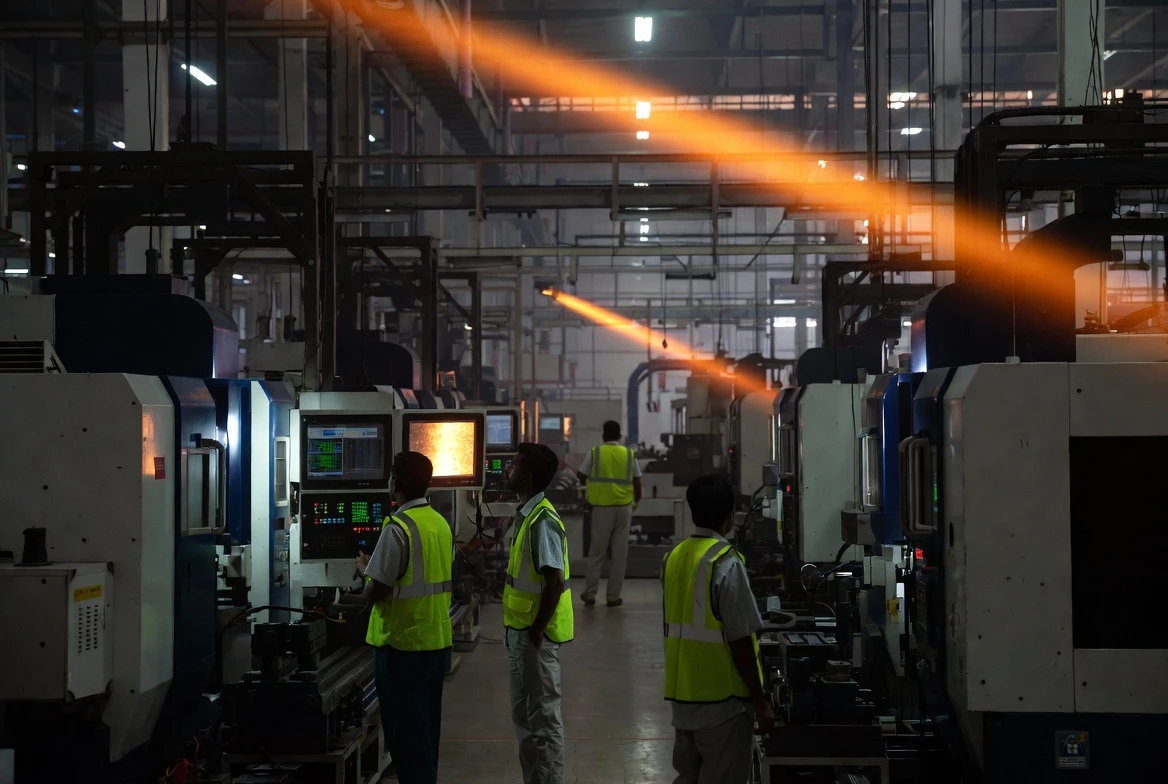
The CMD’s message in the 2025-26 annual report leaves little doubt about which lever LMW is pulling hardest. (1) “The industrial sector is undergoing a significant transformation, with a clear shift towards smart and adaptive machinery,” Jayavarthanavelu wrote. (2) “Equipment today must handle a wider range of materials while delivering consistent performance across varied specifications,” he added. (3)
LMW is integrating AI across its manufacturing operations and into its products and services. (1) The annual report frames LMW as a comprehensive solutions partner working closely with customers on operating parameters. (2) The shift repositions LMW from a machinery manufacturer to a solutions provider. (3) Close collaboration with customers is now framed as imperative for optimising outcomes on next-generation technology platforms. (4) LMW is deepening its technical engagements and enhancing customer integration, empowering clients to fully leverage the capabilities of those technologies. (5)
The machine tool division is the most visible site of the AI work, with plans to develop AI-enabled and IoT-connected tools. (1) Those new tools are meant to serve a wider set of end-markets than the current automotive-heavy base. (2) The annual report ties the AI push to a wider reorganisation that automates sales and operations planning, supply chain management, customer relationship management and human lifecycle management. (3) Technology, in the CMD’s framing, is the central plank of the transformation strategy. (4)
LMW is further reinforcing its established positioning as a comprehensive solutions partner, moving well beyond the traditional scope of a machinery manufacturer.
Chairman and Managing Director Sanjay Jayavarthanavelu set out the solutions-partner framing in the 2025-26 annual report published on June 29, 2026. (1) It is the clearest articulation yet of where LMW is putting its capex and its organisational energy. (2)
Four Functions the BPR Programme Is Rewriting
AI is not arriving in a vacuum at LMW. (1) The company has launched a comprehensive business process re-engineering (BPR) programme to redesign its core processes and improve organisational agility. (2) BPR, in the CMD’s framing, is a fundamental redesign of core processes to improve performance, eliminate redundancies and strengthen execution discipline. (3) The objective is to build a more agile, responsive and future-ready organisation. (4) The reorganisation runs alongside the AI push, with the BPR programme acting as the operating-model backbone for the new technology investments. (5)
The BPR effort is being applied across four key functions. (1) LMW has automated key processes across these areas to improve efficiency, visibility and decision-making. (2) A pipeline of additional automation initiatives is also advancing, with the goal of building a fully integrated, digitally enabled operating model. (3) The reorganisation is enterprise-wide, touching how LMW plans sales, manages supply, sells to customers and runs its workforce. (4)
- Sales and operations planning
- Supply chain management
- Customer relationship management
- Human lifecycle management
The Machine Tool Division Takes the Load
The annual report is explicit about which business is doing the heavy lifting in FY26. (1) The machine tool division is the principal growth engine offsetting weakness in textile machinery, with order books fed by demand from the automotive, electronics manufacturing services (EMS), aerospace and defence sectors. (2) Capacity utilisation of 70-75 per cent suggests there is room to grow on the current footprint. (3) Order momentum has held up better than in the textile business even as global conditions have soured. (4) The annual report credits the Atmanirbhar Bharat policy push for sustaining the demand base. (5)
The division has also flagged where it plans to grow next. (1) Management is targeting three new end-markets beyond automotive. (2) Each one is tied to a different policy tailwind. (3)
Product work is also under way on the AI and IoT side. (1) AI-enabled and IoT-connected machine tools are in development. (2) The addressable market for those tools is wider than the current automotive-heavy base. (3) The annual report frames the new product line as part of the same solutions-partner shift that runs through the rest of the LMW reset. (4)
- Mobile manufacturing
- Defence
- Locomotive
Why LMW Says the Bet Has To Land Now
The annual report frames FY26 as a year of geopolitical recalibration as much as operational reset. (1) The reduction in U.S. tariffs on select Indian textile and manufacturing exports has improved export competitiveness and encouraged capacity expansion at home. (2) LMW sees the move as part of a broader China Plus One reorientation of global supply chains. (3)
China experienced a relatively slower and uneven recovery during FY 2025-26, the annual report notes, marked by subdued domestic consumption, stress in the real estate sector and weakening export momentum. (1) That moderation has pushed global manufacturers to diversify sourcing and production bases, strengthening India’s relative position. (2) India’s manufacturing push, supply chain diversification and free trade agreements with key global partners are creating favourable conditions for long-term growth, the CMD said. (3) LMW is aligning its strategy to capture that flow. (4) The bet is that the combination of Atmanirbharta, free trade agreements and supply chain diversification will keep order books fed even as the textile machinery heartland faces weak export demand. (5)
The Foundry Carries Its Own Weight
The foundry division is the smallest of LMW’s three businesses but is being asked to carry more weight than its scale would suggest. (1) FY26 revenue came in at ₹115 crore on sales of 5,593.7 tonnes, with capacity utilisation lower because of the textile slowdown. (2) Inventory rationalisation, energy optimisation and higher in-house production improved operational efficiency through the year. (3)
Workforce and culture sit alongside technology and process in the CMD’s framing of the reset. (1) “Managing technological shifts and market pressures requires a skilled, agile and committed workforce,” Jayavarthanavelu wrote. (2) “Investing in our people will remain a strategic priority as our teams continue to sustain and advance the LMW brand.” (3) The annual report positions the workforce as the carrier of the AI push, central to delivery. (4)
The FY27 test is whether the AI bet and the machine tool diversification can keep delivering while the textile business waits for export demand, cotton supply and tariff clarity to converge. (1) LMW is recalibrating its global approach to remain resilient, relevant and well-positioned to capture emerging opportunities, the CMD said. (2) The annual report acknowledges that uncertainty has become a defining feature of the global order. (3) Fast-evolving geopolitical developments are reshaping competitive dynamics worldwide, it adds. (4) The textile machinery business is no longer the company LMW was built around, and the AI bet is shaping the next phase of growth. (5)
LMW’s 2025-26 annual report and CMD’s message to shareholders · AI transformation reframed as business redesign