Bob Zangrillo is reviving a $3 billion mixed-use development in Miami’s Little Haiti neighborhood, more than a decade after first announcing plans to build on the land. The technology investor, who runs the Miami-based private investment firm the official Magic City Innovation District site calls a purpose-built AI and innovation hub, told Bloomberg he sees the current moment as the right one to move. The pitch has changed since 2012, when Zangrillo first bought parcels in the neighborhood. What was once a generic tech-and-residential project is now being marketed as a campus for AI companies, asset managers and venture capital firms, the kind of tenants that did not exist as a Miami class a decade ago.
The obstacles have not changed. The project carries the weight of a 2019 federal indictment, a 2021 presidential pardon, and a years-long fight with community activists over gentrification. Zangrillo is betting that the arrival of Palantir Technologies, Apple’s Coral Gables office, and Amazon’s Wynwood expansion has finally made the case he was making in 2012: that Miami, not New York, is the next place where global technology and finance firms converge.
What the Magic City Innovation District Will Be
The Magic City Innovation District, as Zangrillo calls it, is sized to rival some of the largest master-planned projects in Miami-Dade County. It will cover 7.8 million square feet on an 18-acre site inside a 30-acre district that includes surrounding public parks, according to the project’s own master plan. The construction cost is expected to top $3 billion, up from the $1 billion figure attached to the project when it was approved in 2019. The site benefits from a Special Area Plan designation, a zoning tool that has been used for other large-scale Miami projects such as Brickell City Centre and Mana Wynwood, and from a federally designated Opportunity Zone tax break.
The first phase will include an AI-focused office campus anchored by Zangrillo’s Dragon Global and a 25-story residential tower with 349 rental apartments. Anthony Orso, president of capital markets strategies at brokerage firm Newmark, will lead marketing of the district. As AI real estate tools like those covered in how AI tools are reshaping real estate feasibility studies have moved from niche to standard, Zangrillo’s bet is that the same firms building those tools will want a physical address tied to the AI conversation.
The development sits within a federally designated Opportunity Zone, a program launched in 2017 that provides tax breaks in exchange for investing in low-income communities. That status has shaped both the project’s economics and the political fight around it.
| Spec | Figure |
|---|---|
| Total square footage | 7.8 million |
| Construction cost | $3 billion |
| Residential units | 2,600+ |
| First-phase apartments | 349 |
| Site acreage | 18+ acres (in 30+ acre district) |
What is planned for the site:
- An office campus focused on AI, asset management, and venture capital
- More than 2,600 residential units in towers across the district
- A hotel and retail space
- A public promenade and connection to a planned commuter rail stop
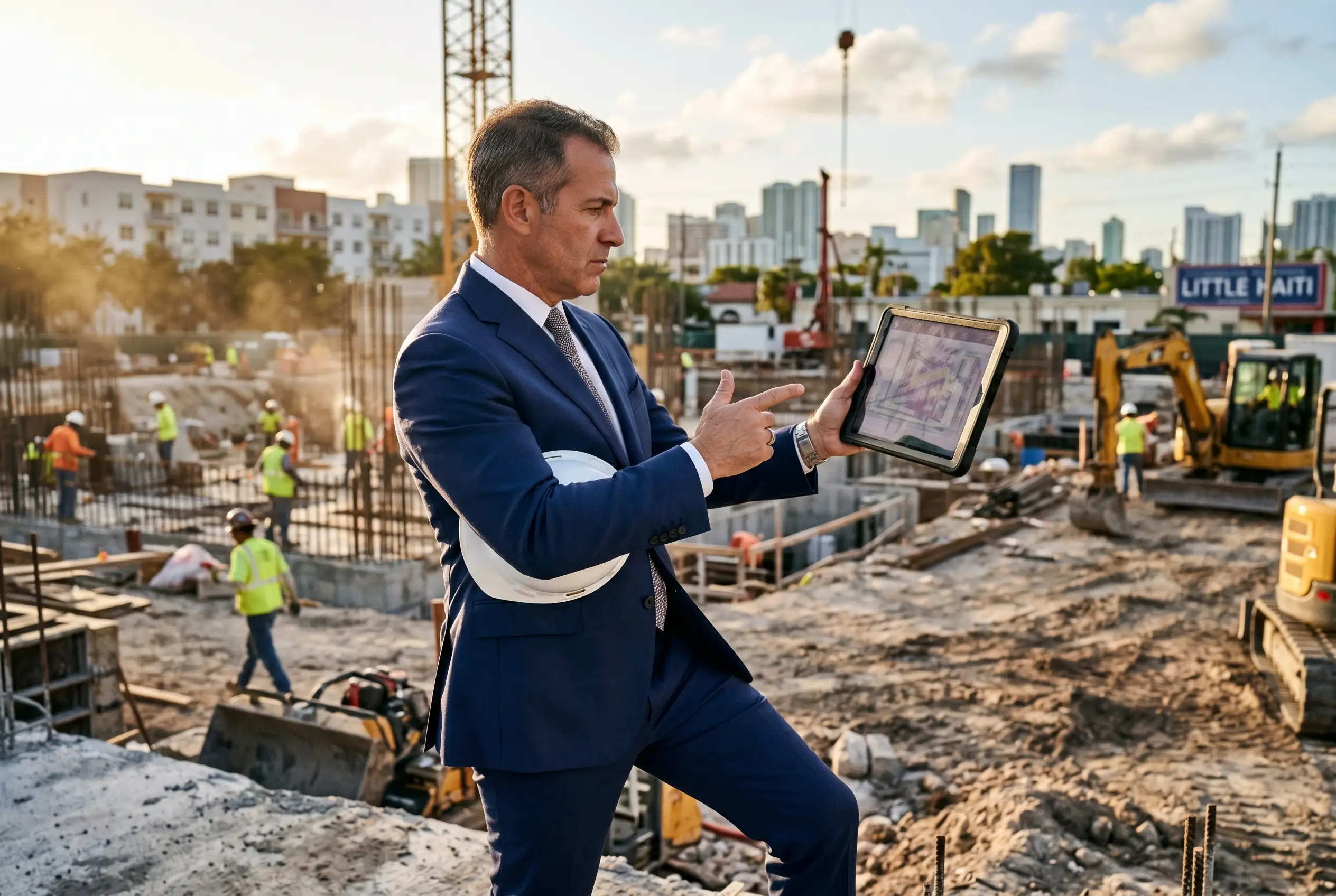
Fourteen Years from Land Deal to Groundbreaking
The Magic City Innovation District traces its roots to 2012, when Zangrillo first revealed plans for a large-scale development and began acquiring land in Little Haiti. He spent the next five years assembling parcels, then secured approval from the Miami City Commission in 2019. The project was a $1 billion vision at that point, with a smaller residential count and an office program built for the pre-AI tech ecosystem.
That same year, the effort stalled. Federal prosecutors indicted Zangrillo in March 2019 as part of Operation Varsity Blues, the college admissions bribery case that charged more than 50 parents with paying bribes to get their children into elite universities. He was 52 at the time, founder and CEO of Dragon Global. Per the Miami Herald’s 2019 report on Zangrillo stepping away, he was removed as the manager of MCD Dragon LLC, the division participating in the Little Haiti project, on March 26, 2019, and replaced by Zachary Annson Vella.
Local developer Plaza Equity Partners remained the managing partner of the project through the legal fight, and Miami’s planning approvals stayed in place. Tony Cho, who had been a co-developer on the project, exited in 2022 to focus on other ventures.
From there the project moved quietly, while the surrounding market caught up. The budget has since grown to $3 billion, the office program has been rewritten around AI, and the residential count has climbed past 2,600 units. Construction of the first residential tower is expected to begin by the end of the year, with a new residential building planned every 16 to 18 months, per Plaza Equity Chairman Neil Fairman. The first tower has been reported as the 25-story Sixty Uptown with 249 units and 17,000 square feet of ground-floor retail, with the Bloomberg/Insurance Journal version citing 349 units in the first-phase 25-story tower.
The Pardon That Cleared the Path
On the final day of his first term, January 20, 2021, President Donald Trump granted Zangrillo a full pardon. According to the January 20, 2021 White House clemency statement, the pardon was supported by billionaire Len Blavatnik, real estate developer Geoff Palmer, Trump friend and real estate investor Tom Barrack, former Meta Platforms President Sean Parker, and Walid Abu-Zalaf.
The response from prosecutors was sharp. Andrew Lelling, the U.S. Attorney for the District of Massachusetts whose office brought the case, said the pardon of Zangrillo “illustrates precisely why Operation Varsity Blues was necessary in the first place.” Per the AP’s account of the Zangrillo pardon, federal prosecutors in Boston had accused Zangrillo of paying $250,000 to get his daughter into the University of Southern California as a transfer in 2018, after she had been denied in 2017. Zangrillo had been scheduled to stand trial in September 2021.
More than 40 defendants in the broader Varsity Blues case pleaded guilty. Zangrillo did not, and the pardon closed the case without a trial. The White House noted that his daughter “did not have others take standardized tests for her and she is currently earning a 3.9 GPA” at USC.
a well-respected businessman and philanthropist
That description came from the January 20, 2021 White House clemency statement, in the section announcing Zangrillo’s pardon. Zangrillo has denied any wrongdoing. “There was really no case at the end of the day,” he told Bloomberg. “They were trying to attack rich parents.”
Little Haiti’s Gentrification Fight
The project’s local reception has been a separate battle. Community activists and residents have raised concerns about gentrification and the displacement of working-class people who have lived in Little Haiti for years. A research study commissioned by groups opposing the project estimated the development could displace more than 3,000 households in the neighborhood.
Zangrillo has pointed to a $31 million commitment his team has made to Miami’s Little Haiti Revitalization Trust, which promotes economic development and facilitates building affordable housing in the area. The trust is overseen by a five-member committee led by Miami Commissioner Keon Hardemon, who represents the Little Haiti district.
Zangrillo framed the land acquisition as uncontested. “We didn’t buy any property that would demand us relocating existing residential tenants,” he told Bloomberg. The 2023 New York Times reporting on the trust described the deal as a $31 million commitment paid in installments.
Little Haiti has emerged as one of the neighborhoods being gentrified quickest in Miami, with a budding culinary scene and projects to develop more upscale housing, retail and commercial space. The question of whether the trust’s $31 million is enough to offset that pressure is the one the project’s opponents have raised from the start, and the one the next phase of construction will be watched against.
Why Miami, Why Now
Zangrillo’s pitch for Little Haiti as a tech hub finally has company in the form of large, public moves by firms that have actually relocated. Palantir Technologies relocated its headquarters to Miami in February 2026, having moved from Denver, where it had shifted from Palo Alto in 2020. Apple’s South Florida office at The Plaza Coral Gables and Amazon’s Wynwood office at Wynwood Plaza have both opened or expanded in recent years. Gemini, the cryptocurrency firm backed by the Winklevoss twins, has a Wynwood office at the Sterling Bay-developed 545wyn.
That tenant pipeline is what made the project viable to revive. Per Palantir’s February 2026 relocation from Denver to Miami, the company changed its principal executive office address to 19505 Biscayne Boulevard in Aventura, near Miami. “I had a vision about 14 years ago that Miami was going to be the capital, or the future New York City, for technology companies and asset managers from around the world to converge,” Zangrillo told Bloomberg.
The project by the numbers:
- 7.8 million square feet of total development
- $3 billion in projected construction cost
- 2,600+ residential units planned across the district
- 349 apartments in the first-phase 25-story tower
The Investor Behind the Bet
Zangrillo started his career in Silicon Valley, moved to New York in the 1990s to start the e-commerce software firm Interworld, and later founded Dragon Global, the Miami-based private investment firm that anchors the Magic City Innovation District. He has been an early investor in Uber Technologies, Anthropic, and SpaceX, among other companies.
Per Dragon Global’s own site, Zangrillo has been founder, chairman & CEO, or investor in 24 companies that have surpassed $1 billion in market value, including 11 above $10 billion, five above $100 billion (Uber, Anthropic, xAI), and two above $1 trillion (Meta and SpaceX). The strategy, the firm says, is concentrated bets in AI-enabled businesses with addressable markets above $100 billion.
The Little Haiti project fits the same playbook: a 14-year incubation, a contrarian site pick, and a pitch that requires the market to arrive after the bet is placed. The market is arriving.
Frequently Asked Questions
What is the Magic City Innovation District?
The Magic City Innovation District is a planned 7.8-million-square-foot mixed-use development in Miami’s Little Haiti neighborhood, centered on an office campus for AI, asset management, and venture capital firms, with more than 2,600 residential units, a hotel, and retail space. It is being developed by Bob Zangrillo’s Dragon Global and Miami-based Plaza Equity Partners, with Newmark’s Anthony Orso leading capital markets work.
Who is Bob Zangrillo?
Bob Zangrillo is the founder, chairman, and chief investment officer of Dragon Global, a Miami-based private investment firm. He started his career in Silicon Valley, moved to New York in the 1990s to start the e-commerce software firm Interworld, and has been an early investor in Uber Technologies, Anthropic, and SpaceX.
Why was the project delayed for so long?
Zangrillo first unveiled plans for a Little Haiti development in 2012, assembled land over the next five years, and secured approval from the Miami City Commission in 2019. The project stalled that same year when he was indicted in Operation Varsity Blues. He was pardoned by President Donald Trump on January 20, 2021, the final day of his first term.
What did Zangrillo’s pardon cover?
The pardon was a full pardon, per the January 20, 2021 White House clemency statement. Zangrillo had been charged with paying $250,000 to help his daughter gain admission to the University of Southern California as a transfer student in 2018. He had denied any wrongdoing, and his scheduled September 2021 trial was mooted by the pardon.
How much has the developer committed to the Little Haiti community?
Zangrillo’s team has committed $31 million to Miami’s Little Haiti Revitalization Trust, a five-member committee led by Commissioner Keon Hardemon that supports economic development and affordable housing in the area. The commitment is paid in installments, per the 2023 New York Times reporting on the trust.