BP and SOCAR have run a 1.1-kilometer horizontal open pipe and a multilateral well at the BP-operated Azeri-Chirag-Gunashli (ACG) field in the Caspian Sea. The first multilateral well ever drilled in the Caspian, well C44, was completed from the West Azeri platform 30 days ahead of plan, with three more MLT wells planned for 2026 and additional wells scheduled for 2027 and 2028.
Multilateral well technology (MLT) lets a single wellbore reach multiple sections of reservoir, multiplying the drainage points that can be reached from each platform slot. On ACG, where platform slots are constrained and the geology is increasingly complex, the technology sits at the centre of a decline-management strategy that the operator says will run for the remaining years of the production sharing agreement signed in 2017 to 2049.
A 1.1-Kilometer Pipe Out of Central Azeri
The B18W well, drilled from the Central Azeri platform, is the project that carried the 1.1-kilometer-long horizontal open pipe. State Oil Company of the Republic of Azerbaijan (SOCAR), BP’s partner in the ACG venture, said the pipe and the advanced drilling and completion technologies around it made “an important contribution” to the pilot. “The project once again confirmed the effectiveness of innovative solutions in terms of increasing production and optimizing operations,” SOCAR said.
Russell Morrice, BP’s vice president for wells in Azerbaijan, Georgia and Türkiye, was direct about the partnership angle. “Proud to work closely in conjunction with State Oil Company of the Republic of Azerbaijan (SOCAR) to deliver the B18w horizontal well on Central Azeri,” he said, framing the work as a joint demonstration. ACG is a co-venture, and that framing runs through the operator’s announcement.
A 1.1-kilometer pipe reaches a section of reservoir that a shorter horizontal well could not, and it does so from a slot already in use on the platform. ACG’s available platform slots are finite, and the field’s geology is increasingly difficult to drill through. The B18W test is the proof of concept that the same approach can be repeated at Central Azeri and across the rest of the producing platforms in the field.
Multilateral Wells Reach the Caspian
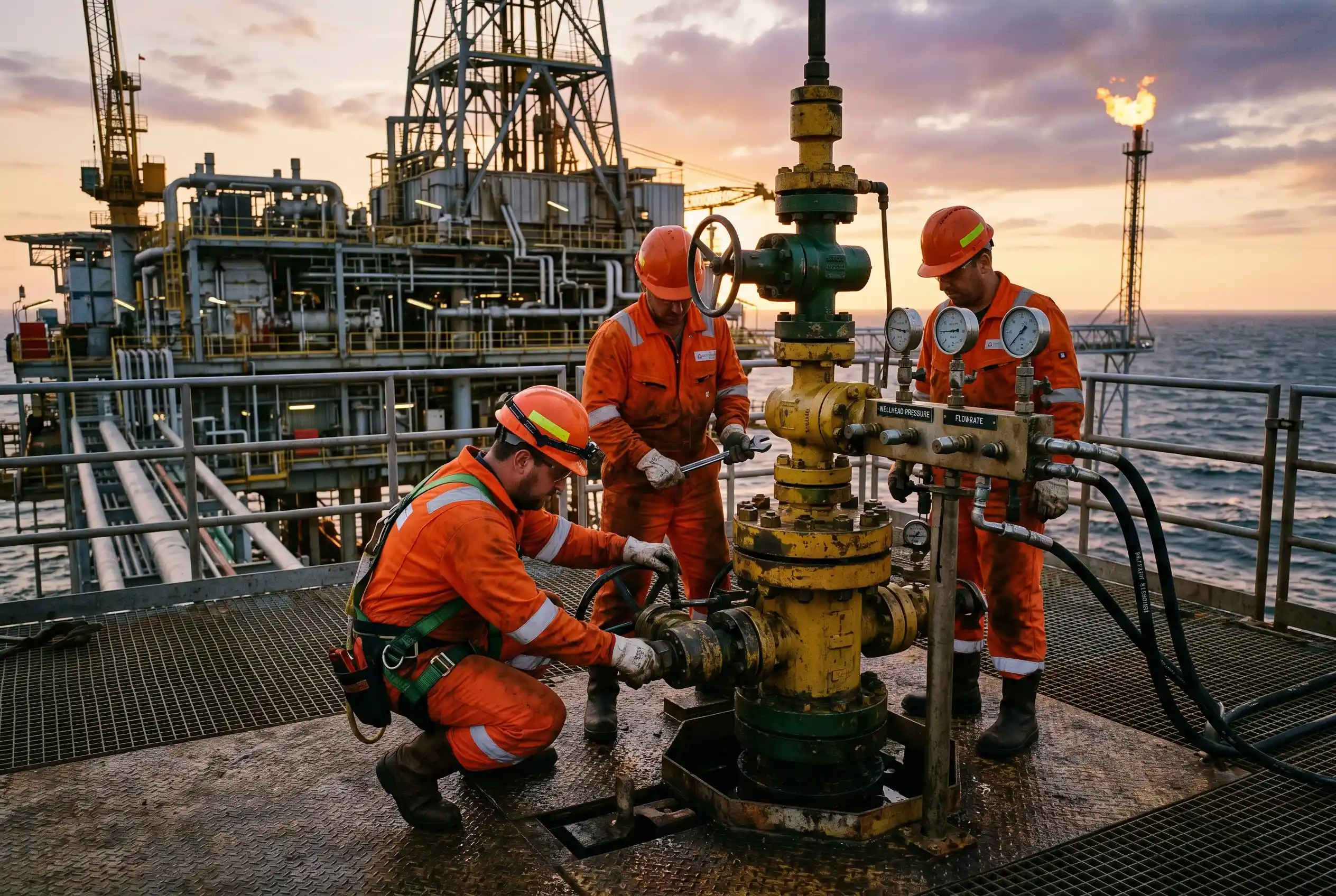
C44 is the headline of the rollout, drilled from the West Azeri platform. It is the first multilateral well ever completed in the Caspian, and BP’s first multilateral well technology deployment at the ACG field.
This is the first time we are applying this well design in ACG, and it clearly demonstrates our commitment to deploying the right technologies to maximize recovery from our existing assets. Looking ahead, innovations such as this will be essential to sustaining long-term production and unlocking additional value.
Gio Cristofoli, BP’s regional president for Azerbaijan, Georgia and Türkiye, made the comment in the operator’s written statement on the first multilateral well. C44 was delivered with no incidents, completed 30 days ahead of schedule, and posted strong safety performance across both the drilling and completion phases. BP attributed the result to “disciplined planning, high-quality execution and effective management of subsurface uncertainty,” and to the integration of subsurface, drilling and completion disciplines on a single project.
The result matters because it is the proof point that the operator can carry into the next MLT wells. Three of them are already scheduled for 2026, with C44 and D41 both due onstream in the first half of the year, and a broader multilateral programme is mapped for 2027 and 2028. The B18W horizontal pipe on Central Azeri and the C44 multilateral on West Azeri are the two anchor tests of the campaign, and both are being run on platforms that marked 20 years of production in 2025. The 30-day buffer on C44 and the early delivery on both phases give BP a defensible business case to scale up.
- C44 (West Azeri): first multilateral well in the Caspian, completed 30 days ahead of plan
- D41: scheduled to come online in the first half of 2026
- A third MLT well: planned for 2026 alongside C44 and D41
- Further MLT wells: planned for drilling between 2027 and 2028
What a 30-Day Head Start Buys
A well that finishes 30 days ahead of schedule on a Caspian platform is unusual enough to clear the gate for the next one. BP and its co-venturers spent about $1,288 million in capital expenditure on ACG activities in 2025, alongside about $564 million in operating expenditure, according to the operator’s annual disclosure. The 30-day buffer is being framed by BP as both a project outcome and a portfolio argument.
Delivered with strong safety performance and no incidents, the first MLT well was completed 30 days ahead of plan, with both drilling and completion phases significantly outperforming timelines. Beyond its immediate performance, the first MLT well establishes a compelling business case for wider deployment of multilateral technology across the field.
Russell Morrice, BP’s vice president for wells, made the comment in the operator’s written statement on the first multilateral well. C44 is the first of three MLT wells scheduled for 2026, and BP has mapped a further round of multilateral drilling for 2027 and 2028. Morrice’s argument is straightforward: the early result on C44 is the basis for the wider rollout.
A Field Built for One Million Barrels, Now Producing 330,000
ACG is not a frontier asset. The complex produced an average of about 330,000 barrels of oil per day in 2025, or about 120 million barrels (16 million tonnes) for the year, according to the operator’s annual disclosure of platform-level production. The platform that still leads ACG production, Central Azeri, marked the 20th anniversary of first oil on 18 February 2025, with cumulative output of 1.2 billion barrels (157 million tonnes).
The 2025 number is a fraction of the field’s peak. ACG hit a peak of 885,000 barrels a day in 2010, with the 2025 average of 330,000 barrels a day well below that level. Multilateral drilling is part of BP’s stated “decline management strategy” for the asset, and the stated goal is to keep the field producing economically through the production sharing agreement that runs to 2049.
The other platform at the same milestone, West Azeri, marked 20 years since first oil on 30 December 2025, with cumulative production exceeding 1 billion barrels (142 million tonnes). The B18W well on Central Azeri and the C44 well on West Azeri are both being delivered into the same mature reservoir system. The two wells are also the test cases for two of the three MLT wells planned for 2026.
The 2025 platform breakdown, from BP’s annual disclosure, shows where the production comes from. Central Azeri produced an average 90,000 barrels per day, West Azeri 76,000, Deepwater Gunashli 51,000, East Azeri 43,000, ACE 25,000, West Chirag 24,000 and Chirag 21,000. End-of-year well counts underline the maturity: 147 oil wells were producing, with 49 used for water injection and 10 for gas injection, and the 2025 drilling programme delivered 10 oil producers, 5 water injectors, 1 gas injector and 1 cuttings re-injector. Multilateral wells let the same surface slot access multiple reservoir sections, and that geometry is why the technology is being marketed as a way to convert underused slots into additional drainage points. ACG also deployed riserless light well intervention (RLWI) technology for the first time in BP’s Caspian operations during 2025, using the Blue Ocean Riserless Intervention System from Oceaneering International.
- ~330,000 barrels per day: ACG average production in 2025 (120 million barrels or 16 million tonnes for the year)
- 885,000 barrels per day: ACG’s 2010 peak production level
- $1,288 million: 2025 capital expenditure on ACG activities by BP and its co-venturers
- 1.2 billion barrels: cumulative production from Central Azeri as of 2025
- 147 oil wells: producing at ACG at the end of 2025, with 49 used for water and 10 for gas injection
The 2026 to 2028 MLT Roadmap
BP has already mapped out the next two and a half years of multilateral drilling. Three MLT wells are planned for 2026, including C44 and D41, with both scheduled to come online in the first half of the year. A further round of MLT wells is planned for drilling between 2027 and 2028.
C44 came in 30 days ahead of plan. D41 will be the second test of the multilateral concept, on a different platform with a different reservoir target. BP’s plan is to combine MLT with horizontal drilling, advanced geo-steering, and smart completion systems, including sand control and inflow management, to match the technology mix to the local geology. The deployment mix is selected by reservoir target rather than applied uniformly across the field.
The 2026 to 2028 programme gives BP and its co-venturers a multi-year, measurable test of how much recovery the multilateral approach can deliver in ACG. The full answer will only land in the 2027 and 2028 production reports.
The Partnership and the Long Game
BP and its co-venturers have begun non-associated gas production at ACG, with the first well drilled from the existing West Chirag platform, according to the operator. The well accesses two priority deep-gas reservoirs, the shallower NKP and the deeper PK, both located beneath the currently producing oil reservoirs. The NKP reservoir is the main target for first non-associated gas production, and the operator states it was confirmed as a gas-bearing formation by the 2025 appraisal programme. Production from the PK reservoir is also planned for the first half of 2026 for testing purposes, before the operator moves back to the NKP reservoir. A second deep-gas well is targeted for May 2026, with the development target set at 4 trillion cubic feet of non-associated gas, per BP’s stated plan for a second production well at the ACG block.
The gas programme is being layered onto the existing oil production. The field’s production sharing agreement was extended in 2017 to run to 2049, and the multilateral and gas programmes are both parts of how BP and its partners plan to keep ACG economically producing through that horizon. The same constraints apply to every programme: tight platform slots, complex geology, and a long, slow decline.
- BP: 30.37% (operator)
- SOCAR: 31.66%
- MOL: 9.57%
- INPEX: 9.31%
- ExxonMobil: 6.79%
- TPAO: 5.73%
- Itochu: 3.65%
- ONGC Videsh: 2.93%
Frequently Asked Questions
What is multilateral well technology?
A multilateral well reaches more than one reservoir section from a single wellbore, so the same surface slot accesses multiple drainage targets. BP and SOCAR used it for the first time at ACG on well C44.
How many multilateral wells are planned at ACG?
Three MLT wells are scheduled for 2026, including C44 and D41, with both due onstream in the first half of the year. A further round of multilateral wells is planned for 2027 and 2028.
How much oil did ACG produce in 2025?
About 330,000 barrels per day on average for the year, or roughly 120 million barrels (16 million tonnes) in total, according to the operator’s annual disclosure.
Who operates ACG and who are the partners?
BP operates the field on behalf of the co-venturers, which include SOCAR, MOL, INPEX, ExxonMobil, TPAO, Itochu and ONGC Videsh, under a production sharing agreement that runs to 2049.
When did the Caspian see its first multilateral well?
Well C44, drilled from the West Azeri platform, was completed 30 days ahead of plan and is the first multilateral well ever drilled in the Caspian Sea, according to BP.