On May 30, 2026, the Ghana Rugby Football Union staged an inclusive one-day competition at the University of Ghana Rugby Stadium in Legon, Accra, where a Deaf Rugby Team drawn from Obuasi and Kumasi played alongside three junior hearing sides. Flags and a sign-language interpreter stood in for sound on the pitch. Conquerors SC Juniors took the Cup.
The scoreboard tilted firmly toward the hearing teams. The result worth watching sits somewhere else, in a development pathway that has been quietly building deaf players in Kumasi for four years and is now asking Ghana whether it will pay to keep going.
Four Teams, One Field at Legon
The day opened not with a kickoff but with a coaching clinic. Rafatu Inusah, a World Rugby Coach Educator who also serves as president of the Ghana Rugby Football Union (GRFU, Ghana’s governing body for the 15-a-side and sevens game), ran a session on handling, teamwork and the laws of the sport before any whistle blew.
Four sides then took the field: Conquerors SC Juniors, Accra Majestics Juniors, African Warriors Juniors and the Deaf Rugby Team. The juniors brought numbers and match sharpness. The deaf side brought players who, in many cases, had picked up an oval ball for the first time only in the last couple of seasons.
Conquerors SC Juniors finished as overall champions after they won all three of their matches, including a 19-0 Cup Final over Accra Majestics Juniors. African Warriors Juniors collected the Plate. For a programme that organisers say is still short of basic kit, simply fielding a competitive deaf team against established junior clubs was the headline most outlets skipped past.
The Kumasi Pathway That Took Four Years
The Deaf Rugby Team did not appear overnight for a one-day showcase. It grew out of a partnership between a coach known as Coach Hakim and Inusah that began four years ago in Kumasi, with a simple aim: introduce deaf athletes to rugby and give them somewhere to develop.
That patience is the part of the story that travels. Deaf sport in Ghana rarely gets a competitive calendar, so a squad that has trained for years without regular fixtures is unusual. The Legon event gave those players something they almost never get, which is real opposition on a marked pitch in front of officials and an audience.
The team travelled with its own support structure. Yaw Kunadu, the side’s coach and president, accompanied the players, alongside Owusu Amuah, a Rugby Sports Development Officer with the National Sports Authority (NSA) in Kumasi, and interpreter Gifty Sammy.
Having a development officer and an interpreter on the touchline matters more than it sounds. It is the difference between a goodwill exhibition that happens once and a structure that can field a team again next season without starting from zero.
How the Game Was Made Visible
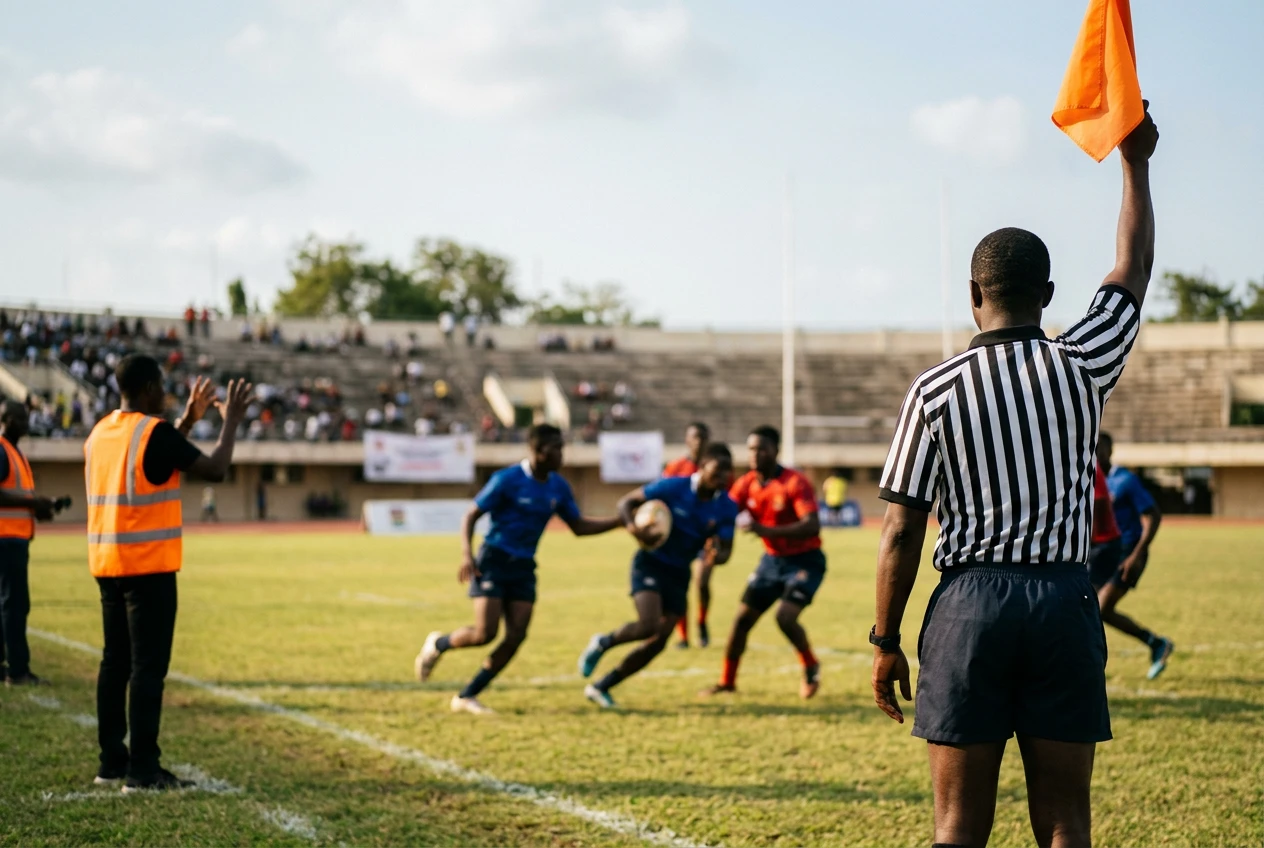
Rugby is an aural game. Referees blow whistles, players call lines, coaches shout from the side. For deaf players, almost all of that has to be redesigned around the eye. Organisers in Legon adopted the same visual toolkit that international deaf rugby uses, communicating stoppages and decisions through sight rather than sound.
The adaptations on the day included:
- Flags and hand signals waved by officials to mark stoppages and key calls, used alongside the conventional whistle so hearing and deaf players could both follow play.
- A sign-language interpreter present throughout to relay communication among players, coaches and match officials.
- Pre-match briefings for referees, coaches and medical personnel on the specific communication needs of deaf athletes before the first kickoff.
None of this is improvised. Global guidance from the international deaf rugby governing body calls for flags, additional referees, no use of voice on the field and interpreters as standard, and it works with both World Rugby and the International Committee of Sports for the Deaf (ICSD, the body that runs the Deaflympics).
The Scoreboard and the Equipment Gap
The final margins were honest about the gap. Conquerors SC Juniors beat African Warriors Juniors 5-0 in pool play before the 19-0 Cup Final. African Warriors then took the Plate with a 24-0 win over the Deaf Rugby Team.
| Team | Final standing | Notable result |
|---|---|---|
| Conquerors SC Juniors | Cup champions | Won all three matches, 19-0 in the final |
| Accra Majestics Juniors | Cup runners-up | Lost the final 0-19 |
| African Warriors Juniors | Plate winners | Beat the Deaf Rugby Team 24-0 |
| Deaf Rugby Team | Plate runners-up | Played with limited specialist kit |
A 24-0 loss reads like a mismatch, and on the day it was. Organisers were candid that the deaf side competed despite limited access to some of the specialist equipment commonly used in deaf rugby, and praised the players’ resilience rather than pretending the result was close.
That honesty is the useful part. The deficit was not effort or talent. It was fixtures, funding and gear, the three things a sustained programme is supposed to supply and a single showcase cannot.
Where Ghana’s Deaf Athletes Stand
The Legon competition lands inside a wider picture of disability sport in Ghana that is growing far faster than the money behind it.
A Growing but Underserved Population
Ghana’s recorded disability population has expanded sharply over a decade, which makes the shortage of competitive outlets more pressing, not less.
- 2,098,138 Ghanaians were recorded as living with a disability in 2021, up from 737,743 in 2010, a near tripling in the share of the population from roughly 3% to 8%.
- 8.8% disability prevalence among women, against 6.7% among men.
- 9.5% prevalence in rural areas, compared with 6.5% in urban centres.
The Ghana Deaf Sports Federation already exists as a registered association under the National Sports Authority, with regional wings meant to push grassroots participation. The structure is there on paper. What rugby is testing is whether one more sport can plug into it.
Policy on Paper, Funding in Practice
Ghana has the legal scaffolding for inclusive sport. The Sports Act, 2016 and the Persons with Disability Act, 2006 both mandate accessible programmes, and the country ratified the United Nations Convention on the Rights of Persons with Disabilities in 2012. Implementation money at district level is the missing piece, according to peer-reviewed research on Ghana’s disability sport profile.
That gap explains why a four-year Kumasi project still scrambles for kit. It also explains why the same broader push to close equity gaps that drives reforms like new protections for women athletes tends to stall at the funding stage when the athletes are deaf, rural or both.
Familiar Faces and Bigger Ambitions
The day drew a notable guest in Zainab Alema, the British-Ghanaian forward who became the first Black Muslim woman in a hijab to play and score in England’s Premiership Women’s Rugby (PWR, the country’s top women’s league) and who runs a grassroots project supplying rugby equipment to children in Ghana. Her presence linked a local deaf showcase to a wider diaspora effort to widen who gets to play the game.
The GRFU, a full member of World Rugby since 2017 and of Rugby Africa, says it intends to work with national and international partners to expand deaf programmes and deepen inclusion across the country. Whether that becomes a recurring calendar, in the way other nations have built deaf-sport development through cross-border international sports cooperation partnerships, is the open question the trophies in Legon did not answer. The full development framework sits with the union’s deaf rugby section.
Frequently Asked Questions
What is deaf rugby and how does it differ from the standard game?
Deaf rugby uses the same laws as the conventional 15-a-side and sevens game but replaces sound-based communication with visual cues. Officials use brightly coloured flags and hand signals instead of relying on the whistle, players avoid voice calls on the field, extra referees are often used, and sign-language interpreters support communication. World Rugby’s guidance on the deaf game sets out these adaptations.
Who organised the inclusive competition in Legon?
The Ghana Rugby Football Union staged the one-day event at the University of Ghana Rugby Stadium on May 30, 2026, opening with a coaching clinic led by president and World Rugby Coach Educator Rafatu Inusah.
Where did the Deaf Rugby Team come from?
The squad was built over four years in Kumasi through a partnership between Coach Hakim and Rafatu Inusah, drawing players from Obuasi and Kumasi, and was supported in Legon by coach and president Yaw Kunadu, a National Sports Authority development officer and an interpreter.
Is deaf rugby played internationally?
Yes. World Deaf Rugby counts around 25 member countries across Africa, the Americas, Asia, Europe and Oceania, and works with both World Rugby and the International Committee of Sports for the Deaf, which runs the Deaflympics.