Global business travel spending will hit a record $1.57 trillion in 2025 and push past $2 trillion by 2029, according to the Global Business Travel Association (GBTA, the industry’s main trade body). The business travel habits that keep top CEOs sharp on the road have quietly stopped looking like soft self-care. They now borrow, almost line for line, from the recovery science elite athletes use between games.
That shift matters because the cost of getting it wrong is no longer vague. Peer-reviewed work has put numbers on what a badly handled trip does to a leader’s sleep, hydration, and decision-making, and the figures are large enough that some executives treat the round trip as a process to be engineered rather than endured.
The $2 Trillion Reason These Habits Are Scaling
The macro picture explains why this is suddenly a boardroom conversation. The GBTA expects spending to grow 6.6% in 2025, rebound to 8.1% in 2026, then run at 6.4% and 6.3% through 2027 and 2028. The survey behind those numbers covers 72 countries and more than 7,300 business travelers, so the trend is broad rather than a quirk of one region.
More travel means more nights in unfamiliar beds, more time zones crossed, and more high-stakes meetings held while jet-lagged. As video calls absorb the routine work, the trips that remain are the consequential ones: deals, board meetings, factory walk-throughs. The demand has been visible at the high end too, with a clear surge in private jet demand among Asian executives looking to compress travel time and control their schedules. The premium on showing up in person is rising, and so is the premium on showing up sharp.
That is the second-order story. The habits below are not about comfort. They protect the one asset a traveling leader cannot delegate: their judgment on the day it counts.
Jet Lag Is a Cognitive Tax With a Price Tag
Most people treat jet lag as ordinary tiredness. The research treats it as a measurable drop in brain function, and that reframing is what separates leaders who plan from leaders who improvise.
Circadian Misalignment Has a Measurable Cost
A study in optimal light-exposure schedules for correcting circadian misalignment, published in PLOS Computational Biology, found that symptoms such as depressed cognitive alertness stem directly from the body clock being out of step with local time. It is not random fatigue. It is a system that has lost its anchor, and it stays lost until you reset it on purpose.
The same body of work shows the fix is not endless rest. It is precisely timed light, delivered and avoided on a schedule. That detail is the whole reason the pre-trip habits work at all.
Light Is the Fastest Lever
Light is the primary signal that syncs the circadian system, and the studies model schedules that re-entrain the clock in days rather than the rough rule of one day per time zone. Effective CEOs treat their light exposure with the same intent they bring to a calendar: morning sun on arrival to anchor the new zone, dimmed screens at night to trigger wind-down.
The numbers from the surrounding literature underline why the effort pays off:
- 10 to 20% relative humidity is what a cruising cabin holds, low enough to drive steady fluid loss for hours.
- 6 to 9% drop in plasma volume was recorded in healthy volunteers during a simulated 10-hour flight.
- 7 to 10% fall in jump performance has been measured immediately on arrival after long-haul travel, a marker of how fast physical output degrades.
The Seven Habits Mapped to the Trip Timeline
Stripped of the sports metaphors, the routine effective leaders run is a phased protocol. Each stage has a job, and each job has evidence behind it. The table is the roadmap; the sections that follow walk through the harder stages.
| Trip Phase | Core Habit | What the Evidence Supports |
|---|---|---|
| Before departure | Shift sleep toward the destination, scout the hotel gym and food options | Pre-adjusting the clock shortens the reset window on arrival |
| In transit | Skip alcohol and caffeine, hydrate, block or seek light by schedule | Counters cabin dehydration and circadian drift |
| On arrival | Morning sunlight, train, run on the 80/20 rule | Timed light resets the clock fastest; exercise blunts travel stress |
| After landing | Debrief, recover, refine the protocol | Treats travel as a repeatable, improvable process |
The Trip Begins on the Calendar, Not at the Gate
A team does not walk into the Super Bowl without scouting the opponent first. The leaders who travel best apply the same logic, and the trip effectively starts the moment it lands on the calendar.
In the days before departure, they nudge their sleep schedule toward the destination time zone, check the hotel gym setup, and locate decent food nearby. Some lean on tools like the Timeshifter app to plan when to seek light and when to avoid it, turning the circadian research into a daily prompt rather than a theory.
None of this is glamorous. It is the unglamorous prep that decides whether a leader steps off the plane ready to work or spends the first 48 hours fighting their own biology. The gap between those two outcomes is exactly the cognitive tax the science describes, paid in missed nuance during the meetings that justified the trip.
The Battle Executives Lose at Altitude
The flight itself is where most travelers fall behind before they land. Cabin air is dry by design, and the body keeps losing water hour after hour. Research in the journal Nutrients on the dehydration risk of long-haul flights documented how steeply fluid loss climbs as humidity drops, and even mild dehydration is enough to dull focus, mood, and memory.
So the in-transit habits are defensive. Effective CEOs skip the alcohol and the late caffeine, both of which fragment deep sleep, and they drink water steadily rather than waiting until they feel thirsty. The aim is to walk off the plane in better shape than the person who treated the flight as downtime.
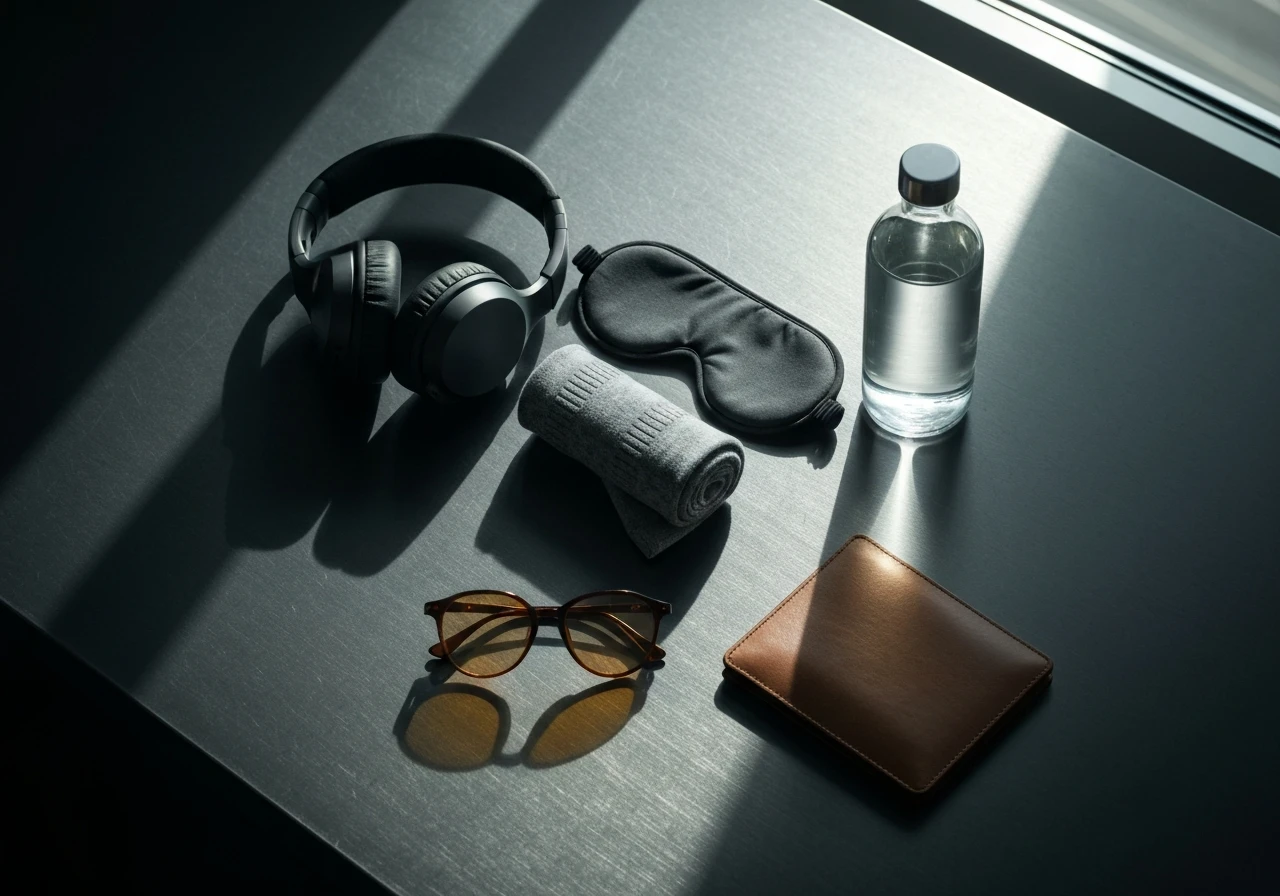
A small kit does most of the work, and the items are the same ones frequent flyers reach for:
- Noise-canceling headphones to cut engine drone and protect sleep.
- A sleep mask to hold darkness on the body’s schedule, not the cabin’s.
- Blue-light-blocking glasses for evening flights and bright terminals.
- Compression socks to keep blood moving during long stretches in the seat.
It is a modest list, and it overlaps heavily with the travel gear that seasoned flyers swear by. The point is repeatability: the same kit, packed the same way, every trip.
Fitness and Mindset Stay Non-Negotiable on the Road
Arrival is where the habits turn active. The leaders who hold up best refuse to let the road erase their baseline, and they guard their attention as carefully as their body.
The Fitness Baseline
Exercise on the road does more than maintain appearance. It helps blunt jet lag, lowers travel stress, and supports the focus that high-stakes decisions demand. That can mean a hotel gym session, walking between meetings, or a morning run that doubles as a way to learn the city. In a job where outcomes take months to land, a workout is one of the few guaranteed wins available the same day.
Controlling the 80/20
No itinerary survives contact with delays, fatigue, and the small disasters of travel. The useful question is not how to avoid friction but how to respond to it. Leaders who lean on the 80/20 principle protect the few behaviors that matter most, accept that the trip will not be perfect, and still come away with the win. It is the away-game mindset translated into a calendar.
Guarding Judgment
A leader’s inner state eventually shows up in their decisions. On the road, that makes mental upkeep practical rather than indulgent. Short bouts of journaling, meditation, or simply blocking time to call the people who matter all protect the same thing the science keeps pointing back to: clear judgment when the stakes are high and the body is tired.
The Debrief That Turns a Trip Into a Protocol
The most overlooked habit comes after the wheels touch down. The instinct is to sprint straight back into the inbox, which guarantees the next trip repeats the same mistakes. The leaders who improve do a short review instead: what worked, what failed, what physical state they are actually in, and what to adjust next time.
That loop is what converts seven scattered tips into a system that compounds. And the reason any of it is worth the effort traces back to why these leaders fly at all. Jamie Dimon, chief executive of JPMorgan Chase, has been blunt about the payoff of getting out from behind the desk, speaking on LinkedIn’s “This is Working” series.
We can learn so much from our competitors, customers, and employees if we only open our eyes and ears.
That is the prize the habits exist to protect. With business travel spending climbing toward $2 trillion by 2029, the leaders who run the round trip as a repeatable protocol arrive ready to capture that learning, while the ones who wing it keep paying the cognitive tax in the room where it counts.
Frequently Asked Questions
How far in advance should executives prepare for a time-zone change?
The prep starts the moment the trip hits the calendar. In the days before departure, effective travelers gradually shift their sleep schedule toward the destination time zone and plan their light exposure, which shortens the time their body clock needs to reset once they land.
Does morning sunlight actually help with jet lag?
Yes. Light is the main signal that syncs the circadian system, and research in PLOS Computational Biology shows that precisely timed light exposure is the most effective way to correct circadian misalignment. Morning sun on arrival helps anchor the body to the new time zone faster.
Why is hydration such a big deal on long-haul flights?
Cruising cabins hold only 10 to 20% relative humidity, which drives steady fluid loss over a long flight. A study in Nutrients recorded plasma volume falling 6 to 9% during a simulated 10-hour flight, and even mild dehydration measurably reduces focus, mood, and memory.
Should you exercise right after a long flight?
A light session on arrival can help. Exercise reduces travel stress, supports the focus needed for big decisions, and helps combat jet lag, which is why many leaders keep a fitness baseline through hotel gyms, walking between meetings, or a morning run.
What is the 80/20 principle in business travel?
It means protecting the small number of behaviors that drive most of the outcome rather than chasing a flawless trip. Leaders accept that delays and fatigue are inevitable, hold their core habits steady, and still come away with the result that mattered.
Is business travel still worth it when video calls exist?
Many leaders argue it is more valuable, not less. As routine work moves online, the trips that remain are the high-stakes ones, and in-person presence offers learning about customers, competitors, and employees that screens do not capture.