
SpaceX’s Starship Flight 12 splashed down in the Indian Ocean on May 22 after deploying 22 Starlink simulators and two camera-equipped heat-shield inspection satellites from a Version 3 ship. The clean re-entry came roughly 24 months before a deadline set in a December 2025 White House executive order titled Ensuring American Space Superiority, which mandates returning Americans to the Moon by 2028 and standing up a permanent lunar outpost by 2030.
Two leading aerospace voices, Robert Zubrin, the engineer who designed an early prototype of NASA’s Space Launch System rocket, and Brian Hurley, founder of the New Space Economy think tank, told me the splashdown closed one question and opened a harder set. Both call the 2028 finish line “optimistic.” Between Starbase and the Moon’s South Pole sits 380,000 kilometers of vacuum and a queue of engineering problems no spaceflight program has ever solved on schedule.
Flight 12 Cleared the Bar Set by Earlier Tests
The 12th flight test mattered for what it did not break. Super Heavy’s boostback burn failed and the booster was lost, but Ship 39 reached its planned suborbital trajectory and demonstrated payload deploy from a redesigned dispenser bay. The Raptor engines flew in a substantially overhauled configuration on both the booster and the ship, the first full sortie of the Version 3 architecture.
For NASA’s Human Landing System program, which has been waiting on a propellant-transfer demonstration as a contract gate, the V3 debut moves the calendar but does not unlock the next funding tranche on its own. SpaceX’s own Flight 12 brief confirmed the new ship carried Starlink simulators rather than any propellant-transfer hardware.
Hurley, whose think tank publishes a digital magazine tracking the commercial space sector, told me that every Starship test now functions as open-source technical intelligence. “Blue Origin’s lander architecture is different, but SpaceX’s pace matters to Blue Origin because it shapes NASA expectations, political expectations, and the perceived race between commercial lunar-lander providers,” he said. Chinese teams, he added, “would almost certainly study the flight to assess both the promise and the remaining weaknesses of the Starship approach.”
The 2028 Order Reset Every Margin
Before the December executive order, NASA’s Artemis schedule was sliding right. SpaceX’s original 2024 target for a crewed lunar landing had already moved into the back half of the decade, and the agency had quietly broadened the HLS competition. Trump’s signed order reasserted 2028 as a non-negotiable, and bundled it with a directive to deploy nuclear reactors on the Moon and attract $50 billion in additional commercial space investment by the same year.
That single date now drives every contractor’s risk math. NASA’s Artemis 3 mission is the slot SpaceX must fill, with Blue Origin’s Blue Moon Mark 2 lander, awarded a $3.4 billion sustaining contract under the second HLS track, sized for the Artemis 5 window.
The shift in optics is sharp. A program that began life as a public-private partnership with a single anchor tenant is now a two-vehicle race against a foreign state program, and the executive branch has put a number on it. Inside SpaceX, that calendar pressure compounds with the company’s standing engineering mantra of fast iteration. Outside, it sets up a test the model has not faced before: the slowest, most documentation-heavy program in human spaceflight, accelerated to commercial software cadence.
Orbital Refueling Is the Tempo Problem
The single biggest unbuilt piece of the Starship lunar architecture is the refueling chain. Zubrin laid out the sequence in our interview:
- Develop the tanker variant of Starship that ferries cryogenic methane and liquid oxygen up from Starbase.
- Demonstrate propellant transfer in low Earth orbit, ship-to-ship, in microgravity, at scale.
- Refuel the Starship HLS in LEO across multiple tanker rendezvous before trans-lunar injection.
- Repeat the refueling in lunar orbit for the return leg from the surface.
- Do all of it fast enough that cryogenic boiloff does not strand the mission.
“They will need 10 to 15 Starship launches to do all this so that the propellant does not boil away before they can get the mission done,” Zubrin said. NASA’s own internal review and the Government Accountability Office have put the figure higher, at 17 to 19 launches per crewed sortie, a tempo no launch system has ever sustained. Falcon 9 set the modern reuse benchmark at roughly one flight every other day across an entire fleet; HLS asks for that cadence from a single architecture inside a single refueling window.
A December 2025 New Space Economy analysis of Starship orbital refueling identified temperature homogeneity during transfer and station-keeping software as failure modes capable of snapping a docking mechanism mid-flow. A single software glitch in the wrong half-second voids the chain.
The Federal Aviation Administration’s launch licensing is the other choke point. Pushing 17 launches through Starbase inside a refueling window stresses environmental review thresholds that were written for a slower era.
A Fifty-Meter Tower Cannot Land Like Apollo
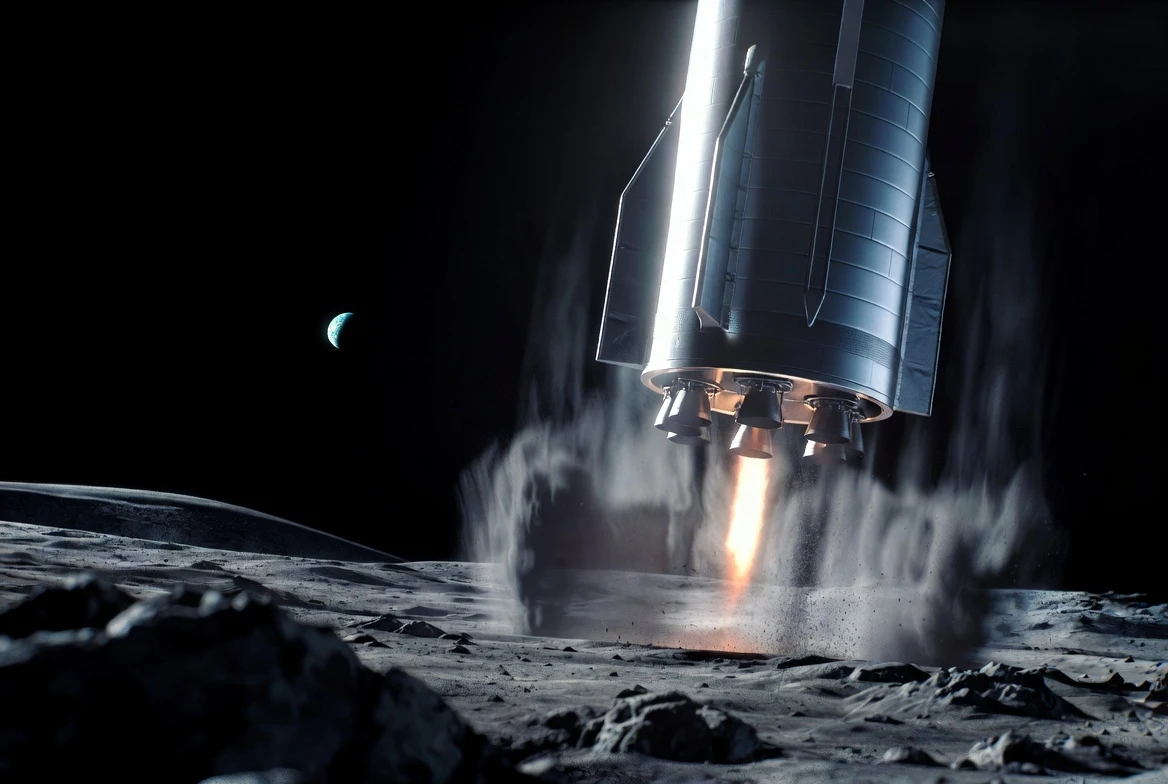
The Starship Human Landing System (HLS, the crewed lunar variant) is a class of vehicle no agency has ever set down on an unimproved surface. Apollo’s Lunar Module weighed about 15 metric tons fueled and stood roughly 7 meters tall. Starship HLS is north of 100 metric tons dry and stands roughly 50 meters from skirt to nose. The center of mass sits high, the footprint is narrow, and the landing site is lunar South Pole terrain that orbital mapping has only partially characterized.
The Plume Problem
Peer-reviewed work cited in NASA briefings has estimated that a Starship-class landing could generate roughly 30 times more surface contamination than an Apollo touchdown, propelling sand-sized particles and small rocks at high velocity across hundreds of meters. SpaceX’s mitigation is a set of high-thrust landing engines mounted in the mid-body of the ship, intended to fire during the final 100 meters of descent so the main Raptors stop sculpting the regolith below.
“The concern is not only that the lunar surface may be uneven,” Hurley said. “It is the combination of Starship’s size, landing-leg loads, possible surface slope, loose regolith, rocks, and the effect of engine plumes on the surface.”
The Leveling and Egress Problem
A lander that touches down on a 5-degree slope with uneven leg loading risks an excessive tilt that the crew may not be able to correct from inside. Even a successful upright touchdown opens the next problem: moving payloads and crew from a deck roughly 30 meters above the lunar surface down to ground level, then back up again before lift-off. Apollo’s astronauts climbed a ladder. Starship’s astronauts will ride an elevator system that has been tested in 1G but not in the abrasive, charged, vacuum-side regolith environment of the South Pole.
The Pad Question
The first uncrewed Starship landing on the Moon will almost certainly happen without a prepared pad. Hurley argues a single-sortie landing is survivable on raw regolith with conservative site selection and autonomous hazard avoidance during descent. A sustained lunar base is a different proposition, and on that horizon prepared landing zones move from optional infrastructure to essential. The first uncrewed Starship demonstrator may itself carry the prefabricated pad for the crewed flight that follows.
Three Landers, Three Architectures, One Window
The competitive frame matters because each architecture has a different exposure to the refueling-and-plume cascade. The comparison sets the trade.
| Lander | Operator | Approximate Height | Refueling Required | First Crewed Target |
|---|---|---|---|---|
| Starship HLS | SpaceX (NASA Artemis 3) | ~50 m | 10 to 19 launches per mission | 2028 (executive-order target) |
| Blue Moon Mark 2 | Blue Origin (NASA Artemis 5) | ~16 m | Cislunar Transporter tug (Lockheed Martin) | 2027 uncrewed demo, crewed later |
| Lanyue | China Manned Space Agency | ~10 m (Apollo-class) | None on-orbit; direct architecture | Before 2030 |
Blue Origin’s 2023 NASA selection as the second HLS provider brought a $3.4 billion contract under the Sustaining Lunar Development track, paired with at least an equal amount of internal company funding. The full-scale Mark 2 crew prototype was delivered to Johnson Space Center for training and testing earlier this year. The cislunar tug architecture means Blue Moon does not need a 17-tanker chain; it does need a separate Lockheed Martin spacecraft to come online.
China’s Long March 10 super-booster ran a low-altitude demonstration flight at Wenchang on February 11, with the Mengzhou crew capsule and the Lanyue surface lander tracking maiden flights in the same window. Lanyue is sized for two taikonauts on the surface, with no on-orbit refueling step, the simplest of the three architectures and the closest in spirit to Apollo’s playbook.
Zubrin’s Argument: Build a Smaller Ship
Zubrin’s read is that SpaceX can sidestep most of the lunar landing risk by shrinking the lander. He has proposed a vehicle he calls the Starboat, a Starship-derived shuttle scaled down by roughly a factor of five in mass, that would ferry crew between an orbiting Starship and the lunar surface while the mothership stays in lunar orbit.
The big Starship would never have to land. Instead it could be used to refuel the Starboat from orbit. A similar Starboat could also serve as a ferry from Mars orbit to the surface.
The argument folds into a longer Zubrin thesis sketched in The Case for Mars, the book SpaceX has openly drawn from for its Martian propellant-production strategy. A two-vehicle architecture, Starship for Earth-to-orbit lift, Starboat for surface sorties, sidesteps the plume problem (smaller engines, lighter footprint), the leveling problem (lower center of mass), and the egress problem (a shorter deck height). It also turns the orbital refueling chain into a recurring resupply rather than a single mission-critical sprint.
SpaceX has not signaled any work on a downscaled lunar variant. Professor Kip Hodges of Arizona State’s School of Earth and Space Exploration, a co-author of the decadal white paper on Starship missions to the Moon and Mars, told me that the schedule pressure is real enough that NASA may push ahead without prepared pads or a smaller ferry at all. “I think there is enough urgency to not be beaten to the Moon by the Chinese that they want to get Americans there as quickly as they can,” Hodges said.
What the Next 24 Months Need to Show
The propellant-transfer demo is the watershed. It is the contract gate, the boiloff proof point, and the dress rehearsal for the tempo problem rolled into one mission. NASA has wanted that flight on a 2026 calendar; Flight 12 did not move it forward. Whether Starship V3 can host the transfer hardware on its next outing, and whether a tanker variant flies in the same window, will tell investors and the agency more about the 2028 odds than any splashdown video. Adjacent commercial bets, from Starlink scale-up to Musk’s plan to lift a million data centers into orbit, all run through the same Starbase launch queue.
If the transfer demo lands clean in the back half of this year and a crewed Starship HLS rehearsal flies in 2027, Artemis 3 has a path. If the demo slips into 2027, the executive-order deadline becomes the kind of target the Apollo program quietly walked away from in its later years, and Blue Origin’s Mark 2 timeline starts mattering more than SpaceX’s. The next 24 months belong to refueling, not splashdown.