Sberbank, Russia’s largest lender, has been cleared to operate anti-drone weapons on its own premises under a State Duma law passed this week. The Russian Central Bank and the Russian Cash Collection Association received the same authority. Each will pay for the systems, train the staff and fire without waiting for special forces.
The bill follows a March measure that handed private security firms the same rights, and arrives as Ukrainian drones knock out roughly a quarter of Russia’s oil-refining capacity. Carnegie’s Russia-Eurasia analysis of corporate drone-defence spending puts the private-sector bill at about 200 billion rubles last year, double the 2024 figure, with insurance covering a fraction.
Sberbank Joins the Air Defense Roster
Anatoly Aksakov, who chairs the State Duma’s financial committee, told the RBC news outlet that lenders and adjacent institutions will now handle the cost of buying, installing and operating anti-drone systems without state reimbursement. The categories named in the bill include Sberbank, the Russian Central Bank and the Russian Cash Collection Association, each of which now has the right to arm staff and engage incoming uncrewed aerial vehicles (UAVs) inside Russian territory.
That measure widens a March law signed by President Vladimir Putin opening the same lane to private security firms guarding “strategic enterprises”. Vasily Piskarev, the State Duma lawmaker who co-authored the March bill, told TASS that combat firearms for temporary use during the operation would significantly improve protection at critically important facilities. Banks sat outside that package because deposit-taking institutions fall under a separate regulatory regime; this week’s vote folds them in.
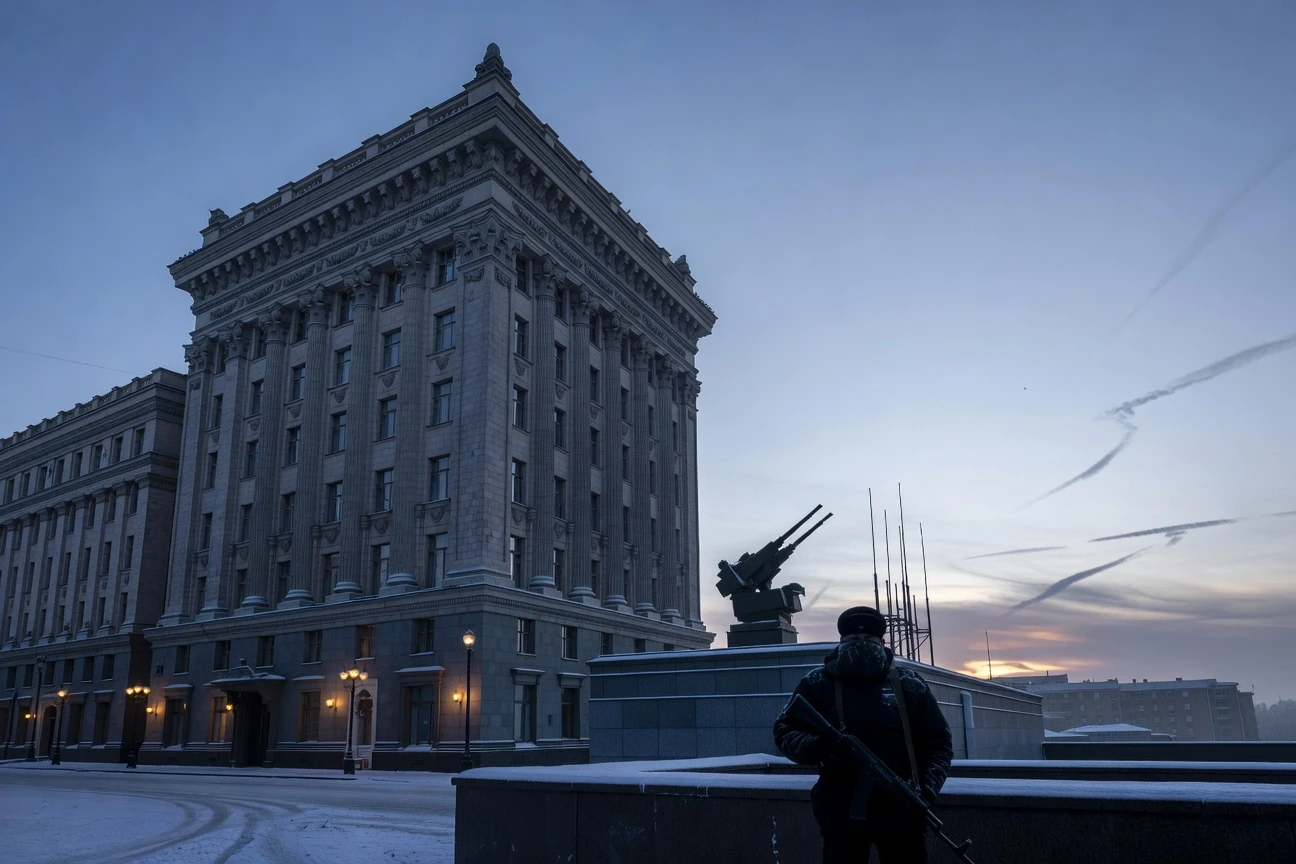
Until early 2025, the legal architecture treated rooftop air defence as the Russian armed forces’ job and the National Guard’s job. Companies could buy passive countermeasures, jammers and electronic spoofers, but firing on a Ukrainian drone above a Russian site required a uniform. The new framework asks private balance sheets to buy the kit, hire the gunners and squeeze the trigger. The state will not write a cheque.
Why the Refinery Map Forced the Decision
The pressure that moved the law sits in the refinery numbers. Ukrainian long-range strikes have taken between 17 and 38 percent of Russian refining capacity offline at peak, by Carnegie’s count. Reuters’ tally puts the combined annual capacity of plants currently halted or sharply reduced at 83 million metric tons, close to a quarter of the national base.
Ryazan, run by Rosneft, suspended operations on 15 May. The Moscow refinery shut on 17 May. Lukoil’s Permnefteorgsintez plant near Perm went down on 30 April. Rosneft’s Tuapse facility on the Black Sea coast was hit on 16, 20 and 28 April and again on 1 May, with fuel oil leaking into the water and what locals described as oily black rain coating cars in the town. Surgutneftegaz was targeted by 29 UAVs in a single sweep on 5 May.
The geography matters because Russian air-defence inventory has been pulled toward Moscow. Roughly 43 new defensive towers were added to the capital’s perimeter through last year, with Pantsir-S1 point-defence batteries mounted on rooftops, landfill mounds and rail sidings to complement S-300 and S-400 sites. Coverage in Bryansk, Kursk and Belgorod thinned to make the maths work. The same pattern recurs in our reporting on Russian drone strikes on Ukrainian rail infrastructure, which run on the inverse logic: cheap drones probing a long perimeter.
The 200-Billion-Ruble Bill Lands on Private Books
Carnegie’s Russia-Eurasia programme estimates Russian corporates spent about 100 billion rubles on drone defence in 2024 and roughly double that figure in 2025. Property insurance payouts for drone damage across last year totalled 1 billion rubles, less than the loss from a single major refinery fire. The Russian Union of Industrialists asked the Kremlin in August 2025 to reimburse half of those costs through tax credits; the Finance Ministry refused, calling the spending “one-off and individual”.
The regional pattern shows the gap. Belgorod oblast paid out 4 billion rubles to owners of 18,500 vehicles damaged by drones and shrapnel; federal transfers covered 1.66 billion. Kursk’s regional government estimated agricultural losses at 90 billion rubles and received 2.5 billion from the federal reserve. Moscow firms lost between 3 and 5 billion rubles during five days of internet blackouts in March, when mobile networks were throttled across the city to disrupt drone navigation.
| Region or Sector | Estimated Damage / Cost | Federal Cover |
|---|---|---|
| Belgorod vehicles (18,500 damaged) | 4 billion rubles | 1.66 billion rubles |
| Kursk agricultural losses | 90 billion rubles | 2.5 billion rubles |
| Moscow firms (March internet shutdown) | 3 to 5 billion rubles | None disclosed |
| All-Russia corporate drone defence (2025) | ~200 billion rubles | None |
| All-Russia drone-damage insurance payouts (2025) | 1 billion rubles paid | n/a |
Tatarstan’s governor, Rustam Minnikhanov, told a regional meeting last summer that the region would have to deal with the attacks using its own resources because no one else would protect it. The legislation that arrived this week reads as Moscow’s federal acknowledgement of that line.
Shokhin Asks for Bigger Calibres
Alexander Shokhin, head of the Russian Union of Industrialists and Entrepreneurs and the country’s most powerful business lobby, used a Monday meeting with Putin to make the corporate demand list visible. He asked for permission to buy more than 7.62-calibre rifles for plant guards.
Not only light weapons of 7.62 caliber, but also larger ones, including various electronic warfare systems, laser installations and other calibers.
That was Shokhin’s pitch on the floor of the meeting, paired with two other asks: a deferral of penalties on late tax payments while damaged facilities are repaired, and a fix for the reservist units guarding factories, which he said are being rotated between sites too often to be effective.
The political signal is awkward for the Kremlin. Russia’s defence industry is producing at near-record volume, yet corporate Russia is being asked to permit private purchasing of electronic-warfare gear and laser counter-drone systems, hardware that until recently sat firmly inside military procurement. The Finance Ministry’s August refusal to reimburse half of corporate drone-defence costs is now load-bearing. If lenders, refiners and fertiliser plants are going to fund their own perimeter, they want the same calibre choices the army gets.
Kyiv’s Diplomatic Counter-Punch at the UN
Nearly 50 countries used a UN General Assembly session on Tuesday to condemn what they called recent Russian threats against diplomatic missions in Kyiv. Ukraine’s UN representative, Andriy Melnyk, read out the joint statement; signatories included most of the European Union, Japan and South Korea. Washington did not sign.
Moscow’s foreign ministry had told the US a day earlier to evacuate its Kyiv embassy and warned other missions to do the same, framing the notice as advance warning of “systematic strikes” on Ukrainian “decision-making centres”. A weekend barrage of drones and missiles killed four people in the capital and damaged residential blocks across several districts.
Germany and Norway each summoned Russia’s ambassador for a reprimand. The European Union said it has no intention of moving staff out of Kyiv. UN Secretary-General Antonio Guterres said he was deeply concerned by the Russian announcement and by the targeting of decision-making sites in a residential city.
Kyiv’s framing of the warning has been blunt. President Volodymyr Zelenskyy’s office called it blackmail and asked allies to ignore it. So far, almost every embassy on the Russian list has stayed open. Connectivity inside the capital has held in part because of commercial satellite links, the same gap covered in our piece on portable satellite internet keeping Ukrainian war zones online.
Prague Holds the Million-Round Pipeline
The Czech-led artillery-ammunition initiative, the single largest external source of large-calibre shells reaching Ukrainian gun lines, has contracts for around 1 million rounds in 2026, the Czech defence ministry confirmed this week. The programme delivered roughly 1.5 million rounds in 2024 and 1.8 million in 2025, a cumulative total above 4.4 million shells since launch.
The initiative came close to collapse in December 2025, when Andrej Babis took office as prime minister with anti-Ukrainian coalition partners and signalled a wind-down. Pressure from Petr Pavel, the Czech president and a former chair of NATO’s Military Committee, plus from donor governments, kept the procurement architecture running. Babis has refused any further Czech state cash, which had been a small share of the overall total but a symbol with weight.
The 2026 funding mix breaks out like this:
- About 1 billion euros committed so far this year, the Czech ministry said, with room to rise if more donors deliver
- Active donor governments include Denmark, the Netherlands and Germany among nine participants, down from 18 at the initiative’s peak
- Yields on frozen Russian sovereign assets, channelled through the European Commission, are now a recurring contributor
- Ukraine retains the option to draw against the European Union’s 90 billion euro loan to top up shell purchases
Even at half its peak membership, the initiative still accounts for roughly half of all large-calibre rounds reaching Ukraine’s batteries. Kyiv is also exporting its own counter-drone know-how to pay for that gap, an arc covered in our reporting on Zelenskyy’s anti-drone technology deals with Gulf states.
Sberbank’s first installed system has not yet been disclosed by location, and Prague’s first 2026 tranche has not yet shipped. If the bank-rooftop air defence comes online before the Czech contracts close, Russia buys itself a few months of cushion against the refinery campaign. If it does not, Ukraine’s drone economy keeps eating capacity faster than Moscow’s private balance sheets can plug the hole.