Maine voters will not see a transgender-sports restriction on their November ballot. Secretary of State Shenna Bellows ruled Tuesday that more than 12,000 signatures submitted by Protect Girls Sports in Maine were invalid, leaving the petition drive a few hundred names short of the 67,682 valid signatures required under state law.
That outcome stalls a coordinated three-state effort to take the trans-athlete fight directly to voters this fall. The Maine campaign was meant to run alongside qualifying initiatives in Colorado and Washington. Every one of the 29 statewide bans currently on the books reached state law through a legislature or a state agency, never through a public vote.
A Few Hundred Signatures Decided Maine’s Fall Ballot
The parents’ group behind the measure, Protect Girls Sports in Maine, turned in roughly 82,000 signatures in early February. The cushion looked comfortable. The 67,682 threshold is pegged at 10 percent of votes cast in the most recent gubernatorial race, and the campaign had pulled in more than 14,000 names above that line.
Three and a half months of staff review changed the math. The secretary of state’s office tossed enough signatures to push the campaign 200 to 300 names below the threshold, according to a recommended decision released the week before the formal ruling. The petition, the recommended decision said, “does not meet the constitution threshold” of valid signatures.
Principal officer Leyland Streiff said the group is “continuing our defense of the Protect Girls Sports ballot measure” and last week indicated the campaign would press on regardless of the recommended decision. Petitioners have 10 days from Tuesday’s ruling to file an appeal in state court.
The proposed measure would have required public schools to assign sports-team eligibility, and access to bathrooms, locker rooms, and shower rooms, based on the sex listed on a student’s birth certificate. It defined sex as a person’s status at birth, language matched closely to laws already in force across roughly two dozen Republican-led states.
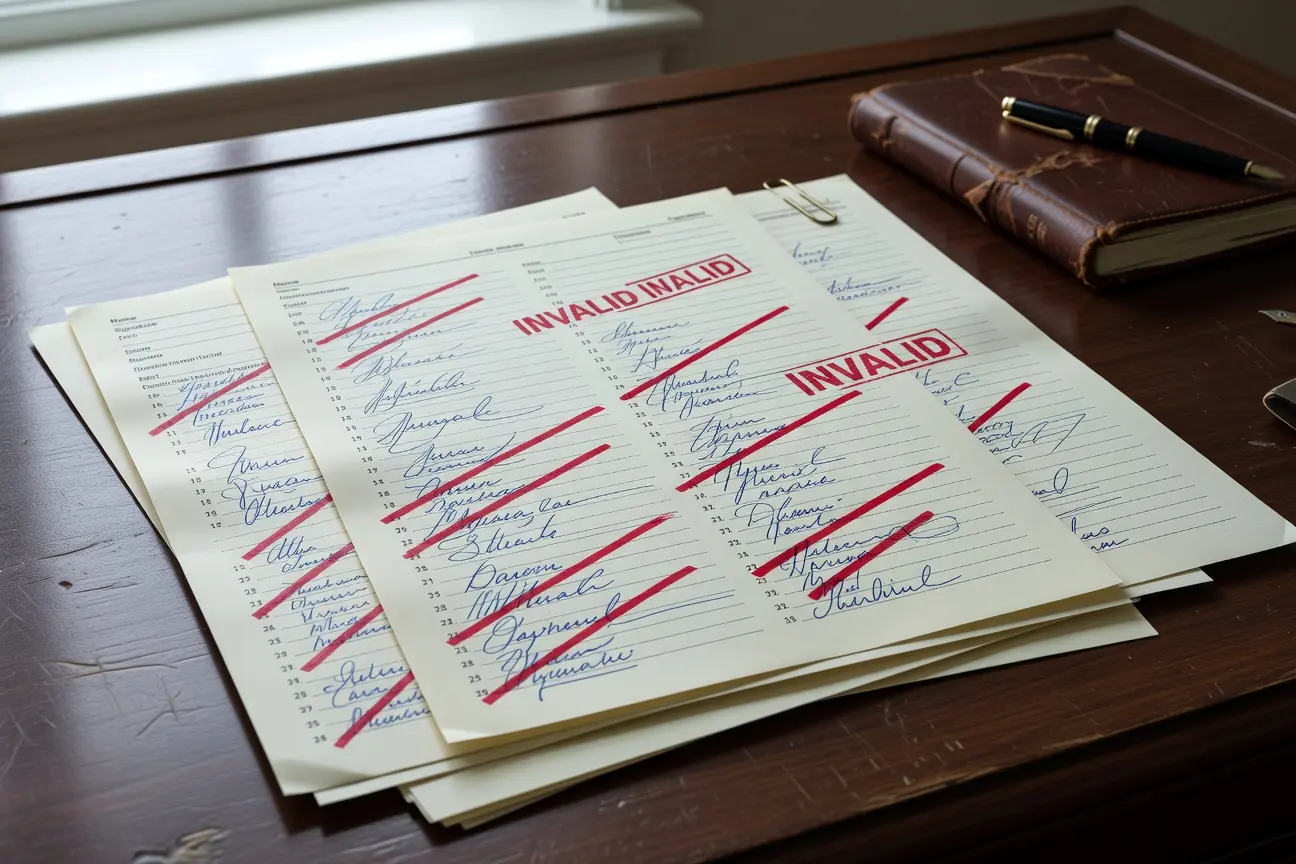
Why the Secretary of State Tossed Twelve Thousand Names
The reasons were procedural, not political. Bellows said two out-of-state signature collectors violated Maine law by leaving their petition sheets unattended, a disqualifying lapse under the state’s chain-of-custody rules. Others, she said, failed to properly swear the oath that paid circulators must take in front of a notary.
We take the integrity of the petitions just as seriously as we take the security of voting. It’s really important that anyone seeking to place an initiative on the ballot follow the law.
That came from Bellows in remarks announcing Tuesday’s decision.
The numbers worth holding onto:
- 82,000+ raw signatures submitted to the secretary of state in February
- 67,682 valid signatures required to qualify, set at 10 percent of the last gubernatorial vote
- 12,000+ signatures invalidated, primarily for circulator-conduct violations
A successful court appeal would need to restore enough signatures to clear the gap, not relitigate the merits of the question. That narrows the path. Circulator-oath defects are routinely upheld in state ballot litigation because they go to the evidentiary chain on which the entire petition rests.
Twenty-Nine Bans, Zero From the Ballot Box
Here is the line buried in most wire coverage Tuesday: no state has restricted transgender athletes through a public vote. The Movement Advancement Project’s national equality map counts 27 states with statutory bans on trans participation in school sports and two more, Alaska and Virginia, where the bans operate through state regulation or agency policy. 29 statewide bans in total. Every one came out of a legislature or a state agency.
The Legislative Wave Since 2020
The earliest, Idaho’s Fairness in Women’s Sports Act, passed in 2020. The wave that followed, roughly 25 statutes between 2021 and 2024, moved through Republican-controlled chambers. Ohio’s ban passed in 2024; Wyoming’s in 2023. Court orders currently block enforcement of bans in at least four states, including Arizona, Idaho, and Montana. The trajectory has been speed plus durability, with most challenges losing at the circuit-court level before reaching the Supreme Court.
The Supreme Court’s January Hearing
On January 13 of this year, the justices heard arguments in Little v. Hecox, the challenge to Idaho’s 2020 statute, and West Virginia v. B.P.J., a challenge to West Virginia’s categorical ban on transgender girls in girls’ sports. By most accounts of the oral argument, the conservative majority appeared willing to uphold state authority over scholastic-sports eligibility. Decisions are expected by late June.
Why Activists Turned to Voters
Until this election cycle, no organized push existed to take the question to voters. In Republican-trifecta states, ballot initiatives were redundant because the legislature would simply pass the bill. In Democratic-trifecta states, signature drives were prohibitively expensive against well-funded opposition. Maine, Colorado, and Washington fit a third category, Democratic-leaning states where polling suggested voters might break with their state lawmakers. A Gallup survey conducted in May 2025 found 69 percent of US adults believed transgender athletes should compete only on teams matching their birth sex, up from 62 percent in 2021. Support split 90 percent among Republicans, 72 percent among independents, and 41 percent among Democrats.
Colorado and Washington Carry the Strategy Forward
Two other initiatives survived the signature gate. In Colorado, Protect Kids Colorado submitted more than 169,000 signatures for Ballot Initiative 109, a measure that would require sports teams sponsored by schools or athletic associations to be designated for male, female, or co-ed competition. Colorado’s secretary of state verified the signatures in March and placed the measure on the November ballot. A companion initiative, 110, would bar gender-transition surgeries for minors and qualified through the same drive.
Washington’s version moves through the state’s Initiative to the Legislature process. The Sex Verification Requirements for Female School Sports Initiative, scheduled for the November 3 ballot, would require school districts and the nonprofit groups governing interscholastic activities to prohibit “biologically male students” from competing against female students in sports with separate boys’ and girls’ teams.
Where the three campaigns diverged on the petition track:
| State | Ballot status | Signatures submitted | Threshold | Outcome |
|---|---|---|---|---|
| Maine | Removed | ~82,000 | 67,682 | Shortfall after invalidations |
| Colorado | Certified | ~169,000 | ~124,000 | On November 2026 ballot |
| Washington | Certified | Sponsor-reported sufficient | ~324,000 | On November 3, 2026 ballot |
Funding and organizational backing tie the three campaigns together, with overlap among national groups including Independent Women’s Forum and the Alliance Defending Freedom, both of which have supported legislative drives in red states since 2020. The legal environments diverge. Colorado’s initiative process applies fewer circulator-conduct rules than Maine’s. Washington’s Initiative to the Legislature pathway lets sponsors submit signatures to a chamber that can either adopt the measure outright or send it to voters.
Opposition campaigns are already organizing. One Colorado, a coalition of progressive and LGBTQ advocacy groups, has begun raising money to defeat both 109 and 110. In Washington, the Fuse Washington coalition is coordinating opposition messaging. Both bets rest on the same theory: that the substantive question, when framed around specific teenagers in specific schools, polls differently than the abstract question Gallup measures.
The Mills-Trump Backdrop That Made Maine the Test Case
Maine became the loudest battleground on this issue last year for reasons that had nothing to do with ballot petitions. In February 2025, President Donald Trump and Governor Janet Mills, a Democrat in her final year of office under term limits, clashed publicly at a White House governors’ event over Maine’s policy of allowing transgender girls to compete on girls’ teams. Mills, when pressed about Trump’s executive order, told him: “We’ll see you in court.”
What followed turned the dispute into a federal-funding standoff. The Department of Education and the Department of Health and Human Services accused Maine’s education agency of violating Title IX, the 1972 federal law against sex discrimination in federally funded education programs. The Department of Justice sued the state in April 2025, and some federal funds were frozen before a partial settlement restored them later that year. The arc through Augusta and Washington left an opening for petition organizers to argue that voters, not state lawmakers, should resolve the question.
The chronology that shaped this petition drive:
- February 2025: Maine’s governor and President Trump clash at a White House governors’ event over the state’s policy.
- April 2025: The Department of Justice files suit against Maine over Title IX compliance.
- Late 2025: Maine and the federal government reach a partial settlement restoring frozen education funds.
- February 2026: The parents’ group submits roughly 82,000 signatures for the ballot petition.
- May 2026: The secretary of state’s office rules the petition short of the qualification threshold.
The political subtext of Tuesday’s ruling did not go unnoticed by opponents of the petition. David Farmer, campaign manager for the Campaign for Free and Fair Schools, said petitioners “failed to follow the rules.” For supporters, the ruling read as the opposite kind of political timing: a Democratic official, currently running for governor, certifying that a measure she would have campaigned against on policy grounds had failed on procedural grounds.
Mills is term-limited out at the end of 2026. The secretary of state is running to succeed her in a Democratic primary field with at least three other declared candidates. Bellows’ office defended the decision strictly on circulator-conduct grounds.
Petitioners have until early June to file their appeal in state court. Even if the court restores enough signatures to revive the measure, the calendar tightens fast; Maine’s deadline for finalizing November ballot language sits in early August. If the appeal fails or the court declines to expedite, the campaign keeps the option to gather signatures for a future cycle. The cleaner test of whether voters will approve trans-sports restrictions where state legislatures have declined now sits with two campaigns, in two states, on a single Tuesday this November.