While Western nations scramble to restock depleted armaments, South Korea is delivering advanced tanks and jets at a pace that has stunned global observers. The secret lies not in miracles but in a relentless industrial engine that never sleeps. We investigate how Seoul quietly became the ultimate arsenal for democracy in a volatile world.
The secret behind the hot production lines
The global defense landscape shifted dramatically following the invasion of Ukraine. Nations that had long enjoyed a “peace dividend” suddenly found their stockpiles empty and their factories cold. Yet, amidst this supply chain crisis, one country stood ready. South Korea has emerged as a powerhouse capable of fulfilling orders in months rather than years. Eugene Kim, Chairman of Huneed Technologies and President of the Korea Defense Industry Association (KDIA), provides a critical window into this phenomenon.
Kim argues that the speed of South Korean production is a structural result of maintaining a “hot” industrial base. The constant security threat from North Korea means the assembly lines in the south were never turned off. While the US and Europe consolidated or closed facilities after the Cold War, Seoul kept its engines running.
This readiness creates a massive strategic advantage. When a buyer places an order, they are not paying for the construction of a new factory. They are simply stepping into a line that is already moving. This “always-on” capability is the primary reason countries like Poland have turned to Seoul for their urgent modernization needs.
Dual use tech fuels military precision
A major hurdle for traditional defense contractors is the isolation of military technology from the commercial world. South Korea has taken a different path by creating a symbiotic relationship between its defense sector and its world-class commercial industries. The lines between military and civilian manufacturing are intentionally blurred to maximize efficiency.
This ecosystem allows defense firms to leverage the massive buying power and logistical mastery of the country’s commercial giants. Companies like Hanwha and Hyundai do not just make weapons. They are deeply integrated with semiconductor, shipbuilding, and automotive sectors.
Eugene Kim highlights how Huneed Technologies utilizes this dual-use strategy. By applying the same precision manufacturing techniques used by Korea’s global electronics leaders, they can source components rapidly. They avoid the long lead times that plague competitors who rely on bespoke, low-volume supply chains.
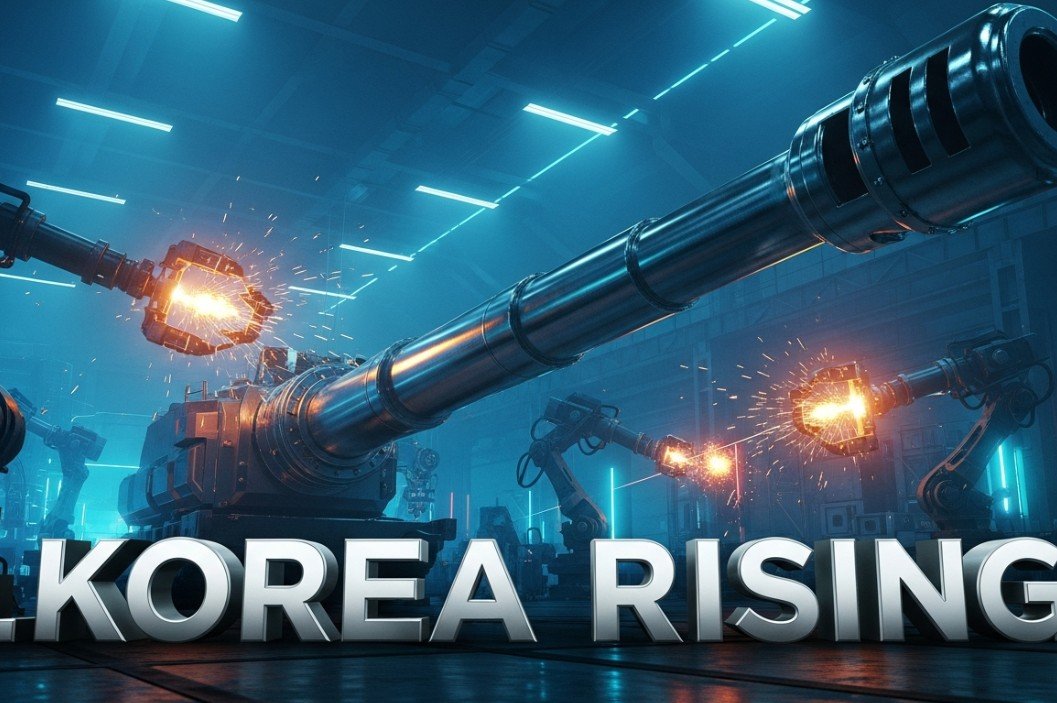
This integration extends to Industry 4.0 protocols. The use of additive manufacturing and smart factory systems is standard practice rather than a novelty. It allows for rapid prototyping and mass production to happen almost simultaneously. This results in high-tech equipment that is robust enough for the battlefield but built with the efficiency of consumer electronics.
Global deals reshape the arms market
The numbers backing this industrial surge are staggering. South Korea has set an ambitious target to become the world’s fourth-largest arms exporter by 2027. Recent years have seen exports jump from roughly $7 billion to over $17 billion. This growth is driven by massive contracts that Western competitors simply could not fulfill in the required timeframe.
Poland’s acquisition of K2 Black Panther tanks and K9 Thunder howitzers serves as the perfect case study. Warsaw needed heavy armor immediately. German and American manufacturers quoted delivery times spanning years. South Korea began delivering tanks within months of the contract signature.
The table below illustrates the competitive edge Seoul currently holds regarding delivery timelines for major land platforms.
| Feature | Western Standard | South Korean Standard |
|---|---|---|
| Production Status | Cold / Warm | Hot / Active |
| Supply Chain | Fragmented | Integrated (Vertical) |
| Delivery Lead Time | 3 to 5 Years | 6 to 18 Months |
| Scalability | Low (Requires CapEx) | High (Existing Capacity) |
This reliability has opened doors beyond Eastern Europe. Nations in the Middle East and the Indo-Pacific are now looking to the KDIA and its members for solutions. The FA-50 light attack aircraft, produced by KAI, is seeing increased interest as a cost-effective alternative to more expensive Western jets. It offers compatibility with NATO standards without the decade-long waitlist.
A future built on constant readiness
The trajectory for South Korea suggests this is more than just a momentary spike in demand. The structural advantages Eugene Kim describes are being cemented into long-term policy. The government is actively supporting R&D to ensure that while they win on speed today, they will win on technology tomorrow.
Huneed Technologies acts as a microcosm of this broader ambition. As a medium-sized enterprise, it connects the dots between global aerospace giants like Boeing and Airbus and the Korean supply chain. Their success in military communications proves that the model works for specialized electronics just as well as it does for heavy armor.
This approach challenges the traditional Western procurement model. It suggests that maintaining industrial capacity is a form of deterrence in itself. By keeping lines active, South Korea signals to adversaries that it can sustain a prolonged conflict. This is a lesson that NATO allies are now frantically trying to relearn.
Until other nations can rebuild their industrial base, Seoul will remain the go-to shop for democracies in a hurry. The blend of corporate strategy, government policy, and geopolitical necessity has created a juggernaut that shows no signs of slowing down.
South Korea has transformed into a global defense titan by keeping its production lines active and integrating military manufacturing with its powerful commercial tech sectors. Led by experts like Eugene Kim, the industry utilizes a “hot” industrial base to deliver weapons systems like K2 tanks and FA-50 jets years faster than Western competitors. As global security threats rise, Seoul’s ability to provide rapid, high-quality defense solutions positions it to dominate the future arms market.