
As offshore wind turbines grow taller and heavier, the race is on to move foundations that now rival skyscrapers in size. A new handling and transport approach is quietly changing how these giant monopiles are lifted, stored, and delivered to sea, cutting time, cost, and port disruption in the process.
Bigger turbines bring a heavier problem onshore
Offshore wind is scaling fast. Taller turbines capture stronger winds farther out at sea, producing more electricity with fewer units per project. That efficiency, however, comes with a physical consequence.
Foundations are getting massive.
Next-generation monopiles now stretch close to 90 meters in length and weigh more than 2,000 tonnes. These steel giants must be lifted, stored, capped, and transferred to installation vessels with tight schedules and little margin for error.
Ports, meanwhile, have limits.
Traditional methods rely on enormous crawler cranes, but cranes large enough to match offshore installation vessels often exceed available space and ground-bearing capacity. Reinforcing quay walls and port surfaces can add months and millions to a project.
That bottleneck has pushed logistics specialists to rethink the entire chain.
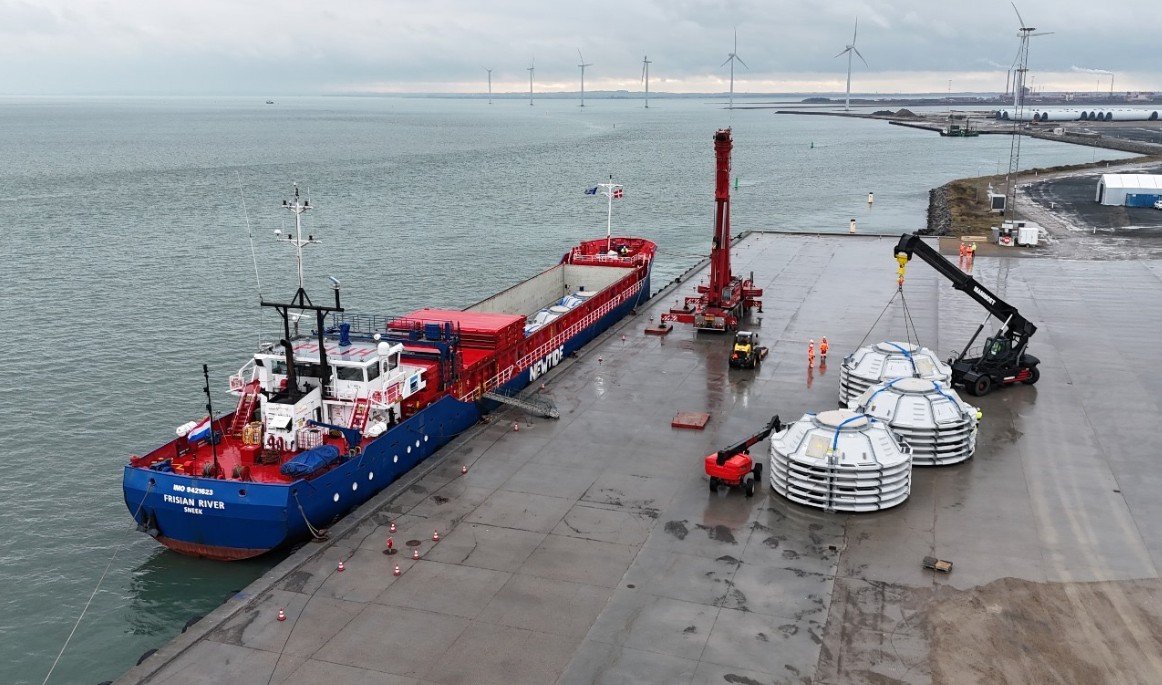
Mammoet’s rethink of monopile handling
Heavy-lift specialist Mammoet has spent recent years developing alternatives that avoid oversized cranes altogether. The aim was simple on paper. Move XXL monopiles faster, safer, and cheaper, without rebuilding ports.
The solution combined two elements.
First, an upgraded terminal crane capable of lifting mega monopiles directly into the water for offshore feedering. Second, a patented jacking-and-cradle system designed specifically for monopiles, used together with self-propelled modular transporters, or SPMTs.
Instead of lifting everything high into the air, the system supports the load along its length. Weight is distributed. Stress is controlled. Space requirements drop sharply.
In practical terms, ports gain breathing room.
Turning a Danish port into an assembly line
The value of that approach became clear at the Port of Rønne in Denmark. There, Mammoet’s equipment effectively turned the quay into a production line for offshore foundations.
Monopiles were offloaded from vessels, transported, temporarily stored, capped to make them watertight, and then lifted into the sea. All of it happened without reinforcing the quay or performing major civil works.
That detail is not minor.
Civil reinforcement can delay projects and strain local infrastructure. Avoiding it keeps ports flexible and reduces knock-on effects for other users.
One sentence captures the shift.
The port worked around the monopiles, not the other way around.
A real-world test at the Windanker project
The technology was deployed during marshalling operations for the Windanker GmbH Windanker offshore wind farm, a 315-megawatt project in the Baltic Sea.
Installation offshore was led by Van Oord, with Mammoet supporting all onshore lifting and transport.
Twenty-one monopile foundations were involved. They arrived at Rønne from Spain in seven separate shipments.
The largest monopile weighed roughly 2,150 tonnes and measured about 87 meters in length.
Those numbers matter.
Handling loads of that scale repeatedly, on a tight schedule, is where conventional methods struggle most.
How the transport system actually worked
Once the monopiles arrived, Mammoet’s XXL transport system came into play. Each monopile was lifted from its grillage using SPMTs fitted with 90 axle lines, spreading the weight evenly across the ground.
The patented cradle held the monopile securely, reducing stress points and limiting movement during transport.
From there, the process followed a steady rhythm.
-
Offloading from the transport vessel
-
Movement to temporary storage areas
-
Placement onto sand bunds
-
Capping operations to seal the structures
-
Call-off for lifting into the water
Each step flowed into the next.
There was no need to reshuffle equipment or wait for specialized cranes to arrive. The same system handled multiple stages.
Less ground pressure, fewer headaches
One of the quieter benefits of the system is reduced ground pressure.
By spreading loads across many axle lines, the SPMTs avoided overstressing the quay surface. This allowed operations to proceed without reinforcing the port or restricting other activities nearby.
For port authorities, that flexibility is gold.
Ports can host large offshore projects without committing to permanent structural changes that may not suit future users.
Project planners, meanwhile, gain predictability. Schedules tighten. Risks drop.
Time savings that ripple through the project
Speed matters in offshore wind. Installation windows are shaped by weather, vessel availability, and grid connection deadlines.
By simplifying onshore handling, Mammoet’s approach trimmed time from the front end of the project. Monopiles were ready when offshore vessels needed them, reducing idle time and costly delays.
Those savings ripple outward.
Shorter port stays mean lower charter costs. Fewer heavy cranes mean fewer specialists on site. Reduced civil works mean fewer approvals and less coordination.
Why this matters as turbines keep growing
The Windanker monopiles are large by today’s standards. They will not be the largest for long.
Offshore turbines continue to climb in height and capacity. Foundations will follow. Ports that cannot adapt risk falling out of the supply chain.
Flexible handling systems offer a way forward.
Rather than upgrading ports for a single project, logistics providers can bring capability with them. That portability aligns with how offshore wind is developing across multiple regions at once.
A shift in offshore construction thinking
What stands out in this case is not just the machinery, but the mindset.
Instead of forcing existing ports to behave like purpose-built yards, the approach adapts to real-world constraints. It treats ports as partners, not obstacles.
For developers and contractors, that reduces friction.
For ports, it opens doors to projects they might otherwise decline.
And for the offshore wind sector, it removes one more barrier between ambition and execution.
Looking ahead
As Europe and other regions push for larger offshore wind farms, the logistics of foundation handling will keep drawing scrutiny. Foundations may sit out of sight once installed, but the way they reach the sea shapes project success.
The Windanker operation shows that there is room to rethink old assumptions.