
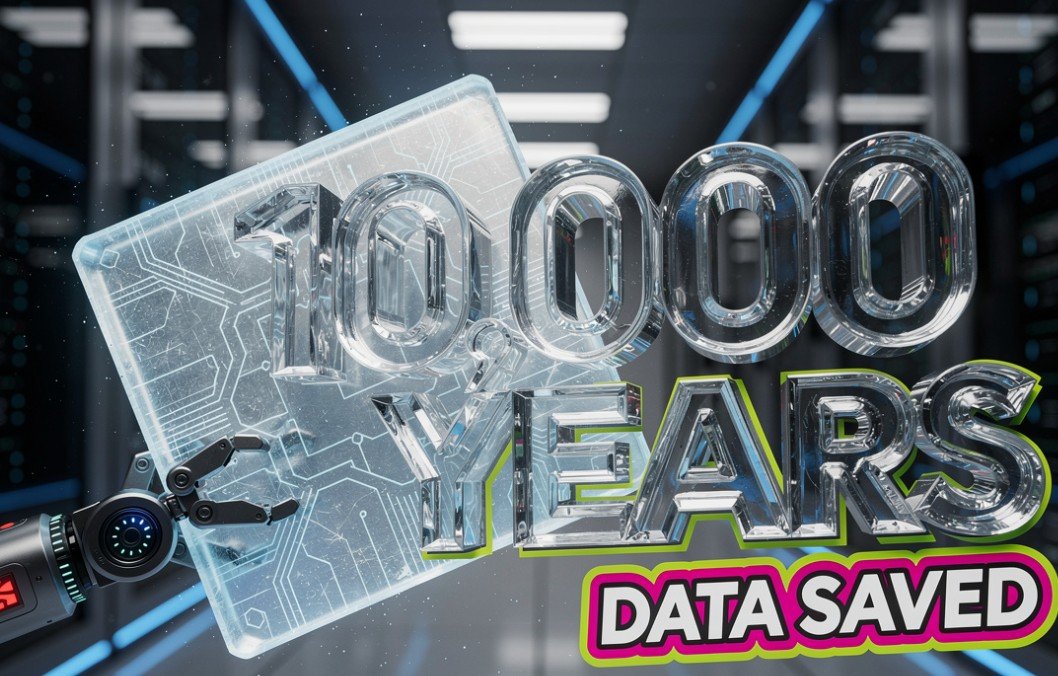
Imagine dropping your family photo album into boiling water or baking your hard drive in an oven. The memories would be gone instantly. But Microsoft is changing this reality with a piece of glass the size of a drink coaster. Their Project Silica initiative has successfully stored data on quartz glass that remains readable for 10,000 years. This breakthrough technology promises to safeguard humanity’s digital history against time, disasters, and magnetic decay.
Lasers writing data inside solid glass
The technology behind Project Silica sounds like science fiction. Engineers are not just scratching the surface of the material. They use ultrafast femtosecond lasers to change the physical structure of the glass itself.
The laser pulses create tiny three-dimensional gratings and deformations known as voxels.
These voxels are buried deep inside the borosilicate glass. Think of it like freezing a moment of time inside an ice cube. But unlike ice, this glass does not melt.
The process is incredibly precise. The laser permanently alters the glass structure at the nanoscale level.
Current optical discs like Blu-rays have data on the surface. This makes them vulnerable to scratches and heat. Project Silica writes the data internally.
You can scrub the outside of the glass with steel wool. You can spill coffee on it. The data remains safe inside the heart of the glass pane.
This method allows for incredible density. Since the laser can focus at different depths, engineers can stack layers of data on top of each other. It creates a multi-layer skyscraper of information within a thin sheet of glass.
Why hard drives and tapes are failing us
We create more data every day than we know how to store. The world is facing a storage crisis that traditional hardware cannot solve.
Hard disk drives are mechanical. They have spinning platters and moving heads that eventually wear out. Most hard drives last only three to five years before they need replacement.
Magnetic tape is the current standard for long-term archives. It is cheaper than disks but still fragile. Tapes degrade over time and sensitive to temperature and magnetic fields.
Companies spend millions migrating data. They have to copy old data to new tapes every few years to prevent “bit rot.” This is expensive and risky.
Project Silica offers a write-once, read-many solution that eliminates the need for data migration.
Once the data is written into the glass, it is chemically and physically locked in place. It does not require electricity to maintain the data. It does not degrade over time.
| Storage Medium | Lifespan | Main Vulnerabilities |
|---|---|---|
| Hard Disk Drive (HDD) | 3-5 Years | Mechanical failure, magnets, heat |
| Magnetic Tape | 15-30 Years | Humidity, temperature, wear |
| Project Silica Glass | 10,000+ Years | Extreme physical force (shattering) |
This durability helps the environment too. Data centers currently consume massive amounts of energy to keep hard drives cool and spinning. Glass storage sits on a shelf at room temperature. It needs zero energy until you need to read the file.
Packing terabytes into a small coaster
The storage capacity of these glass plates is staggering. Early prototypes held only a movie or two. The latest iterations have seen a massive jump in density.
A single small square of glass can now hold roughly 7 terabytes of data.
To put that in perspective, that is enough space to store about 1.75 million songs or 3,500 movies. All of that fits on a square that sits in the palm of your hand.
Microsoft is designing a library system to manage these glass plates. It operates differently than a standard server room.
The glass plates are stored in a passive library. No power runs to the shelves. When a user requests data, a robot retrieves the specific glass slide.
The robot carries the glass to a reader station. This reader does not use a laser to read back the data. It uses a computer-controlled microscope.
Machine learning algorithms analyze the light passing through the glass to decode the data.
The polarization of the light changes as it passes through the voxels. The AI interprets these changes and converts them back into digital files like videos or documents.
This separation of the storage medium from the reader is smart. The glass never changes. But the readers and AI can get faster and better over the decades.
Building a greener future for cloud data
Sustainability is a massive driver for this project. The cloud is not actually invisible. It is made of massive warehouse filled with hot, power-hungry hardware.
Microsoft Azure and other cloud providers are looking for ways to cut carbon emissions. Eliminating the need to constantly replace hardware is a huge step.
Glass storage reduces the e-waste generated by expired hard drives and tapes.
Think about the mineral mining required for hard drives. Think about the plastic used in tape cartridges. Glass is made from silica, which is abundant and cheap.
The durability tests for these glass plates are extreme. Researchers have tried everything to destroy the data.
- Baked at 500 degrees Fahrenheit.
- Boiled in water.
- Microwaved.
- Demagnetized.
- Scoured with steel wool.
In every test, the data remained intact. This makes it ideal for archival data.
Archival data is information you do not need every day but must keep forever. This includes medical records, financial history, legal contracts, and cultural heritage.
The Global Music Vault is already partnering with Microsoft. They plan to store master quality music recordings on glass. They want to ensure our music culture survives for thousands of years.
This shift allows active data to stay on fast SSDs. The cold data moves to glass. It creates a tiered system that is faster, cheaper, and greener.
The timeline for commercial availability is still moving. It is not something you will buy for your home PC next year. It is designed for hyperscale clouds first.
However, the implications affect everyone. Your cloud backup of family photos could one day live on glass. It ensures your great-great-grandchildren can see them.
Microsoft is proving that the most fragile material we know might actually be the strongest guardian of our history.