
BUSINESS
M. Gervich and Sons Outlasted Marshalltown’s Other Scrap Yards
Four Gervich generations came home from law, speech work, and medicine as five Marshalltown scrap yards shrank to one mill-direct shipper founded in 1904.

M. Gervich and Sons is still the scrap yard in Marshalltown, Iowa, four generations after Morris Gervich stepped off a train he could not afford to ride farther. On March 10, 2026, Doug Gervich and his son John, president since 2022, stood at Rotary Club of Marshalltown and told that story again.
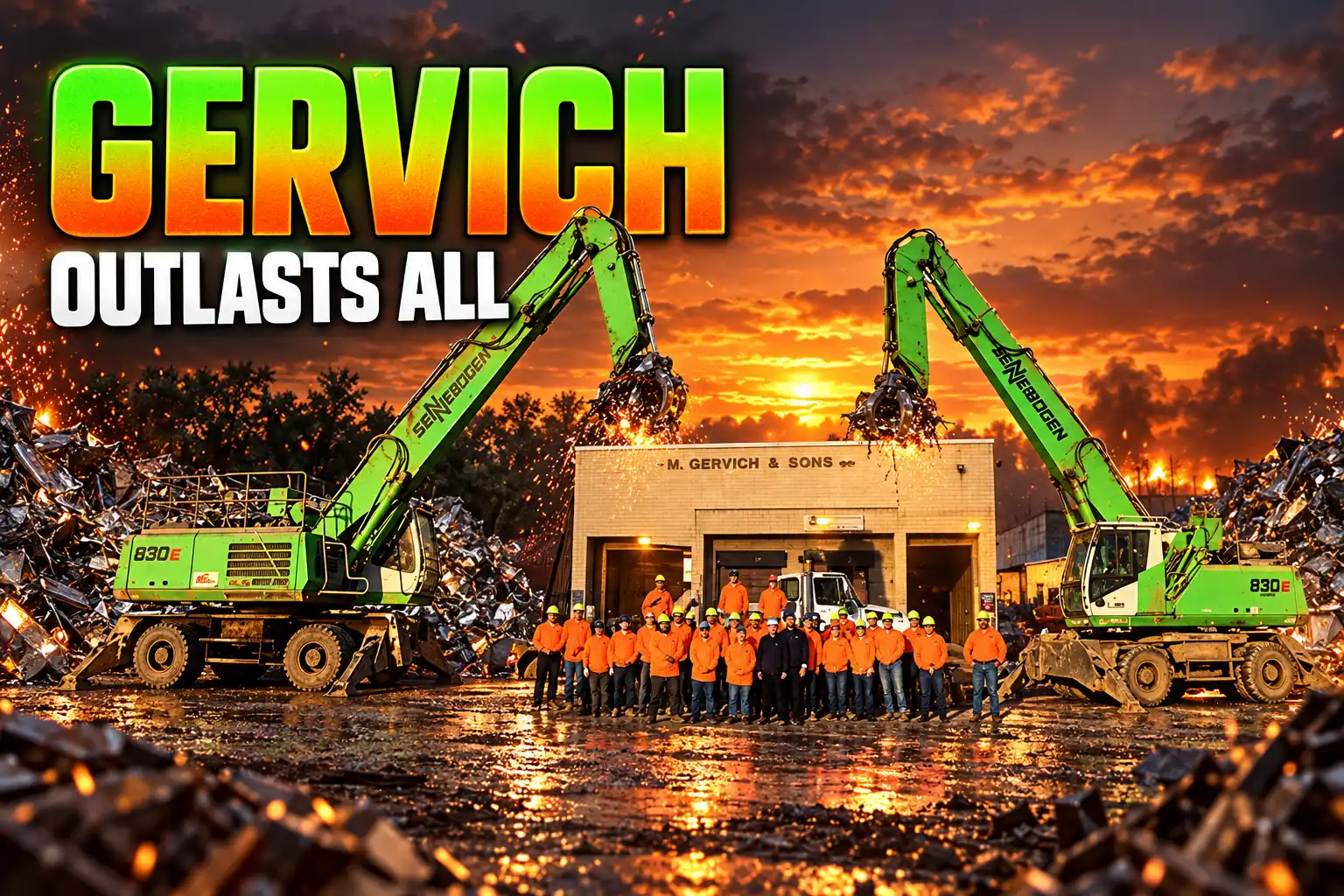
The firm marked its 120th year in 2024 with 28 employees at 901 E. Nevada St. Directories now list a single scrap yard in the city. That is the pattern: each Gervich man came home from another profession as the local field shrank from five yards to one mill-direct shipper.
Why Morris Gervich Never Reached Fort Dodge
Morris fled Nikolaev, a city in present-day Ukraine then under the Russian Empire, after his father warned that searchers were after him. Doug said the young man left Kyiv on a truck of manure and that it took three or four years to reach the United States. He was 18. He came through Ellis Island with $5 and a loaf of bread, and he meant to settle in Fort Dodge, where enough Jews lived to pray as a group.
He ran out of money at the Marshalltown station. Local Jewish residents told him they needed 10 men for a minyan, the quorum required for certain prayers, so he stayed. He collected bones, hides, furs, and metals, then leased ground next to the railroad. He received his citizenship papers in 1904, the same year the business began, and worked a horse and wagon as what the trade then called a collector.
He had the foresight, the knowledge at the time to know that these things he would collect had marketable value, and could at least do enough with them to get by. So in some ways, he might be a reluctant scrapper or entrepreneur.
John Gervich, president, M. Gervich and Sons
Morris ran the yard alone for five years before he hired help. In the late 1930s his son Jules came in. Sam, five years younger, went to law school at the University of Iowa, left for the Army, then finished his last year after the war and prepared to practice. Morris bought him a piece of Marshalltown ground and told him Jules could not handle the place alone. From about 1945 the brothers ran it together. Sam never took a case. He wrote long letters to Rex Ryden, the company’s counsel, and stayed on as a consultant into his mid-80s. He died in 2002.
Each Son Had a Different Profession First
The second, third, and fourth generations all had another job in mind. Sam had the law degree. Doug earned a University of Iowa bachelor’s degree and a master’s in speech pathology and communicative disorders from Truman State University in Missouri, then worked in Ottumwa with his wife Margaret, a Marshalltown native. John graduated from Marshalltown High School in 2003, studied Spanish and political science at Creighton University, and completed two years of medical school before he quit.
FOUR GENERATIONS AT THE YARD
| Generation | Who ran it | First plan | When they came in |
|---|---|---|---|
| First | Morris Gervich | Reach Fort Dodge | Founded the yard in 1904 |
| Second | Jules and Sam Gervich | Sam: law practice | Jules in the late 1930s; both from about 1945 |
| Third | Doug Gervich | Speech pathology | Joined in 1978 |
| Fourth | John Gervich | Medicine | Scale house in 2014 at 29; president in 2022 |
Doug has said he could not wait to leave. He was one of a handful of Jewish children in his elementary school, and he started summer classes at Iowa two weeks after high school. When Sam neared retirement he called his son with a choice that was not really a choice: come home, or watch a larger firm buy the book. Doug came home in 1978 with no business training and spent 15 or so years buying the company.
John’s off-ramp looked the same. After medicine went cold he moved back, he said, because the tunnel vision of school had left him short of other ideas. In 2014, at 29, he took the scale house and called customers “patients” more than once. Coworkers assumed he already knew the plant. He said he had grown up hitting wiffle balls in the warehouse and running an acetylene torch in high school, not studying the metal. It took a few more years before he treated the yard as a career. In 2018, as Doug and Margaret talked more seriously about stepping back and a corporate buyout again sat on the table, he showed he wanted the job.
Five Local Yards, Then Two, Then One
When Sam came home from the Army, five scrap yards worked Marshalltown, and several were bigger than M. Gervich and Sons. By the time Doug was back in 1979, two remained. Krantmans later left both scrap and steel, and the Gervich book grew into the gap.
FROM FIVE YARDS TO ONE
- 1904: Morris Gervich opens the Marshalltown yard the same year he receives his citizenship papers.
- About 1945: Sam and Jules run the company after the war, against five local scrap yards.
- 1978 to 1979: Doug joins; two yards are left in town.
- Around 1995: The firm adds a new-steel division after Krantmans exit scrap and steel.
- 2014: John, 29, starts on the scale at 901 E. Nevada St.
- 2022: John becomes president; Doug still comes in every day.
- 2024: The company marks 120 years with 28 people on the payroll.
Doug later called the firm the “big dog” for industrial scrap inside a 100-mile radius. Peddlers and smaller dealers who cannot go straight to a mill still sell into the same scale. The national picture rhymes with the local one. In 2023 the five leading U.S. steel-scrap processors handled 26 million tons across 354 plants, a concentrated top over a long tail of independent yards.
The Mills That Melt Marshalltown Scrap
The yard is a direct mill shipper of ferrous and non-ferrous scrap, including steel, stainless, carbide, aluminum, copper, zinc, and brass. Doug has described two sides of the trade: factories, wreckers, and peddlers who sell metal in, and the melt shops that buy it as feedstock. Industrial plants are the largest source. A factory box might roll in at 15 to 20 tons. A peddler might bring about two.
MILLS ON THE RECEIVING END
- Nucor Steel
- U.S. Steel
- ArcelorMittal
- Steel Dynamics
- SSAB Steel
- Gerdau Steel
Processed loads move to mills and foundries in Iowa, Wisconsin, Illinois, Nebraska, and Missouri, and sometimes Indiana and Ohio. Ferrous scrap, Doug noted, does not move cheaply from the central plains to the coasts, so the steel stays regional. Non-ferrous can go overseas, and the company has pushed that channel. U.S. Geological Survey figures put apparent consumption of iron and steel scrap at 57 million tons in 2025, up from 55 million tons in 2024, on the back of more than 150 years of scrap use in American steelmaking. Domestic purchases of that scrap were estimated at $19.7 billion in 2025, down from $20.4 billion in 2024. The survey’s rule of thumb is blunt: 1.1 tons of iron ore, 0.6 ton of coking coal, and 0.05 ton of limestone stay in the ground when a mill melts a ton of scrap instead of starting from ore. The U.S. scrap recycling rate has run between 80 and 90 percent for a decade.
A Green Box and a 24-Hour Pickup Promise
Around 1995 the family added a new-steel division because local plants lacked a nearby service center for carbon steel, stainless, galvanized, and aluminum. The website still splits the hours in two. Scrap and new steel both run Monday through Friday, 7 a.m. to 4:30 p.m. Scrap stops taking metal at 4 p.m., and the crane sits idle from 12 to 1 p.m. Both sides close Saturday and Sunday. People who want metal recycled without a sale can drop it in a green box during business hours.
In 2019 Doug said six trucks covered accounts on a 75 to 80 mile daily radius, stretching to 100 miles on special jobs, with a promise to pick up a supplier’s scrap within 24 hours. Drivers start an inbound source-control check at the factory; the scale operator looks over every load; the yard walks the dump the same day. An analyzer gun pressed to a piece of metal reads the basic chemistry in under 10 seconds, which matters when a melt shop will not take high-manganese steel. The cleanness rules for ferrous scrap used in mill trades spell out the same demand in writing: grades are supposed to arrive free of dirt, non-ferrous metal, and foreign material, with only negligible accidents of mixing allowed.
Doug also said the company had looked at a multi-million-dollar automobile shredder and a high-speed non-ferrous baler, then backed off when markets and the bank did not agree. The upgrades that did land were faster shears, larger magnets, and quicker cranes for loading railcars. The yard belongs to the Institute of Scrap Recycling Industries, now operating as ReMA, and Doug cited its Circle of Excellence program for ethics and safety standards.
The Crew John Inherited
The 28-person roster in 2024 matched the count Doug gave in 2019, when four or five people had already been there more than 30 years. John met Claire Hanken, a fellow Marshalltown graduate, on the day of the town’s EF-3 tornado. They married less than two years later and have three sons. He has said he hopes that after 30 years the company is still a reliable employer for the 28 people who bought into the operation, and that it remains a decent steward of the metal it handles.
Marshalltown looks a lot different than it did when I grew up. We are better as a community for it. We’re better as a company for it. The diverse population brings the town a great spirit, more perspectives, and our company benefits from all of that.
John Gervich, president, M. Gervich and Sons
The yard hires from the same newer immigrant streams that remade the town, mainly from Latin America and Bosnia. Doug has said workers tell him John is the best boss they have had, and that his son understood from the start that employees are the most valuable resource, even if the pay cannot match the city’s largest plants. After the tornado the company told residents they could drop empty appliances at no charge during cleanup. That is the same civic role the minyan once asked Morris to fill: be the extra pair of hands the town actually needs.
Doug Gervich Still Takes the Rotary Microphone
John took the president’s title in 2022, but the handoff did not empty the office. Doug still came in every day when the 120-year mark was being written up, and he was still on the program with his son at Marshalltown Rotary on March 10, 2026. Todd Jacobus, commandant of the Iowa Department of Veterans Affairs, posted that the two men had spoken about the fourth-generation yard begun in 1904 by Morris, a Russian immigrant. John also appears as a board member on the Marshalltown Chamber of Commerce’s 2025 filing.
Iowa DNR inspector Malia Schepers walked the plant on December 30, 2025, for an appliance-demanufacturing permit check, the first since May 12, 2021. A January 5, 2026, letter on that December 2025 appliance demanufacturing inspection went to Jimmy Perez, listed as the responsible official, at the Nevada Street address. Refrigerant is collected indoors and sent to Johnstone in Ames. The file is the unglamorous proof that the place is still open, still permitted, and still taking white goods apart so the metal can move.
Doug has said his son does not need him, and that the disheartening part is watching John handle email-first customers, wages, and HR while mill visits fill with other 40-year-olds. John has said you do not accomplish anything on your own. If the family pattern holds, one of his three sons will hear the same call Sam, Doug, and John each tried to dodge, and the last yard in Marshalltown will ask him to come home anyway.

Saquon Barkley’s Hamstring Leaves the Eagles Thin in London

The Online US Passport Still Needs a Witnessed Oath

Ken Urker Died on His Birthday With No Cause Named

FOX Ices Portnoy After Ohio State’s Access Fight

Micron’s Record Memory Profits Lock RAM Tight Through 2028

Musk’s $914 Billion Lead Is a Public SpaceX Bet

Microsoft’s 96% Cyber Score Sits at 86.3% on the Board

Free Live Sports Streaming in 2026: What to Watch Without Cable

Endgame Encore’s $86 Million Trial for Infinity Vision

The Odyssey’s IMAX Film Run Hit a 41-Theater Limit
-
 BUSINESS4 months ago
Musk’s $914 Billion Lead Is a Public SpaceX Bet
-
 NEWS2 months ago
Microsoft’s 96% Cyber Score Sits at 86.3% on the Board
-
 SPORTS3 months ago
Free Live Sports Streaming in 2026: What to Watch Without Cable
-

 ENTERTAINMENT4 weeks ago
Sterling Point Holds No. 2 on Prime Video After 32 Days
-
 ENTERTAINMENT3 months ago
The Odyssey’s IMAX Film Run Hit a 41-Theater Limit
-
 ENTERTAINMENT3 months ago
Endgame Encore’s $86 Million Trial for Infinity Vision
-

 ENTERTAINMENT2 years ago
Andrew Garfield’s Spider-Man Films Are No Longer Free
-

 NEWS4 weeks ago
G20 Cheers AI Investment After Bailey’s Frontier Cyber Warning