
Refuelling time has long been the psychological barrier keeping many drivers loyal to petrol cars. BYD now appears determined to chip away at that final objection, unveiling ultra-fast charging capabilities that shrink waiting times to something approaching a regular fuel stop.
A short video circulating online this week may mark a turning point.
In the clip, a BYD electric vehicle plugs into a high-capacity charging station and surges to nearly 750 kilowatts, adding a substantial amount of range in under five minutes. For an industry still struggling to convince drivers that electric can be just as convenient, the message is hard to miss.
A video that caught the industry’s attention
The footage, shared on social media by automotive observer Dominic Lee, shows a BYD model charging at a peak rate of about 746 kW. According to on-screen estimates, the vehicle reaches roughly 70% charge in about four minutes and 40 seconds.
That kind of speed is rare even by global standards.
Most public fast chargers today operate in the 150 kW to 350 kW range. Even premium EVs capable of higher intake often taper quickly to protect battery health. BYD’s demonstration suggests a system designed to hold extreme charging rates longer than most rivals.
The automaker has not disputed the figures shown in the video.
Instead, it has pointed to the technology underpinning the feat.
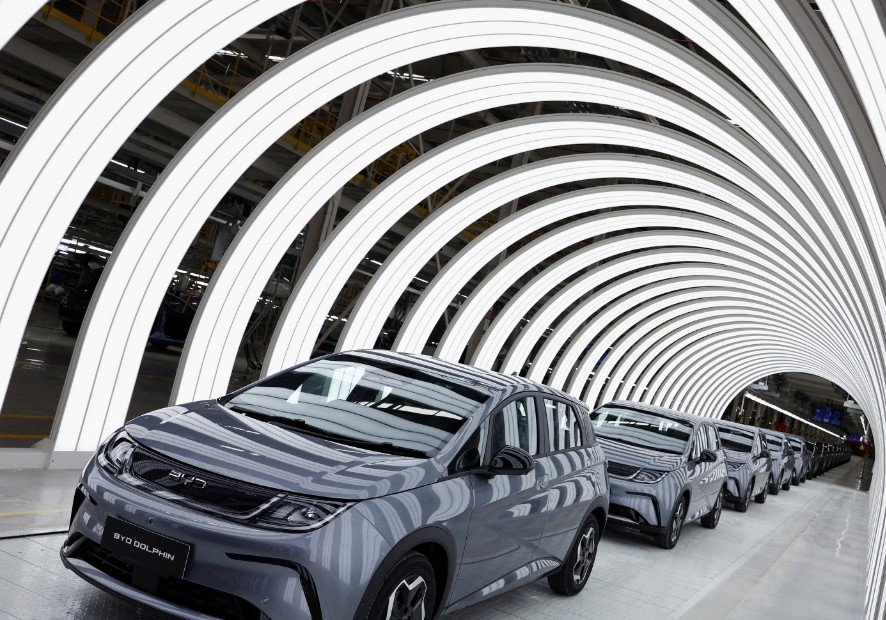
The Super e-Platform explained
At the heart of BYD’s fast-charging claim is its Super e-Platform, first deployed in two flagship models, the Han L sedan and the Tang L SUV.
The platform brings together several high-spec components designed to work as a system rather than isolated upgrades.
BYD says the architecture includes:
-
A 1,000-volt high-voltage electrical system
-
A Flash Charging Battery capable of handling up to 1,000 amps
-
Charging rates up to 10C, far higher than most current EVs
-
Support for “dual-gun” fast charging at compatible stations
The setup allows the vehicle to accept massive amounts of energy in very short bursts, while managing heat and stability within the battery pack.
According to the company, the Han L can charge from 10% to 70% in about six minutes, with a full charge completed in roughly 20 minutes. The larger Tang L can recover up to 370 kilometers of driving range in just five minutes under ideal conditions.
Those are numbers that, even a few years ago, would have sounded unrealistic.
Blade batteries, refined again
Both vehicles rely on BYD’s second-generation Blade battery technology, based on lithium iron phosphate (LFP) chemistry.
The Han L uses an 83.2 kWh version, while the Tang L carries a larger 100.5 kWh pack.
LFP batteries are generally known for safety, durability, and lower cost, but they have historically lagged behind nickel-based chemistries in charging speed and energy density. BYD’s latest iteration suggests that gap is narrowing.
By pairing LFP cells with a high-voltage system and aggressive thermal management, BYD is pushing the chemistry into territory once dominated by more expensive alternatives.
That matters because LFP batteries are already widely used in China and increasingly adopted elsewhere. Scaling this technology could have broad implications.
Why refuelling time still matters
Range anxiety often gets the headlines, but industry surveys consistently show that charging time is just as important for many drivers.
Petrol cars offer a familiar rhythm. Pull in, refuel, leave. Even drivers open to electric vehicles worry about long stops, queues, and uncertainty on road trips.
Ultra-fast charging attacks that concern directly.
If an EV can add hundreds of kilometers of range in five minutes, the mental model changes. Charging becomes something you do briefly, not something you plan your day around.
That’s why automakers and charging networks are racing to close this gap, even if such speeds are not available everywhere yet.
Infrastructure remains the limiting factor
As impressive as BYD’s demonstration looks, it raises an obvious question. Where can drivers actually charge like this?
Ultra-high-power charging requires:
-
Dedicated high-capacity stations
-
Reinforced grid connections
-
Vehicles capable of sustained high intake
China has moved faster than most markets in deploying new charging infrastructure, especially along major corridors. BYD’s test appears to have taken place at a purpose-built station designed to showcase peak performance.
Outside China, infrastructure lags behind.
In Europe and North America, most public chargers top out well below 500 kW, and grid constraints make rapid expansion challenging. Even if vehicles are ready, the ecosystem must catch up.
Still, technology tends to lead infrastructure, not the other way around.
A narrowing gap with combustion engines
Traditional internal combustion vehicles still win on refuelling simplicity. A few minutes at a pump, and you’re back on the road.
BYD’s latest move doesn’t eliminate that advantage entirely, but it narrows it significantly.
For daily driving, most EV owners already charge at home. Ultra-fast charging matters most on long trips, where time sensitivity is highest.
If five-minute stops become common, the practical difference between electric and petrol travel shrinks to near insignificance for many users.
That shift could influence buying decisions more than range figures alone.
Competitive pressure on global automakers
BYD’s announcement adds pressure to other manufacturers working on fast-charging solutions.
Several brands have promised sub-10-minute charging windows in future models, but few have publicly demonstrated speeds approaching 750 kW. Even fewer have done so using LFP batteries.
Rivals will now face questions about timelines, scalability, and cost.
The race is no longer just about who offers the longest range or the biggest screen. It’s about who wastes the least time.
Caution from engineers and analysts
Not everyone is ready to celebrate just yet.
Battery experts caution that repeated ultra-fast charging can accelerate degradation if not managed carefully. Heat, current density, and long-term cell stability remain concerns, even with advanced control systems.
BYD insists its design prioritizes durability and safety, pointing to extensive testing and the inherent stability of Blade batteries. Independent long-term data, however, will take time to emerge.
There’s also the matter of real-world conditions. Peak charging speeds are usually achievable only under optimal temperatures and battery states.
Drivers may not see these numbers every time.
Why this still matters
Even with caveats, BYD’s progress sends a strong signal.
Electric vehicles are evolving quickly, and the traditional arguments against them are losing weight one by one. Charging speed was one of the hardest problems to solve. It now looks far less daunting than it once did.
For consumers, this translates into choice. For the industry, it raises the bar.