
Marico Limited posted a 25% year-on-year rise in consolidated profit after tax to ₹630 crore for the quarter ended 30 June 2026, its highest PAT growth in 28 quarters, as India volumes climbed 11% and revenue rose 23% to ₹3,957 crore. EBITDA matched the PAT rise at 25% to ₹819 crore, with margins up 40 basis points to 20.7%.
The beat rested less on any single brand spike than on a clear second-layer shift: Foods and premium personal care scaling fast enough to dilute commodity exposure, while international growth outside Bangladesh stayed firm. Management reiterated confidence in crossing ₹15,000 crore revenue in FY27.
The Numbers That Hit Multi-Quarter Highs
Consolidated revenue from operations reached ₹3,957 crore from ₹3,221 crore a year earlier. India contributed ₹3,003 crore, up 21%. International revenue rose 29% in rupee terms and 15% in constant currency. Shares closed near ₹875 on the NSE, leaving the company with a market capitalisation of about ₹1.13 lakh crore.
Advertising and promotional spends also rose 25% as the company kept funding brand equity. Over 96% of the domestic business either gained or held market share on a moving annual total basis. E-commerce accelerated, with quick commerce growing more than 50%.
- PAT: ₹630 crore, +25% YoY, highest growth in 28 quarters
- EBITDA: ₹819 crore, +25%, margin 20.7% (+40 bps)
- India volume: +11%, highest in 20 quarters
- Consolidated revenue: ₹3,957 crore, +23%
The full Q1 FY27 earnings presentation details confirm the two-year CAGRs of 10% volume, 23% revenue and 17% PAT, underscoring consistency rather than a one-off bounce.
| Metric | Q1 FY27 | Q1 FY26 | Change |
|---|---|---|---|
| Revenue (₹ cr) | 3,957 | 3,221 | +23% |
| EBITDA (₹ cr) | 819 | 655 | +25% |
| EBITDA margin | 20.7% | 20.3% | +40 bps |
| PAT (₹ cr) | 630 | 504 | +25% |
| India volume growth | 11% | – | 20-qtr high |
PBT rose about 20% to ₹790 crore. Standalone revenue was ₹2,794 crore, up 19%, with standalone PAT at ₹460 crore.
Parachute, Saffola and the Volume Rebound
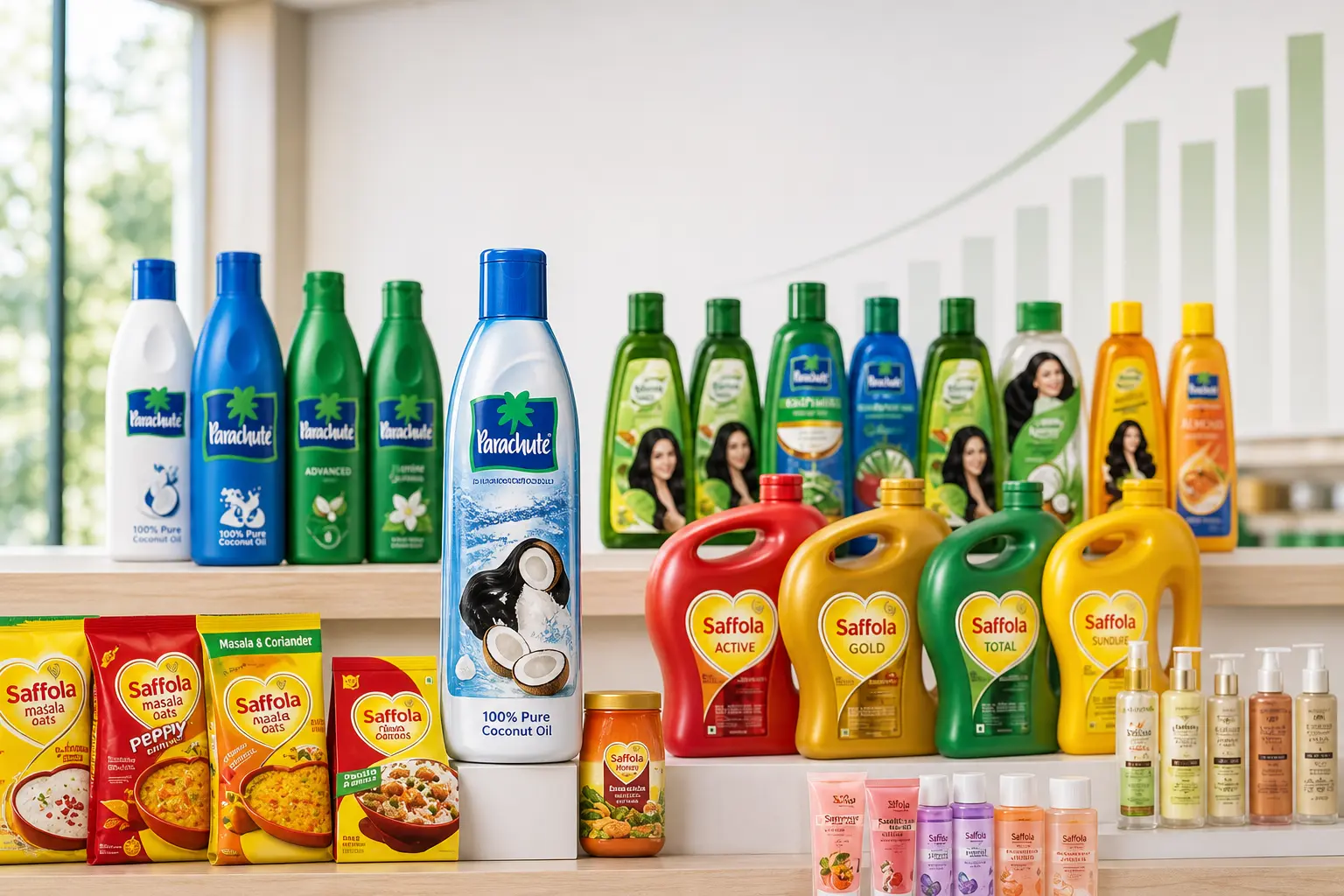
Parachute Rigids, the flagship coconut oil brand and roughly 35% of India revenues, delivered 10% volume growth and 23% value growth, its strongest volume print in 20 quarters. Volume market share hit a record 59%. Value-Added Hair Oils (about 18% of India revenues) posted 22% value growth and an 80 bps MAT value market-share gain, helped by Project SETU’s direct-reach push into mid and premium segments.
Saffola Edible Oils (16% of India revenues) managed 7% value growth even as volumes fell high-single-digit. Management deliberately rationalised supply of select variants to protect threshold profitability rather than chase every volume point. The trade-off kept the franchise healthy while the broader portfolio carried the volume load.
- Parachute Rigids: 10% volume, 23% value, 59% volume market share
- Value-Added Hair Oils: 22% value growth, share gains on MAT
- Saffola Oils: 7% value, high-single-digit volume decline by design
- Quick commerce: over 50% growth inside an accelerating e-commerce channel
Domestic traditional and organised trade both delivered double-digit expansion. The pre-results operating update on demand had already flagged the multi-quarter high volume trajectory and Parachute’s double-digit recovery before the board locked the final numbers.
Foods Crosses a New Run-Rate Threshold
The Foods portfolio expanded 43% and crossed an annualised revenue run-rate of ₹1,300 crore. Saffola Oats, Soya Chunks and Muesli led the charge. Recently acquired brands 4700BC and Cosmix posted sequential growth in the quarter. Premium Personal Care, including digital-first brands, reached an annualised run-rate above ₹1,100 crore, with the premium hair-nourishment, cleansing, male-grooming and skincare slice alone above ₹450 crore annualised.
| Portfolio | Q1 Growth / Run-rate | Notes |
|---|---|---|
| Foods | +43% value / ₹1,300+ cr ARR | Oats, Soya Chunks, Muesli lead |
| Premium Personal Care (incl. digital) | ₹1,100+ cr ARR | Beardo, Plix, Just Herbs traction |
| Premium hair & related slice | ₹450+ cr ARR | Nourishment, cleansing, grooming |
Contribution of Foods and Premium Personal Care (including digital-first) to India revenues has climbed steadily from low-single digits years ago toward the mid-20s range on a trailing basis, with management targeting roughly 27% by FY27 and 33% by FY30. Digital-first brands are on track for double-digit EBITDA margins by the end of FY27. The scale-up is the clearest second-order driver: every rupee of Foods and PPC growth carries higher structural margins and lower commodity beta than the core oil franchises.
Vietnam and MENA Pull Ahead of Bangladesh
International constant-currency growth of 15% came despite Bangladesh, still the largest overseas market, slowing to 4% CCG. Pricing anniversary effects and inflation-linked demand softness weighed on the Bangladesh franchise. Vietnam led with 27% CCG on strong traction in both male and female personal care. MENA delivered 24% CCG, helped by Gulf markets, GTM changes, e-commerce and Egypt. South Africa grew 8%, with hair care still the main engine.
Non-Bangladesh markets now contribute around 59% of international revenues, up from roughly 50% a couple of years earlier, and management aims for about 65% by FY30. The February 2026 acquisition of a 75 per cent stake in Skinetiq, a Vietnam D2C beauty and personal-care player, extends the digital and premium footprint in that market. Integration of Beardo and Just Herbs into the parent is also expected to streamline operations.
On X, Marico’s own account framed the quarter as “continued progress across our strategic priorities” driven by “innovation, premiumisation, and disciplined execution.” Street commentary noted the “boringly consistent” quality of the print and the clean beat on margins; several brokerages reiterated Buy ratings with targets in the ₹900-950 zone citing domestic volumes, digital acceleration and the FY27 outlook.
Copra Falls While Packaging Stays Hot
Copra prices declined 29% year-on-year and sit well below recent peaks (down roughly 45% from the high), though still above long-term historical averages. Management expects them to stay broadly range-bound with a mild upward bias. That tailwind more than offset sharp inflation in crude-linked inputs: liquid paraffin rose 97% and HDPE climbed 65%. Rice bran oil, relevant for Saffola, was up about 23% year-to-date.
Gross margin improved sequentially on the copra relief and a richer product mix. The company continues to run its MarVal structural cost programme and lean on supply-chain intelligence for core commodities. Higher A&P investment of 25% was absorbed without margin compression, a sign that operating leverage from the growth engines is starting to show.
Crossing Fifteen Thousand Crore This Year
MD and CEO Saugata Gupta said the company remains confident of crossing the ₹15,000 crore revenue mark in FY27. The full-year framework calls for high-single-digit volume growth in India, mid-teens constant-currency growth internationally, and high-teen EBITDA growth. Medium-term, Marico is aiming for a double-digit revenue CAGR that takes the group past ₹20,000 crore by 2030, with mid-teen EBITDA CAGR, premium categories at roughly 50% of the portfolio, and digital-first businesses already at double-digit margins.
The company was confident of crossing the ₹15,000 crore revenue mark in FY27, with expectations of high single-digit volume growth in India, mid-teens constant currency growth internationally, and high-teen EBITDA growth for the full year.
That is Saugata Gupta’s reiterated stance after the board approved the numbers. Mayank Jain, market analyst at Share.Market by PhonePe, called out the broad-based execution and the Skinetiq addition as a highlight for the international piece, while noting that the long-term technical trend for the stock remains constructive.
The second-order story is straightforward. Core brands still deliver the bulk of profit and cash, but Foods, premium personal care and non-Bangladesh international markets are growing fast enough to change the company’s risk profile and margin trajectory. The multi-quarter highs in volume and PAT growth are the visible proof. The quieter proof sits in the run-rates, the mix targets and the rising share of businesses that do not live or die by the next move in copra. Full materials remain available on the Marico investor relations hub.
Frequently Asked Questions
What were Marico’s exact Q1 FY27 consolidated revenue and PAT figures?
Consolidated revenue from operations was ₹3,957 crore, up 23% from ₹3,221 crore, while PAT reached ₹630 crore, up 25% from ₹504 crore, marking the highest PAT growth rate in 28 quarters.
How fast did Marico’s Foods portfolio grow and what is its annualised run-rate?
Foods grew 43% in value and crossed an annualised revenue run-rate of more than ₹1,300 crore, led by Saffola Oats, Soya Chunks and Muesli, with 4700BC and Cosmix also contributing sequential gains.
What volume market share did Parachute Rigids reach in Q1 FY27?
Parachute Rigids hit a record 59% volume market share inside the coconut oil category after posting 10% volume growth, its strongest volume performance in 20 quarters.
By how much did copra prices fall year-on-year and what happened to packaging inputs?
Copra prices declined 29% year-on-year (and roughly 45% from peak levels), while liquid paraffin rose 97% and HDPE rose 65%, so the copra relief offset crude-linked cost pressure.
What stake did Marico take in Skinetiq and when?
Marico’s South-East Asia subsidiary acquired a 75% equity stake in Vietnam D2C beauty company Skinetiq in February 2026 for approximately ₹261 crore to expand its premium and digital footprint.
What full-year FY27 guidance did Marico reiterate after Q1?
Management expects high-single-digit India volume growth, mid-teens international constant-currency growth, high-teen EBITDA growth, and consolidated revenue crossing ₹15,000 crore.