Marketing slides and a May 2026 technical document obtained by MyMobiles with OnLeaks lay out the Pixel Watch 5 in full a week before Google’s August 12 event: 64GB storage, Wear OS 7, and batteries that grow by only a few milliamp-hours while rated life stays flat. The Snapdragon W5 Gen 2, 3,000-nit Actua 360 display and charge times match the Watch 4 exactly. US prices are set to rise across every configuration.
Google is betting Gemini Intelligence and tighter health software can sell that package. Samsung’s Galaxy Watch 9, already on sale with a newer chip, makes the wager public.
The leak arrives late enough to lock expectations and early enough to shape the pre-order conversation. Hardware continuity is the through-line. Software differentiation is the ask.
What the Leak Puts on the Table
OnLeaks shared the promo material and both size sheets on August 4. MyMobiles published the full set the same day. The pitch slides barely mention silicon. They lead with Gemini as a proactive assistant that surfaces information and suggests replies from the conversation on the watch face, “most accurate sleep tracking yet,” and Loss of Pulse Detection that can alert emergency services if a pulse vanishes.
Satellite SOS returns with two years included at no extra cost after activation. The case stays 100% recycled aluminum. Packaging is plastic-free. Four finishes appear: Matte Black, Polished Silver, Satin Pyrite, and Champagne Gold limited to the 41mm model.
- Storage: 64GB on both sizes, double the Watch 4
- Batteries: 332 mAh (41mm) and 465 mAh (45mm)
- Rated life with AOD: still up to 30 hours and 40 hours
- Software: Wear OS 7.0 out of the box
An earlier Google Play Console listing pointed to 3GB of RAM, up from 2GB. The latest technical document does not list memory capacity, so that figure remains unconfirmed in the new materials.
The materials treat storage and the free satellite window as checklist wins rather than headline features. Gemini, sleep accuracy, and Loss of Pulse sit at the top of every slide deck. That ordering is the strategy in miniature: sell the assistant and the health layer, then note the capacity bump as a quiet upgrade.
Because the technical document and the promo slides arrived together, the gap between marketing claim and component list is easy to measure. Where the two disagree or stay silent, as with RAM, the safer reading is the one that withholds the number.
The Parts That Do Not Move
Side-by-side with the Pixel Watch 4 official tech specs, the carry-over list is long. Both sizes keep the 12.3 mm thickness and nearly identical weights (31 g and 36.7 g without strap). The Actua 360 LTPO AMOLED still runs 1-60 Hz and peaks at 3,000 nits under custom 3D Gorilla Glass 5. The Qualcomm Snapdragon W5 Gen 2 and Cortex-M55 coprocessor return. Charging still hits 50% in about 15 minutes; full charge stays roughly 45 minutes on the small watch and 60 minutes on the large one.
| Spec | Pixel Watch 4 | Pixel Watch 5 (leaked) |
|---|---|---|
| Storage | 32GB | 64GB |
| Chip | Snapdragon W5 Gen 2 | Snapdragon W5 Gen 2 |
| Display peak | 3,000 nits Actua 360 | 3,000 nits Actua 360 |
| Battery 41mm / 45mm | 325 mAh / 455 mAh | 332 mAh / 465 mAh |
| AOD life | 30 h / 40 h | 30 h / 40 h |
| OS at launch | Wear OS 6 | Wear OS 7 |
Sensors, 5 ATM and IP68 ratings, dual-frequency GPS, Bluetooth 6.0, Wi-Fi 6, UWB and the haptic crown all look unchanged. Existing screen protectors and bands should fit from day one because the glass dome and lug system carry over.
The battery cells rise by 7 mAh on the 41mm and 10 mAh on the 45mm. Rated always-on life does not move. That pairing implies the extra capacity is absorbed by the same display budget, the same radios, and whatever background work Wear OS 7 and Gemini add on the wrist.
Charge speed parity matters for daily rhythm. A buyer who already tops up during a shower or a commute will feel no new friction and no new freedom. The dock behavior is a known quantity, which keeps accessory reuse simple and removes one variable from the upgrade decision.
Software Carries the Entire Pitch
Google’s own slides make the strategy plain. Hardware talk is almost absent. The four themes are Gemini, sleep, Loss of Pulse, and the familiar battery claim of “up to 40 hours.”
- Gemini Intelligence is framed as a personal, proactive assistant that anticipates needs and offers reply suggestions drawn from on-screen conversation.
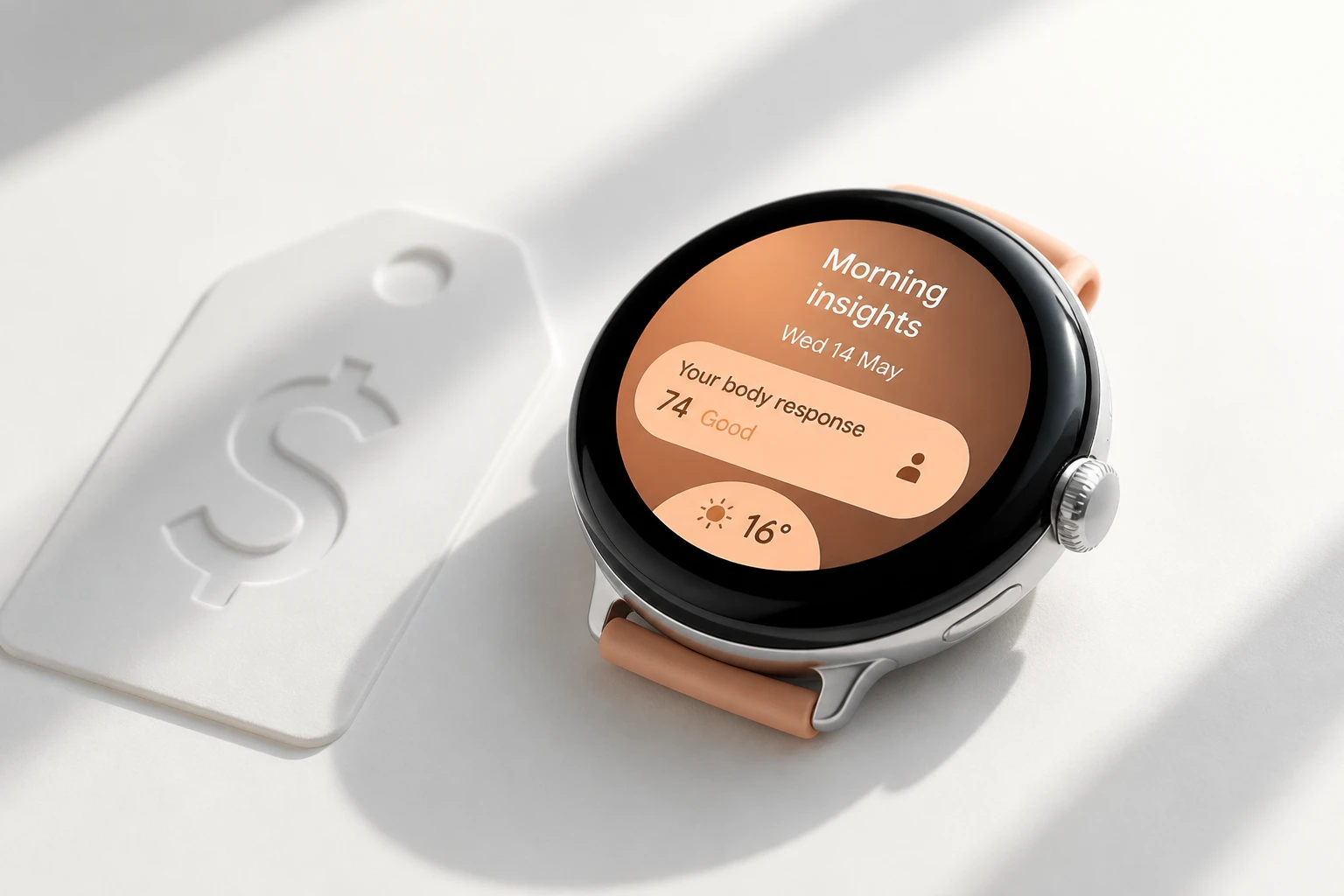
- Sleep tracking is called the most accurate yet, with stages, breathing rate, a personalized sleep score, and a morning Insights screen that pairs readiness data with the day’s weather.
- Loss of Pulse Detection, which first shipped on the Pixel Watch 3 in supported markets, gets prominent placement even though it is not new to the line.
- Morning Insights and deeper Google Health integration continue the Fitbit-rooted health stack that already pairs with tools many owners use daily.
Wear OS 7 arrives on the new watch while older Pixel Watches are already receiving the same platform. Owners who bought the Watch 4 or even the Watch 3 with its three years of Wear OS updates on earlier models will see many of the same software gains without opening their wallets again.
That update path cuts both ways. It lowers the penalty for skipping a generation, and it raises the bar for what must feel new on day one of the Watch 5. If Gemini reply suggestions and the morning Insights layout are the differentiators, they have to feel faster, clearer, or more useful on the new hardware than on a Watch 4 that receives the same platform train.
Loss of Pulse Detection’s return to the spotlight is telling. The feature is established in the line, yet the slides still lead with it. Continuity of safety messaging appears to matter as much as novelty. The health stack is being sold as a maturing system, not a single-year leap.
A Higher Price Meets a Faster Rival
Leaked US pricing puts the 41mm Wi-Fi model at $399 and LTE at $499. The 45mm versions land at $429 and $529. That is a clean $50 step up from the Pixel Watch 4 battery and starting price structure that opened at $349 for the small Wi-Fi watch. In the UK the rise hits mainly the 41mm; the 45mm holds prior levels.
Samsung already launched the Galaxy Watch 9 on July 22. General availability began August 7. The Galaxy Watch 9 Snapdragon Wear Elite launch brought a new 3 nm platform Samsung says delivers large CPU and GPU gains over the W5 Gen 2 generation, a 390 mAh cell in the 40 mm model, the same 3,000-nit brightness class, and a US starting price of $379.99. LTE variants sit lower than the leaked Pixel LTE tags. The Ultra2 adds an 800 mAh battery and a 5,000-nit panel for those who want the high-end path.
| Model | US start (Wi-Fi) | Silicon note | Store timing |
|---|---|---|---|
| Pixel Watch 5 41mm | $399 (leaked) | W5 Gen 2 (carry-over) | Event August 12 |
| Pixel Watch 4 41mm | $349 (launch) | W5 Gen 2 | Already shipping |
| Galaxy Watch 9 | $379.99 | Wear Elite, 3 nm | On sale since August 7 |
On paper the Galaxy Watch 9 offers newer silicon and earlier store presence at a lower entry price. Google’s counter is deeper Gemini integration on the wrist, Pixel-exclusive health polish, and the existing band ecosystem.
The $50 US uplift on every Pixel configuration widens the gap the software story must close. Buyers comparing LTE tags will see the Samsung side land lower still. The Ultra2 then occupies the brightness and multi-day battery extreme that the Pixel line does not chase on this cycle.
Who Has a Reason to Move
Current Pixel Watch 4 owners gain little silicon. They already own the same display, chip family, charge speed and endurance ratings. The doubled storage helps music and offline maps. Wear OS 7 and any Gemini refinements will reach them through updates in most cases. The rational move for many is to wait for the inevitable discount on the outgoing model once the Watch 5 ships.
Buyers stepping up from a Watch 3 or earlier, or first-time Pixel Watch customers who want the latest health features and free satellite SOS window, form the clearer audience. They also inherit full band and protector compatibility, which lowers the total cost of ownership. Anyone already deep in Google health pairing with Fitbit tools keeps that continuity.
Android users who prioritize raw processor headroom and multi-day potential may simply choose the Watch 9 that is already on shelves. Crowd reaction on X treated the leak as confirmation of a near-rebadge; one early reply under the OnLeaks post called it “the same watch.” That sentiment is the pressure Google’s software bet must overcome.
Compatibility is the quiet subsidy for switchers inside the Pixel line. Reusing bands and protectors trims the real outlay even when the watch itself costs more than last year’s opener. For households already stocked with Sport Bands and fitted glass, that reuse narrows the effective premium.
The Launch Calendar Leaves Little Slack
The competitive window is already open. Samsung’s July 22 launch and August 7 general availability put finished watches in hands before Google takes the stage. The Pixel event on August 12, expected pre-orders the same day, and wider availability rumored around August 20 leave a short runway to reverse first impressions.
- End of June: Four model numbers clear the FCC.
- July 22: Galaxy Watch 9 launches.
- August 4: OnLeaks and MyMobiles publish the Pixel Watch 5 materials.
- August 7: Galaxy Watch 9 reaches general availability.
- August 12: Made by Google event in New York.
- Around August 20: Wider Pixel Watch 5 availability rumored.
By the time shoppers can order a Watch 5, the Watch 9 will have had days of unboxing, reviews, and shelf presence. Google’s answer has to travel through software demos and health feature walkthroughs rather than a chipset chart. The shared stage with the Pixel 11 series is meant to supply that narrative frame: the watch as companion, not as a solo silicon refresh.
How Storage and Updates Change the Math
Doubling storage to 64GB is the clearest hardware gain that does not depend on a future software drop. Offline maps, music libraries, and local caches stop competing as hard for space. For travelers and gym users who keep media on the wrist, that change is immediate.
The Wear OS 7 launch-day advantage is thinner. Older Pixel Watches are already on the same platform path, and the Watch 3’s three-year update promise showed Google’s willingness to keep prior hardware current. The Watch 5 therefore has to win on how Gemini and the health surfaces feel when they are tuned to the new unit, not merely on version numbers printed on a box.
- 64GB reduces offload trips for music and maps.
- Wear OS 7 parity across recent models softens the upgrade stick.
- Free satellite SOS for two years after activation sweetens first-time buys.
- Unconfirmed RAM leaves performance headroom as an open question.
Together those points sketch a buyer who values continuity and on-wrist assistance over a clean-sheet processor. They also sketch the buyer who will wait: anyone content with Watch 4 silicon and willing to let discounts and shared software updates do the work.
Colors, Box Contents and the Fine Print
Matte Black pairs with Volcanic Black band, Polished Silver with Mist, Satin Pyrite with Olive, and Champagne Gold (41mm only) with Peach Pink. The second-generation Sport Band ships in two sizes. In the box: watch, bands, USB-C fast charging dock, quick start guide. No wall adapter; charge times assume a 30 W brick.
Sustainability language tightens: 100% recycled aluminum case, battery cobalt, and rare-earth magnets. Warranty is listed at two years in the UK, EEA, Switzerland and Australia. Four model numbers cleared the FCC at the end of June, consistent with an August retail window. Pre-orders are expected right after the keynote; wider availability is rumored around August 20.
The watch will share the stage with the Pixel 11 series at the same August 12 Made by Google event in New York. That pairing lets Google sell the watch as the natural companion to the new phones rather than a standalone hardware leap.
Champagne Gold’s 41mm-only limit keeps the smaller size as the fashion SKU. The larger watch stays in the three shared finishes. Band pairings are preset in the slides, which steers unboxing photos and early retail displays toward a fixed lookbook rather than open mix-and-match.
The Wager Is Now Public
Google is asking more money for a watch whose core hardware sheet reads like a lightly revised Watch 4. The company is counting on Gemini feeling indispensable on the wrist, sleep scores feeling more trustworthy, and the Pixel software layer feeling worth the premium once the device is on a buyer’s arm. Samsung has already answered with newer silicon and earlier availability at a lower starting tag.
If the software story lands, the modest storage bump and free satellite window become nice extras rather than the main event. If it does not, the Watch 5 becomes the generation many owners skip while the discounted Watch 4 and the Galaxy Watch 9 split the market. The slides are written. The event is next week. The bet is on the table.
The next week decides whether continuity reads as confidence or caution. Reviews will test reply suggestions, sleep scoring, and morning Insights against the Watch 9’s head start. Price, silicon, and calendar already favor the rival on paper. Google’s case rests on what happens after the clasp clicks shut.