Texas Governor Greg Abbott named Texas Tech University CIO Lin Zhou to the Quantum Initiative Advisory Committee on June 1, 2026, giving a physicist who already runs the university’s AI and quantum portfolio a direct hand in the state’s strategic plan for the quantum economy.
Zhou joined Texas Tech in September 2024 as vice president for IT, chief information officer and executive director of AI and quantum computing. His seat arrives as the state turns a 2025 law into concrete guidance, research priorities and grant mechanisms.
The Physicist Who Runs Campus IT
Zhou holds a Ph.D. in physics from the University of Glasgow and a bachelor’s in physics from Nanjing University. Before higher education he helped lead IBM Watson Education from startup to global AI player in learning. He later served as senior vice president and CIO at The New School in New York, where he launched a quantum initiative, the first Quantum Design Jam and a quantum exhibition.
His Texas Tech vice president and CIO biography lists more than 25 years across blue-chip companies and universities, plus awards including the CIO100 and a Wharton-QS Reimagine Education gold prize. At Texas Tech he also teaches computer science and created the campus’s first dedicated quantum computing course.
- Joined TTU: September 2024
- Faculty satisfaction: more than doubled within a year through customer-centric metrics including net promoter score
- Course outcome: student capstone quantum AI models for breast cancer detection reported over 90% accuracy
- Prior quantum work: New School initiative plus ongoing student research strengthening deep-learning medical imaging
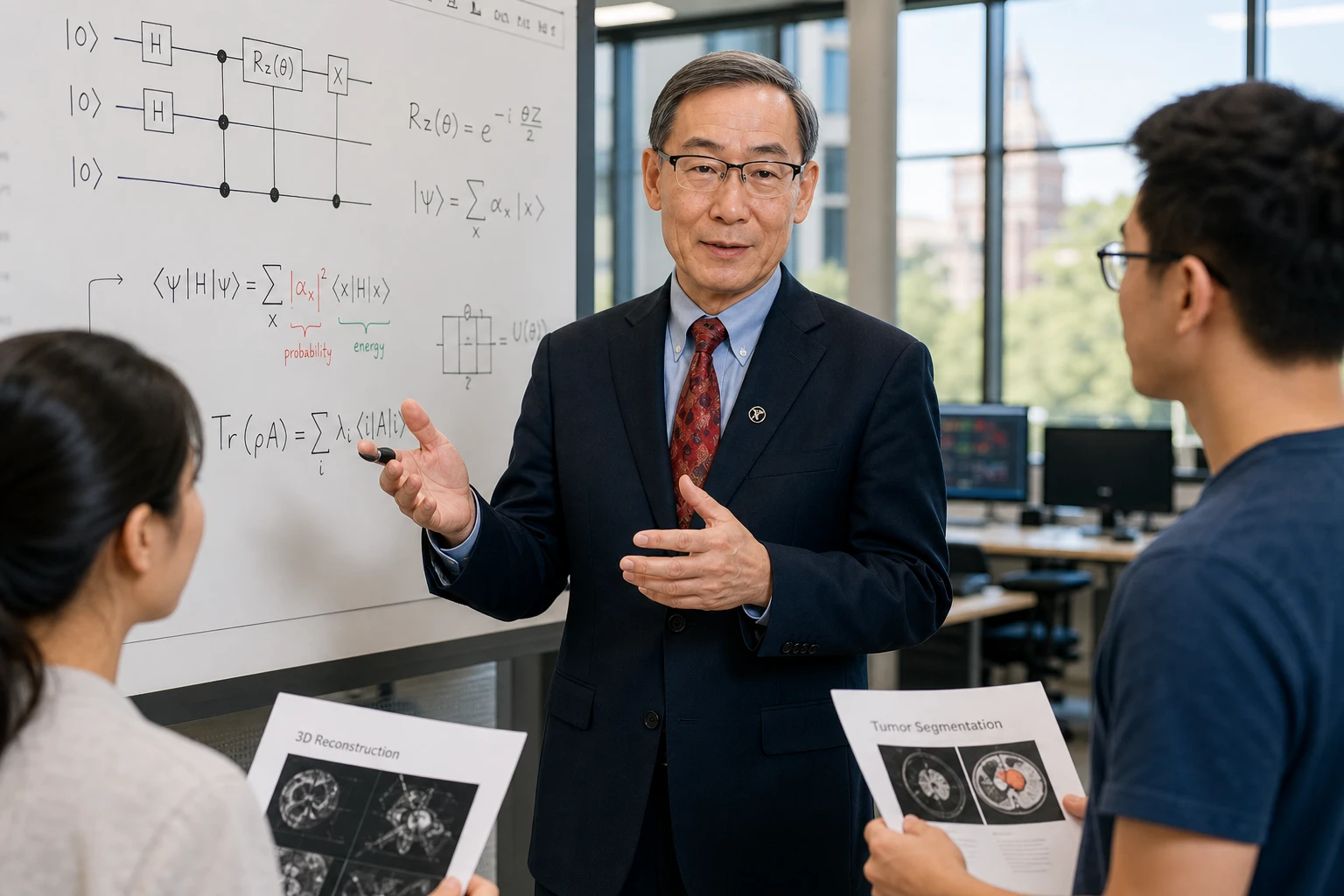
That blend of physics depth, industry AI delivery and campus delivery culture is what the governor’s office put on the committee. The same person who once scaled Watson Education now measures net promoter score on a public campus and grades student quantum models in the same semester. Few committee résumés combine those threads so tightly.
Five Seats, Staggered Terms, One Strategic Plan
Governor Abbott appointed five members to the Quantum Initiative Advisory Committee in staggered terms. The body will help shape the annual strategic plan for promoting the quantum economy in Texas.
| Member | Role / Affiliation | Term Ends |
|---|---|---|
| Lin Zhou, Ph.D. | VP, CIO & Exec. Dir. AI/Quantum, Texas Tech | Jan. 31, 2027 |
| Victor Fishman, Ph.D. | Exec. Dir., Texas Research Alliance | Jan. 31, 2027 |
| Richard “Ross” Coffman | President, Forward Edge AI | Jan. 31, 2029 |
| John Josephakis | Global VP, NVIDIA | Jan. 31, 2031 |
| Jeff Prevost, Ph.D. | Assoc. Prof. & Open Cloud Institute Exec. Dir., UT San Antonio | Jan. 31, 2031 |
The Texas Quantum Initiative itself was created by HB 4751, signed in 2025 and effective September 1, 2025. It sits in the Governor’s Office of Economic Development and Tourism. It creates a six-member advisory committee (priority seats for quantum infrastructure and manufacturing voices), requires annual strategic plans and biennial reports, and establishes the Quantum University and Business Innovation for Texas Fund for grants to universities, agencies and companies. Implementation hinges on future appropriations.
Two seats expire in 2027, one in 2029 and two in 2031. That stagger keeps institutional memory intact when administrations change and when grant cycles turn over. Academic, alliance, startup and chip-industry voices share the same table from the first meeting.
Why Zhou Says the Timing Matters Now
In the EdTech Magazine Q&A published August 4, 2026, Zhou laid out three converging reasons quantum deserves attention alongside the louder AI conversation.
- Semiconductor nodes have shrunk from the 130-nanometer era of his early IBM days to roughly 2 nanometers; quantum offers a path to keep scaling processing power.
- Classical computers hit walls on problems such as full molecular modeling of penicillin; quantum approaches open drug discovery, finance, materials and scientific search that were previously intractable.
- Quantum systems consume far less power than classical supercomputers of equivalent ambition, easing electricity pressure as compute demand grows.
He frames the technology as continuing the long arc of computation rather than a sudden replacement. Texas already hosts major AI infrastructure builds; Zhou’s committee work will sit beside those large-scale Texas AI compute investments as the state looks further ahead.
The three reasons reinforce one another. Smaller nodes buy time but not unlimited headroom. Problems that classical machines cannot finish remain blocked until a different architecture arrives. Power budgets constrain every new data-center announcement. Zhou’s case is that quantum addresses all three pressures at once, which is why the timing of the advisory work matters now rather than later.
Universities Supply Research, Pilots and People
Zhou describes three concrete higher-education roles in building a state quantum industry. First, conduct front-of-wave research that generates new ideas while the field is still young. Second, serve as pilot partners with diverse user bases that industry alone rarely matches. Third, scale outcomes by teaching and training the next workforce.
That third role is already visible at Texas Tech. Zhou identified that productive quantum developers need quantum physics, linear algebra and programming together. The university taught each piece separately; he created the course that unifies them and ends with a capstone. Early student projects produced quantum-enhanced AI models for breast cancer detection with reported accuracy above 90 percent. He also leads student teams applying quantum principles to deep-learning medical imaging, where even modest accuracy gains matter clinically.
Other Texas research universities sit in similar positions. The committee’s mix of TTU, UT San Antonio, NVIDIA, an AI firm and a research alliance signals that the state wants both academic pipelines and commercial voices at the same table.
Access Should Not Stop at Elite ZIP Codes
Zhou returns repeatedly to democratization. Managing risk and broadening access are core leadership tasks for any new technology. In his view quantum should reach community colleges, high schools and remote institutions, not only flagship campuses.
Through my work in quantum research and education, I’ve witnessed how quickly this field is moving from theory to impact, and I’m honored to help position our state at the forefront of innovation and societal impact on a global scale.
That is Zhou’s statement on theory to impact after the appointment. He carries the same language into the statewide role: support quantum access so the entire society rises, not just selected metro ZIP codes. The committee gives him a formal channel to push that agenda into the strategic plan and grant priorities.
If the annual plan and the fund treat access as a checkbox for flagships alone, the workforce pipeline stays narrow. Zhou’s public comments treat breadth as a design requirement, not a later courtesy. That framing can shape which institutions appear in pilot calls and which training models receive early support.
CIO 3.0 Inside a State Initiative
Zhou’s leadership model maps cleanly onto the committee’s work. He describes three CIO generations that institutions still need at different moments:
- CIO 1.0 keeps the foundation running: cables, networks, devices.
- CIO 2.0 partners with departments to deliver technology solutions for their existing goals.
- CIO 3.0 still partners but generates ideas and platforms that advance the institution’s strategic priorities, whether AI, quantum or the next wave.
He argues technologists must scan the cutting edge, judge what is actually beneficial, and bring it home. Standing still is falling behind. The same logic applies at state scale: identify commercial opportunities, workforce gaps and supply-chain holes, then fund and coordinate the pieces that move Texas forward. Texas builders already applying AI tools on the ground show how quickly practical adoption can spread once the infrastructure and talent exist; quantum will need the same deliberate pipeline.
What the Committee Must Deliver
The law requires annual strategic plans covering current and proposed projects, federal funding opportunities and methods to promote Texas leadership. Every two years a report goes to the Legislative Budget Board on activities, research results and funding needs. Commercial relevance is prioritized: practical technologies, scalable networks and hardware, workforce development and supply-chain gaps.
Zhou’s specific brief inside that machinery is clear from his public comments. Keep research moving. Turn universities into reliable pilot sites. Train people who can actually write quantum algorithms. Open access beyond the usual research universities. Measure customer and faculty outcomes the same way he did when he more than doubled IT satisfaction scores at Texas Tech in a single year.
The appointment itself is already complete. The harder work of turning a statute and five résumés into a durable quantum economy now sits with the committee, the fund and the universities that will train the people who use it.
From Statute to Grants in Plain Sequence
The path from bill to working program is already written into the calendar. Each step hands the next one a concrete deliverable rather than a vague aspiration.
- 2025: HB 4751 is signed and takes effect September 1, creating the initiative, the advisory body and the grant fund inside the Governor’s Office of Economic Development and Tourism.
- September 2024: Zhou joins Texas Tech and begins building the campus AI and quantum portfolio that later informs his committee brief.
- June 1, 2026: Governor Abbott appoints the five named members, including Zhou, on staggered terms through 2031.
- August 4, 2026: Zhou’s EdTech Magazine Q&A sets out the semiconductor, application and power arguments that frame why the work cannot wait.
Annual strategic plans and biennial reports to the Legislative Budget Board are the formal outputs. The Quantum University and Business Innovation for Texas Fund is the spending vehicle, still dependent on appropriations. Without those dollars the committee can still set priorities; with them it can move money to universities, agencies and companies for design and manufacturing projects. Continuity across election cycles is the reason terms stretch to 2027, 2029 and 2031 rather than ending together.
How Campus Results Inform State Priorities
Zhou’s Texas Tech record offers the committee a ready set of proof points when it ranks workforce and pilot ideas. The same metrics that rebuilt campus trust also illustrate what a state plan could ask grantees to show.
| Campus result | State-level parallel |
|---|---|
| Faculty satisfaction more than doubled in one year via net promoter score and related metrics | Demand measurable user outcomes from funded projects, not only technical milestones |
| Unified course in physics, linear algebra and programming with a capstone | Treat integrated training, not isolated electives, as the workforce default |
| Student quantum AI models above 90% accuracy on breast cancer detection | Favor pilots that tie quantum methods to concrete clinical or industrial tasks |
| Student teams on quantum-enhanced deep-learning medical imaging | Keep universities as living pilot sites with diverse real users |
None of those results require the committee to invent a new evaluation language. They already exist on one member’s campus. Folding similar expectations into the strategic plan would align grant language with practices that have already moved numbers. Commercial voices on the committee, from NVIDIA to Forward Edge AI, can pressure-test whether those campus patterns travel into industry settings. The research alliance seat adds another channel for multi-institution coordination when pilots need scale beyond a single university.
Frequently Asked Questions
Who else sits on the Texas Quantum Initiative Advisory Committee?
Besides Lin Zhou, the June 2026 appointees are Victor Fishman (Texas Research Alliance), Richard “Ross” Coffman (Forward Edge AI), John Josephakis (NVIDIA) and Jeff Prevost (UT San Antonio). Terms are staggered through 2027, 2029 and 2031 so continuity survives election cycles.
What does the Texas Quantum Initiative actually create?
HB 4751 establishes an advisory committee, an annual strategic-planning process housed in the Governor’s economic development office, biennial legislative reports, and the Quantum University and Business Innovation for Texas Fund that can issue grants to higher-education institutions, state entities and companies for design and manufacturing projects.
How is quantum computing different from classical computing in simple terms?
Classical computers use bits that are strictly 0 or 1. Quantum computers use qubits that can exist in combinations of 0 and 1 at once and can be entangled, allowing certain classes of calculation (chemistry simulation, optimization, some machine-learning tasks) to finish far faster or become feasible for the first time.
What background does Lin Zhou bring beyond the CIO title?
He is a trained physicist with a Glasgow Ph.D., former IBM Watson Education leader, creator of The New School’s quantum initiative and Design Jam, and the faculty member who designed Texas Tech’s first integrated quantum computing course that combines physics, linear algebra and programming.
Will the advisory committee control funding decisions?
The committee helps shape the strategic plan and priorities. Actual grants flow through the dedicated fund and still depend on legislative appropriations; the law explicitly ties certain obligations to whether money is allocated in a given fiscal year.