Tech stocks skidded across three continents Tuesday as investors weighed the soaring cost of building artificial intelligence infrastructure against a sudden Chinese challenge to the chipmakers that power it. The Nasdaq Composite flirted with correction territory, Wall Street’s term for a drop of 10 percent or more from a recent peak, before clawing back to close down just 0.2 percent, The New York Times reported.
Underneath that recovery sits a specific and growing number. Nvidia is discussing financing guarantees worth up to $600 billion to help its biggest customer, OpenAI, the maker of ChatGPT, afford a data center that will eventually buy Nvidia’s own chips, according to Bloomberg and the Wall Street Journal, which broke the story this week. It is a distilled version of what is rattling markets everywhere: a boom partly built on companies bankrolling their own demand, now colliding with a Chinese rival that just became the most valuable listed company in Shanghai.
Wall Street’s Near Miss With Correction Territory
The Nasdaq Composite came within reach of a full correction Tuesday before recovering most of its losses by the closing bell. The rebound masked how uneven the day actually was.
Micron and Advanced Micro Devices (AMD) each dropped more than 8 percent. Nvidia slipped in early trading before turning positive, but the chipmaker remains more than 15 percent below the peak it set in May. SpaceX, Elon Musk’s rocket and artificial intelligence company, also rebounded from an early slide; its stock still sits more than 40 percent below its June high.
Apple moved the opposite way. The iPhone maker, which has taken a more restrained approach to AI spending than rivals such as Microsoft and Meta, rose 0.9 percent and briefly crossed a $5 trillion market valuation. The Dow Jones Industrial Average, far less exposed to technology than the Nasdaq, gained 1 percent, a sign investors were rotating away from AI-heavy names rather than dumping stocks altogether. Japan’s Nikkei and Taiwan’s TAIEX each slid, extending a pattern in which Tokyo tech shares have tracked Wall Street’s own pullback for weeks.
| Index or Stock | Tuesday Move | Context |
|---|---|---|
| Nasdaq Composite | Down 0.2% | Closed down 0.2% after a steep morning slide |
| Nasdaq 100 | Down 1% | About 10% below its June peak |
| Dow Jones Industrial Average | Up 1% | Least tech-exposed of the major indexes |
| KOSPI (South Korea) | Down as much as 11% | 8th circuit breaker of 2026 |
| Nikkei 225 (Japan) | Down about 4% | Tracked Wall Street’s tech pullback |
| TAIEX (Taiwan) | Down about 4% | Chipmaking-heavy index |
| Infineon (Germany) | Down 6%+ | Europe’s steepest chip decliner |
| ASML (Netherlands) | Down 2.9% | Top chipmaking equipment supplier |
| Apple | Up 0.9% | Briefly topped $5 trillion in value |
China’s own stock market, where the tremor started, fell more than 2 percent Tuesday even as the country’s new chip champion kept rising.
Shanghai Crowns a New Chip Champion
The slide began Monday, when shares of ChangXin Memory Technologies started trading on Shanghai’s technology-focused STAR Market. China’s largest DRAM (dynamic random-access memory) chipmaker had priced its initial public offering at 8.66 yuan a share, raising 57.92 billion yuan, or roughly $8.6 billion, the largest mainland Chinese listing since Agricultural Bank of China went public in 2010.
Demand overwhelmed the offering. Retail orders came in roughly 200 times larger than the shares available, leaving successful bidders an allocation rate below half a percent. When trading opened, the stock soared nearly 500 percent, instantly making the company, known as CXMT, worth more than Industrial and Commercial Bank of China, the country’s largest lender by assets and the previous holder of the title of China’s most valuable listed company.
CXMT holds roughly 7.7 percent of the global DRAM market today, ranking fourth behind Samsung, SK Hynix and Micron, but its revenue has climbed fast as Beijing funnels support toward chip self-sufficiency. Government-linked capital has poured into the sector for years: tech sovereignty budgets across China and the West keep climbing even as Forrester’s own sovereignty scores have barely moved.
CXMT slipped 4 percent Tuesday as the broader rout caught up with it. The stock remained far above its offer price.
Seoul’s Two-Stock Problem
South Korea absorbed the sharpest blow. The KOSPI (Korea Composite Stock Price Index) tumbled as much as 11 percent Tuesday, tripping the Korea Exchange’s circuit breaker once the index hit an 8 percent intraday loss and freezing trading for 20 minutes, the eighth such halt this year.
Samsung Electronics and SK Hynix, one of South Korea’s two dominant memory chipmakers, together make up roughly half of the KOSPI’s total market value. Samsung had fallen 9.45 percent and SK Hynix 11.01 percent by the moment the circuit breaker activated, and both slid further as the session continued.
The index has now lost about a third of its value over the past month. It still sits more than 40 percent higher for the year, a gap that shows how far memory chip stocks had run up before Monday’s Shanghai listing gave investors a reason to question how long that run could last.
South Korea’s hold on the DRAM market goes back more than a decade, according to vendor market share data stretching back to 2010. Samsung and SK Hynix have rarely faced a serious domestic Chinese competitor at that scale before CXMT’s debut this week.
Why Is Nvidia Financing Its Own Customer?
Nvidia is in talks to guarantee financing for OpenAI because OpenAI cannot qualify for investment-grade credit on its own. The company has never turned a profit, and reporting this week put it on track to lose about $14 billion in 2026, nearly triple its 2025 loss, even as it projects $100 billion in revenue by 2029.
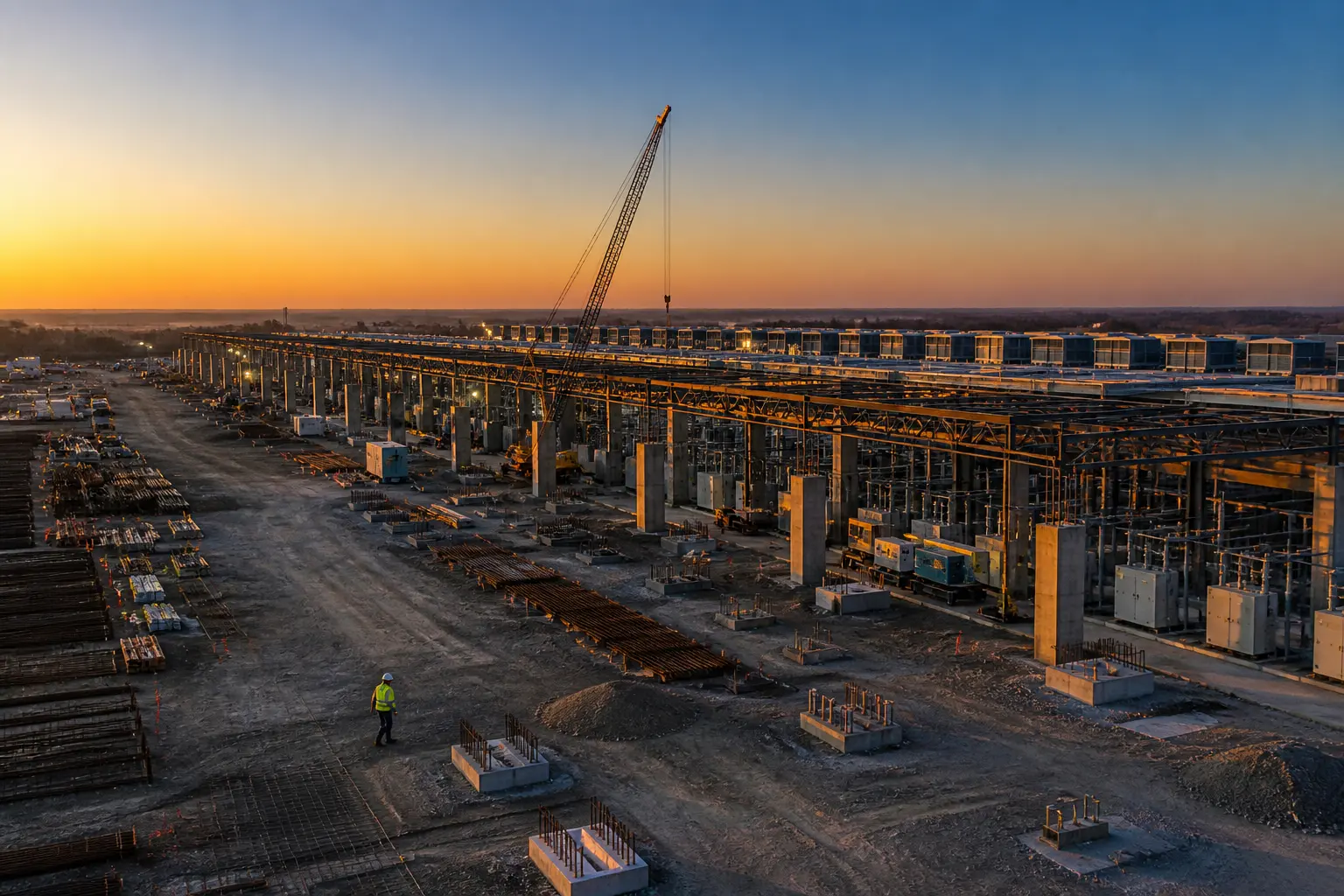
The numbers under discussion keep growing. An initial report put Nvidia’s guarantee at $250 billion, covering the lease and construction of a 10-gigawatt data center that SB Energy, a SoftBank subsidiary, is building on a decommissioned uranium-enrichment site roughly 50 miles south of Columbus, Ohio. Later reporting added a separate discussion covering up to $350 billion more to help OpenAI pay for the chips themselves, pushing Nvidia’s total potential exposure toward $600 billion, beyond the $500 billion price tag first attached to the project.
The structure has a name on Wall Street: circular financing. It works in a loop.
- Nvidia invests in and supplies chips to OpenAI.
- OpenAI commits hundreds of billions of dollars to cloud providers, including Oracle, for computing capacity.
- Those cloud providers spend the money buying Nvidia’s chips, completing the circle.
Analysts tracking similar arrangements across the AI industry have identified more than $800 billion in these deals by 2026, and Nvidia is reportedly negotiating fresh infrastructure commitments worth over $750 billion on top of that. Separate research has put total enterprise spending on new technology above a record $6.31 trillion with AI returns still lagging, a gap that helps explain why investors are suddenly asking harder questions about who is really paying for the AI boom.
Investors Have Seen This Movie Before
Vendor financing built the last great telecom bubble too. In the late 1990s, Lucent Technologies lent billions of dollars to telecom carriers so they could buy its networking equipment, booking the loans as sales along the way. When many of those carriers collapsed after the dot-com crash, Lucent was left holding bad debt and writing down billions in losses.
Wall Street analysts have drawn the comparison openly this week while picking apart the Nvidia-OpenAI talks.
Circular deals, like their cousin the Ponzi scheme, require constant activity in the way of new funds, continuous hype, and the stoking of FOMO.
The warning came from Hammerstone Markets, a markets research firm, in a note circulated to clients this week. Nvidia and OpenAI have not confirmed the numbers publicly, and the negotiations remain early enough that terms could still change or the financing could collapse.
The Supercycle Still Humming Underneath the Panic
Memory chip demand has not slowed at all. By several measures, the current pricing cycle is the strongest the industry has seen in years, led by Samsung’s 146 percent DRAM price jump in the first quarter, tracked by the research firm TrendForce.
- 146%: the average selling price jump Samsung flagged for DRAM chips in the first quarter of 2026.
- Mid-60%: the DRAM price gain SK Hynix reported over the same stretch.
- 54%: SK Hynix’s share of the market for HBM, or high-bandwidth memory, the stacked chip format used in AI accelerators, compared with 28% for Samsung and 18% for Micron.
- 38.5%: Samsung’s overall share of the global DRAM market, still the largest of any single producer.
Those four companies, Samsung, SK Hynix, Micron and now CXMT, control nearly all of the world’s DRAM production between them, per Counterpoint Research’s latest DRAM and HBM market share tracking. CXMT’s climb looks more like a fast-growing newcomer taking share than an established leader losing its footing overnight.
Four Earnings Reports Now Carry the Market
Investors will get a clearer answer soon. Five companies central to the AI buildout report quarterly results this week.
- Wednesday, after the close: Meta, Microsoft and SK Hynix.
- Thursday, after the close: Apple and Amazon.
Investors want to hear how much more each company plans to spend on AI infrastructure next year, and whether any of them signals a pullback. Tesla and Alphabet, Google’s parent company, already unsettled markets last week when their own results revealed how enormous their AI spending needs have become. On Monday, the Chinese start-up Moonshot added to the unease by publicly releasing details of its newest AI model, a reminder that Chinese labs are closing the gap the United States has tried to hold.
Oil prices offered a small reprieve Tuesday. Brent crude, the international benchmark, fell 4.8 percent to $84.09 a barrel after President Trump said Monday there was “a good chance” a new round of diplomatic talks could end the monthslong war in Iran, which has restricted oil exports from the Persian Gulf and Red Sea. Crude still costs more than 15 percent more than before the fighting began, a bill still moving through gasoline pumps and petrochemical costs in economies, including South Korea and Taiwan, that import nearly all of their energy.
Frequently Asked Questions
What Triggers a Stock Market Circuit Breaker?
Exchanges use circuit breakers to pause trading automatically once an index falls a preset percentage within a single session, giving investors a cooling-off period before panic selling accelerates. South Korea’s system froze KOSPI trading for 20 minutes Tuesday after the index fell 8 percent, the eighth time that trigger has activated in the country in 2026.
What Is the Difference Between DRAM and HBM Memory Chips?
DRAM chips handle short-term data storage in ordinary computers and servers. HBM chips stack multiple layers of memory together to move data far faster, which is why the format has become the preferred memory for AI accelerators. SK Hynix controls about 54 percent of the HBM market, well above its 28.8 percent share of conventional DRAM.
Is the Nvidia-OpenAI Financing Deal Final?
No. Multiple outlets describe the talks as early-stage, and both the size and structure of Nvidia’s guarantee could still change before any agreement is signed. Neither company has publicly confirmed the figures being reported, and people close to the discussions have cautioned the financing could fall apart entirely.
Disclaimer: This article is for informational purposes only and does not constitute investment advice. Stock markets carry risk, and figures cited are accurate as of publication; readers should consult a licensed financial adviser before making investment decisions.