The Dow Jones Industrial Average erased its morning gains and closed down 307 points on Monday, a 0.59 per cent drop, as Houthi rebels announced a naval blockade against Saudi Arabia. The S&P 500 slipped 0.2 per cent to 7,443.28 and the Nasdaq Composite barely moved, down less than a tenth of a point, ending at 25,508.07.
None of the three indexes fell far. What moved was oil, and what changed underneath the headlines was bigger than a bad trading day. For five months, Saudi Arabia has quietly kept a full Middle East oil shock from reaching Wall Street by rerouting crude around a closed Strait of Hormuz. On Monday, that workaround came under direct threat for the first time.
Blue Chips Sink While Chipmakers Rally
The Monday selloff was narrow, not broad. Boeing fell 2.12 per cent and Merck dropped 2.51 per cent, dragging the Dow lower alongside Sherwin-Williams. Big banks slid too, with JPMorgan Chase down 0.6 per cent and Bank of America off 1.4 per cent as Treasury yields rose.
Chipmakers told a different story. Broadcom gained 2 per cent, Intel rose 2.1 per cent, Micron added 1.9 per cent and AMD climbed 1.6 per cent, clawing back some of last week’s losses. Alphabet gained ground too, ahead of its earnings update Wednesday.
“The whole US Iran situation is sounding a little dicey at the moment,” said Patrick O’Hare, an analyst at the markets research firm Briefing.com. He said semiconductor stocks were rebounding, but investors remained unconvinced that artificial intelligence spending would justify current valuations.
“There is not a lot of conviction right now,” O’Hare said. “The question is not so much if giants like Alphabet or Tesla will beat the expectations, but ‘Will they beat them by enough?’”
Brent Nears $90 as Gasoline Tops $4 Again
Brent crude futures finished up 1.3 per cent at $89.22 a barrel, after breaching $90 a barrel earlier in the session. US gasoline prices jumped back above $4 a gallon, according to the AAA motor club.
US crude inventories have fallen to just 43 days of supply, the lowest level in 45 years, according to data highlighted by TheStreet, a detail that helps explain why traders are jumpy over any new disruption.
The Strait of Hormuz, the passage between Oman and Iran that normally carries the world’s largest oil cargoes, has been effectively closed since the United States and Israel struck Iran in late February. Before the war, it handled roughly one-fifth of global oil consumption, according to the US Energy Information Administration. Since the conflict began, flows through the strait have collapsed, and the first quarter’s average fell to 14.6 million barrels a day, down almost 30 per cent from a year earlier, per newly published EIA figures.
A Desert Pipeline Is Quietly Holding Prices Down
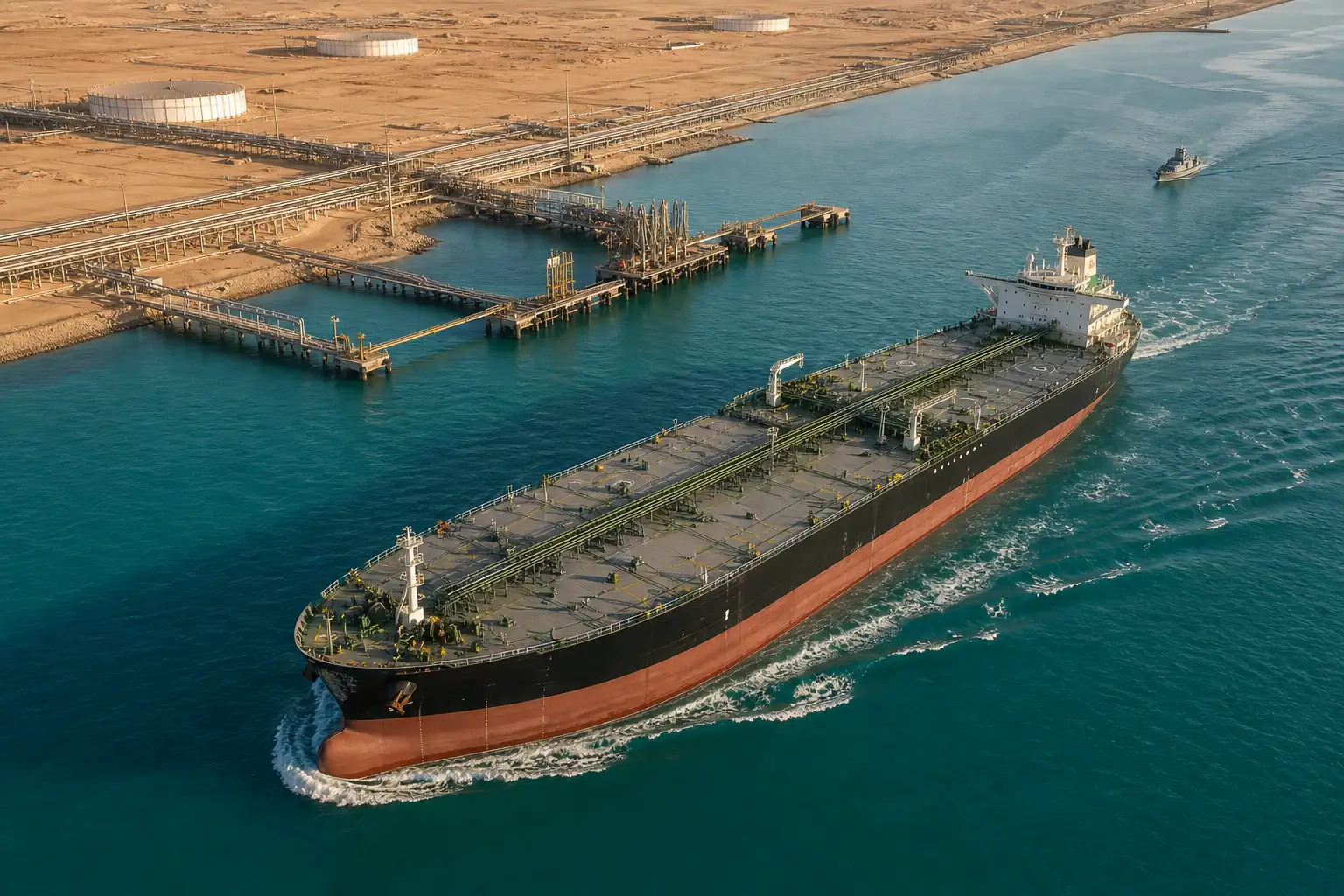
What has kept those losses from becoming a full global shock is a piece of 1980s infrastructure most traders had never heard of six months ago. Saudi Aramco’s East-West pipeline, known as Petroline, runs from the Abqaiq oil fields on the Gulf coast across the Arabian Peninsula to the Red Sea port of Yanbu.
The line reached its full operating capacity of 7 million barrels a day in late March, an all-time high, after Aramco converted parallel natural gas liquids pipelines to carry crude instead. It is a 1,200 kilometer dual pipeline system built from two steel lines, one 48 inches wide and one 56 inches, according to Global Energy Monitor’s infrastructure database.
Of the 7 million barrels flowing through it daily, about 2 million barrels feed Saudi Arabia’s own refineries. The rest reaches tankers waiting at Yanbu, and Saudi Arabia has redirected more than seventy per cent of its total crude exports through this Red Sea corridor since Hormuz shut down.
| Route | Normal Daily Flow | Status as of July 20 | Share of Global Oil |
|---|---|---|---|
| Strait of Hormuz | About 20 million barrels a day | Effectively closed since late February | Roughly one-fifth of consumption |
| Petroline to Yanbu | 5 million barrels a day, historic capacity | Running at a record 7 million bpd since late March | Partial offset only |
| Bab el-Mandeb Strait | 7.4 million barrels a day in June | Houthi blockade declared; enforcement undefined | About 7% of global output |
Every barrel that leaves Yanbu bound for Asia still has to sail south through one more chokepoint before it reaches open water. That chokepoint is exactly what the Houthis targeted Monday.
Houthis Target the One Route Saudi Arabia Has Left
Yemen’s Houthi rebels declared a maritime embargo against Saudi Arabia on Monday, saying it was retaliation for what they called an unjust and oppressive siege of Sanaa. The group’s spokesman, Yahya Saree, said the ban on Saudi shipping through the Bab el-Mandeb Strait would take effect immediately.
The timeline behind Monday’s announcement stretches back nearly five months:
- Late February 2026: US and Israeli strikes on Iran effectively shut the Strait of Hormuz to commercial tanker traffic.
- March 28, 2026: Saudi Arabia’s East-West pipeline reaches its full 7 million barrel-a-day capacity for the first time.
- July 18 to 19, 2026: The US announces three more troop deaths and one service member missing in action over the weekend.
- July 20, 2026: Houthi forces declare a naval blockade against Saudi Arabia at Bab el-Mandeb, and Kuwait reports fresh Iranian missile and drone attacks.
Bloomberg energy columnist Javier Blas noted that Saudi Arabia has so far exported roughly 4.5 million barrels a day from Yanbu. Not all of that oil needs to pass Bab el-Mandeb. Rystad Energy estimated Monday that about 2.5 million barrels a day are specifically exposed to the new blockade, the portion actually sailing south toward Asian buyers rather than moving north through Egypt’s Sumed pipeline.
It would not be the first time the Houthis have made good on a shipping threat. During the Gaza war, oil shipments fell by more than half, from 9.3 million barrels a day in 2023 to 4.1 million in 2024, according to the Council on Foreign Relations. If both Hormuz and Bab el-Mandeb stay closed, roughly a quarter of the world’s oil and gas supply would be blocked at once.
The financial exposure extends well beyond tanker routes. S&P Global has already warned that a full-blown regional escalation could trigger a potential $307 billion deposit outflow from Gulf banks, a risk that grows with every week the Red Sea question stays unresolved.
Why Are Investors So Nervous About Alphabet and Tesla?
Alphabet and Tesla report second-quarter results Wednesday after markets close, and Wall Street is less worried about whether they beat estimates than about what they say next. More than 86 per cent of S&P 500 companies that have already reported this season have topped forecasts, according to TheStreet, yet stocks have sold off regardless when guidance disappointed.
- $180 billion to $190 billion: Alphabet’s guided 2026 capital spending, more than double what it spent the prior year.
- $25 billion: Tesla’s raised 2026 capex target, up from an earlier $20 billion, funding robotaxi and Optimus robot production.
- 480,126 vehicles: Tesla’s second-quarter delivery count, up against margins investors will scrutinize Wednesday.
- $0.52: the consensus adjusted earnings-per-share estimate for Tesla’s print, according to sell-side forecasts.
Alphabet’s own securities filing shows the company generated $174 billion of operating cash flow in the twelve months through March, on top of an $80 billion equity raise in June earmarked for AI infrastructure. It is part of a broader pattern of AI stock swings after Super Micro’s $7 billion raise, where investors have rewarded spending discipline nearly as much as growth.
Tesla shares remain down roughly 13 to 15 per cent for the year, with its valuation resting less on car sales than on whether its robotaxi and humanoid robot programs can eventually justify the spending.
Kuwait Comes Under Fire as London Wobbles Too
Kuwait’s defense ministry said its air defenses engaged missile and drone attacks Monday, describing it as the latest Iranian strike on the country. Washington has already redirected anti-drone systems from Ukraine to Middle East troops, a reallocation that shows how thin American resources have stretched across two active fronts.
Iran’s foreign ministry spokesman, Esmaeil Baghaei, told reporters in Tehran that mediators had conveyed ideas to Iran and that the diplomatic apparatus has been active in recent days, even as President Masoud Pezeshkian described the country as engaged in a full-scale war with the United States.
The turmoil reached London too. The British pound dipped against the dollar as Andy Burnham took over as prime minister, naming former defence secretary John Healey as finance minister in a move markets had not expected. London’s FTSE 100 shed 0.7 per cent, weighed down by, in the words of Tickmill market analyst Patrick Munnelly, a renewed oil shock, rising shipping fears around the Strait of Hormuz and uncertainty over the policy direction of Britain’s new prime minister.
The Houthis have not detailed how they intend to enforce their blockade, leaving tanker operators and insurers to decide for themselves whether the Red Sea route is still worth the risk.
Frequently Asked Questions
Why Are the Houthis Blockading Saudi Arabia Instead of Israel?
The Houthis said the move avenges a Saudi-led siege of Sanaa and a strike near Sanaa’s airport that forced a plane carrying Houthi officials home from Iran to divert elsewhere. Unlike their 2023 to 2025 campaign, which targeted vessels linked to Israel over the Gaza war, this blockade names Saudi Arabia directly as the target.
How Much Oil Normally Moves Through the Strait of Hormuz?
About 20 million barrels a day, or roughly one-fifth of global oil consumption, moved through the Strait of Hormuz before the war, according to the EIA. For comparison, the Strait of Malacca between Malaysia and Indonesia is even busier, handling around 23 million barrels a day as the world’s single largest oil corridor.
What Is Saudi Arabia’s Petroline Pipeline?
Petroline is Saudi Aramco’s East-West pipeline, a 1,200 kilometer system built in the 1980s to move crude from the Abqaiq fields to the Red Sea port of Yanbu. It runs on two parallel steel lines, one 48 inches wide and one 56 inches, and carried roughly 5 million barrels a day before this year’s emergency expansion.
Why Do Alphabet and Tesla’s Earnings Matter So Much for the Whole Market?
Alphabet and Tesla are two of the so-called Magnificent Seven megacap stocks that have driven much of the S&P 500’s gains since 2023. Analysts expect Alphabet’s revenue to grow about 21 per cent from last year’s $96.43 billion, so any hint that AI spending is slowing could ripple through index funds well beyond the two companies.
Will US Gasoline Prices Keep Rising?
Possibly, if the fighting keeps oil elevated. AAA measured pump prices back above $4 a gallon this week, and Treasury yields have already risen on bets that energy-driven inflation could push the Federal Reserve toward a rate hike later this year instead of a cut.