
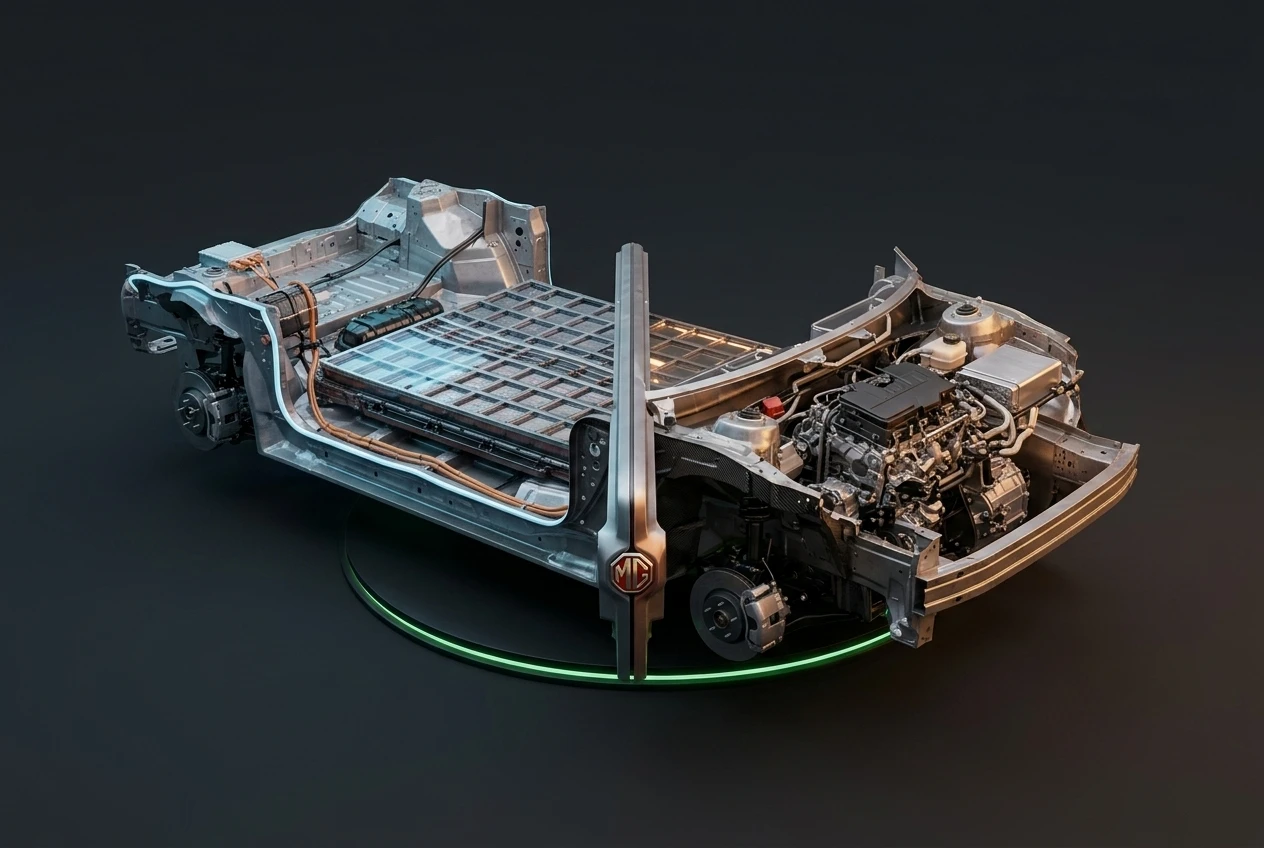
JSW MG Motor India unveiled a new vehicle platform on Thursday built to become an electric car, a hybrid, a plug-in hybrid or a range-extender car from one shared engineering blueprint. The company calls it MG ADAPT, and it will underpin the automaker’s first new-energy models due within the current financial year.
Behind the four-powertrain pitch sits a blunter calculation. JSW MG Motor India, the joint venture between China’s SAIC Motor and India’s JSW Group that builds and sells MG-badged cars, lost money last year and is trying to make one platform do the work of four separate ones, cutting its own product-development bill in the process.
Four Powertrains Share One Engineering Blueprint
MG ADAPT stands for Advance Drive Architecture Platform Technology. The company is calling it India’s first Multi New Energy Vehicle platform, meaning a single architecture engineered to carry four different kinds of electrified drivetrains rather than one.
- EV – battery and motor only, with no engine on board
- HEV – a self-charging hybrid that never needs to be plugged in
- PHEV – a plug-in hybrid with a bigger battery and an engine that can also drive the wheels directly
- REEV – a range extender where the motor always drives the wheels and the petrol engine only tops up the battery
Underneath all four sits the same hardware: a dedicated hybrid engine, a dedicated battery pack, what the company calls India’s first 10-in-1 Intelligent Electric Drive Unit, and an Electromagnetic Dedicated Hybrid Transmission that MG claims is a world first. An Intelligent Energy Management System decides in real time which of four drive modes suits the road ahead.
| Drive Mode | How Power Flows | Built For |
|---|---|---|
| Pure Electric Drive | Battery and motor only, engine off | City driving |
| Series Hybrid Drive | Engine charges the battery while the motor drives the wheels | Stop-start traffic |
| Parallel Hybrid Drive | Engine and motor work together | Overtaking, hard acceleration |
| Engine Direct Drive | Engine drives the wheels directly | Steady highway cruising |
Charging speed is one of the goals MG has attached to ADAPT, and the wider industry is chasing the same problem from the infrastructure side. Shell has already demonstrated technology that charges EVs in under 10 minutes, a reminder that the battery isn’t the only bottleneck buyers worry about.
Mehrotra’s Case Against Betting on One Technology
Anurag Mehrotra, the company’s managing director, framed ADAPT as a response to how uneven India’s shift to electrified cars really is. Electric car penetration nationally was around 8 percent in June, he told reporters, predicting the market would only just reach double digits by year end.
The goal that has been set to get to 30 per cent new energy vehicles by 2030 will not be achieved through one technology alone. Multiple technologies will be required simply because there are different consumer cohorts in the country. Some consumers will embrace EVs straight up, while others would want to take one step at a time, and for them, hybrids would make sense.
Mehrotra made that case at the ADAPT unveiling. More than 70 percent of the company’s current sales already come from new energy vehicles, he said, and half of its EV sales now come from outside Tier 1 cities, with smaller towns growing faster than metros.
The Capital Efficiency Math Behind a Single Platform
Strip away the drive modes and ADAPT is really an answer to a spending problem. Building four separate platforms for four powertrains means paying for engineering four times over. Mehrotra put it plainly when explaining the logic to reporters.
“You are spending twice the money by bringing one platform with all the four technologies in it, you have actually reduced your capex need by at least half,” he said, arguing that a shared architecture beats developing standalone platforms for every powertrain.
The company says roughly 80 percent of the engineering work on future ADAPT vehicles is already done, which changes the math on how fast new products can reach showrooms. A typical automaker takes four to five years to bring a new platform to market, Mehrotra said. With ADAPT already engineered, JSW MG Motor India expects to turn around new products in 12 to 24 months instead, spending mostly on body styles rather than fresh engineering.
That efficiency argument extends to sourcing. The company is targeting 70 percent localisation for ADAPT-based vehicles, with the remaining share concentrated in battery cells and proprietary systems that most global automakers also import.
A Joint Venture Still Bleeding Cash
ADAPT arrives at a company that is still working its way toward profitability. JSW MG Motor India registered 31,741 electric passenger vehicles from January through June 2026, up 18 percent from 26,894 units a year earlier, according to Federation of Automobile Dealers Associations (FADA) Research. That growth still trails the broader electric passenger vehicle market.
To fund its ADAPT-based pipeline, the company plans to invest roughly 3,000 to 4,000 crore rupees over the next few years, including about 1,400 crore rupees during the current financial year, spread across localisation, new products and plant expansion. The first phase of capacity expansion at its Halol plant is due by March 2027, lifting annual output from 120,000 to 160,000 units, with a second phase later targeting 300,000 units a year.
- 31,741 electric passenger vehicles registered by the company from January to June 2026, per FADA Research
- 1,400 crore rupees in planned capital spending for the current financial year alone
- 70 percent localisation target for vehicles built on the ADAPT platform
- 300,000 units targeted annual capacity at Halol once both expansion phases finish
The financial picture behind those numbers is uneven. A report from Whalesbook said the venture’s losses more than doubled to $121 million in the year to March 2025, even as it committed fresh capital to expansion. Separately, JSW MG Motor India has been deploying 1,000 community EV chargers across 470 sites under its MG Charge program even as its ownership structure shifts, with JSW Group reported to be raising its stake toward 45 percent as SAIC Motor’s share recedes. Asked directly about reports of a possible investment by KKR, the private equity firm, Mehrotra declined to comment, saying only that management remained focused on executing its board-approved strategy.
MG’s Crowded Field Against Tata, Mahindra and the Rest
ADAPT is not landing in an empty market. Tata Motors has already surpassed 250,000 EV sales and continues to invest heavily. Mahindra is expanding its own electric portfolio aggressively. Suzuki has committed to an $8 billion India investment aimed at building a global EV production hub, and Hyundai is putting $5.5 billion behind its own EV and hybrid push, including a dedicated India-specific EV. Chinese rival BYD, meanwhile, has slipped to ninth place in the market amid import duties and geopolitical friction.
JSW Group’s ambitions stretch beyond the MG badge. The conglomerate built its fortune in steel and energy, and its move into cars has run on two tracks at once, expanding the MG joint venture while separately preparing its own independent brand. Together the two efforts could involve combined investments of up to USD 1 billion over the coming years.
The multi-powertrain hedge itself isn’t unique to India. General Motors is pairing a sodium-ion battery push with 250,000 bidirectional EVs in a similarly diversified bet on which battery chemistry and vehicle format wins out over the next decade.
What Cars Will Use MG ADAPT First?
The first vehicle expected on ADAPT is an India-spec version of the Wuling Starlight 560, a seven-seat SUV sold globally in both EV and PHEV form. MG has confirmed one EV and one PHEV built on the platform will arrive during FY2026-27, though it has not named either model yet.
Test mules of the Starlight-based SUV, in both electric and plug-in hybrid guise, have been spotted on Indian roads for months, and its design was patented in India in March. Industry reporting has floated the name Hector Hawk for the plug-in hybrid version, though MG itself has not confirmed it.
What We Know:
- The Wuling Starlight 560 has been caught testing in India in both EV and PHEV form, and MG has confirmed an EV and a PHEV built on ADAPT will debut during FY2026-27.
- The dedicated hybrid engine is naturally aspirated and tuned specifically for hybrid duty rather than adapted from an existing petrol engine.
What’s Unconfirmed:
- Official model names, pricing and exact launch dates have not been announced.
- Engine displacement, cylinder count and power output for the dedicated hybrid engine remain undisclosed.
JSW Group’s ambitions don’t stop at the MG showroom. The conglomerate is separately readying its own independent JSW Motors brand built on a Jetour T2 based SUV, targeting a launch around Diwali at roughly 30 lakh rupees, a sign that the group’s automotive bet extends well beyond the ADAPT platform itself. MG has also flagged solid-state battery ambitions for future models further down its roadmap, building on plans it first laid out for solid-state battery powered cars.
Whichever model arrives first, it will be judged on range, charging time and price rather than the platform’s name. ADAPT only proves its case once real cars built on it reach Indian roads.
Frequently Asked Questions
What Does MG ADAPT Stand For?
ADAPT stands for Advance Drive Architecture Platform Technology, and MG is billing it as India’s first platform engineered to support four separate new energy powertrains at once. MG’s own teaser campaign ahead of the launch referred to the underlying technology as Drive.NEV before the company settled on the ADAPT name at Thursday’s event.
What Is the Difference Between a PHEV and an REEV on ADAPT?
Both use a battery, a motor and a petrol engine, but the engine’s job differs. A plug-in hybrid can send engine power straight to the wheels through Engine Direct Drive on the highway, while a range extender’s engine never touches the wheels at all and exists only to recharge the battery.
Which MG Model Will Use ADAPT First?
The first candidate is an India-spec Wuling Starlight 560, a seven-seat SUV measuring 4,745mm in length with a 2,810mm wheelbase in its global form, though MG has not confirmed whether the India version will match those exact dimensions.
How Much of an ADAPT Vehicle Will Be Built in India?
JSW MG Motor India is targeting 70 percent localisation for ADAPT-based vehicles. Mehrotra has said the remaining 30 percent is concentrated in battery cells and certain proprietary systems that most other automakers also choose not to localise.
Is JSW MG Motor Making Money Yet?
Not yet. The joint venture narrowed its net loss to around 586 crore rupees in the fiscal year ending March 2024, before losses widened again the following year, according to Whalesbook, even as the company keeps pouring capital into new products and plant capacity.