Taiwan Semiconductor Manufacturing Co. just posted its best quarter in company history, and Wall Street sold the stock anyway. Dutch lithography giant ASML got the same treatment days after its own blowout earnings. The Nasdaq Composite fell 1.5% Thursday (Jul 16), Seoul’s Kospi dropped more than 6%, and crude oil barely moved even as the United States and Iran exchanged fresh strikes.
Investors punished record profits out of the world’s biggest chipmakers, then all but shrugged off a shooting war near one of the planet’s most important oil chokepoints. U.S. retail sales data, out the same morning, added a third data point to an already jumpy week for markets.
TSMC Posts a Record Quarter, Chips Still Slide
Taiwan Semiconductor Manufacturing Co., known as TSMC, said Thursday that second-quarter net profit jumped 77.4% from a year earlier to a record $22 billion (NT$706.56 billion), beating analyst estimates and marking the company’s fifth straight quarter of record earnings. Revenue rose 36% to $40.2 billion, with high-performance computing, the category that includes AI chips, generating 66% of the total.
Chief Executive C.C. Wei used the results to announce another $100 billion investment in Arizona, bringing TSMC’s total committed spending in the state to $265 billion. For the third quarter, the company guided to revenue of $44.6 billion to $45.8 billion.
“TSMC’s strong second-quarter revenue shows AI demand remains healthy, driving demand for its advanced chip production and CoWoS packaging,” said Dan Nystedt, research analyst at TriOrient.
ASML, which holds a global monopoly on the machines needed to print the most advanced chips, delivered its own beat a day earlier. The company posted quarterly net sales of €9.3 billion, with net income of €2.9 billion, and raised its full-year sales guidance to between €43 billion and €45 billion, the second upgrade this year, pointing to order visibility extending into 2028. ASML shares climbed on the news Wednesday. They slid Thursday, dragged down with the rest of the sector.
Each of the sector’s biggest names beat expectations in some form within the same two weeks. Each stock fell anyway.
| Company | Q2 2026 Headline Number | Stock Reaction |
|---|---|---|
| TSMC | Net profit up 77.4% year on year to a record $22 billion | Fell in New York trading despite the beat |
| ASML | Net income of €2.9 billion; full-year guidance raised for the second time this year | Rose Wednesday, then slid Thursday with the sector |
| Samsung Electronics | Profit topped both Nvidia and Apple; guided to an 1,800% jump in operating profit | Dropped 8% on the news earlier this month |
| SK Hynix | Nasdaq debut raised roughly $28 billion, the second largest such sale after SpaceX | Jumped 13% on debut, then fell 15.4% the next session, its worst day ever |
The table only covers the headline names. The damage has been broader across memory and equipment makers alike.
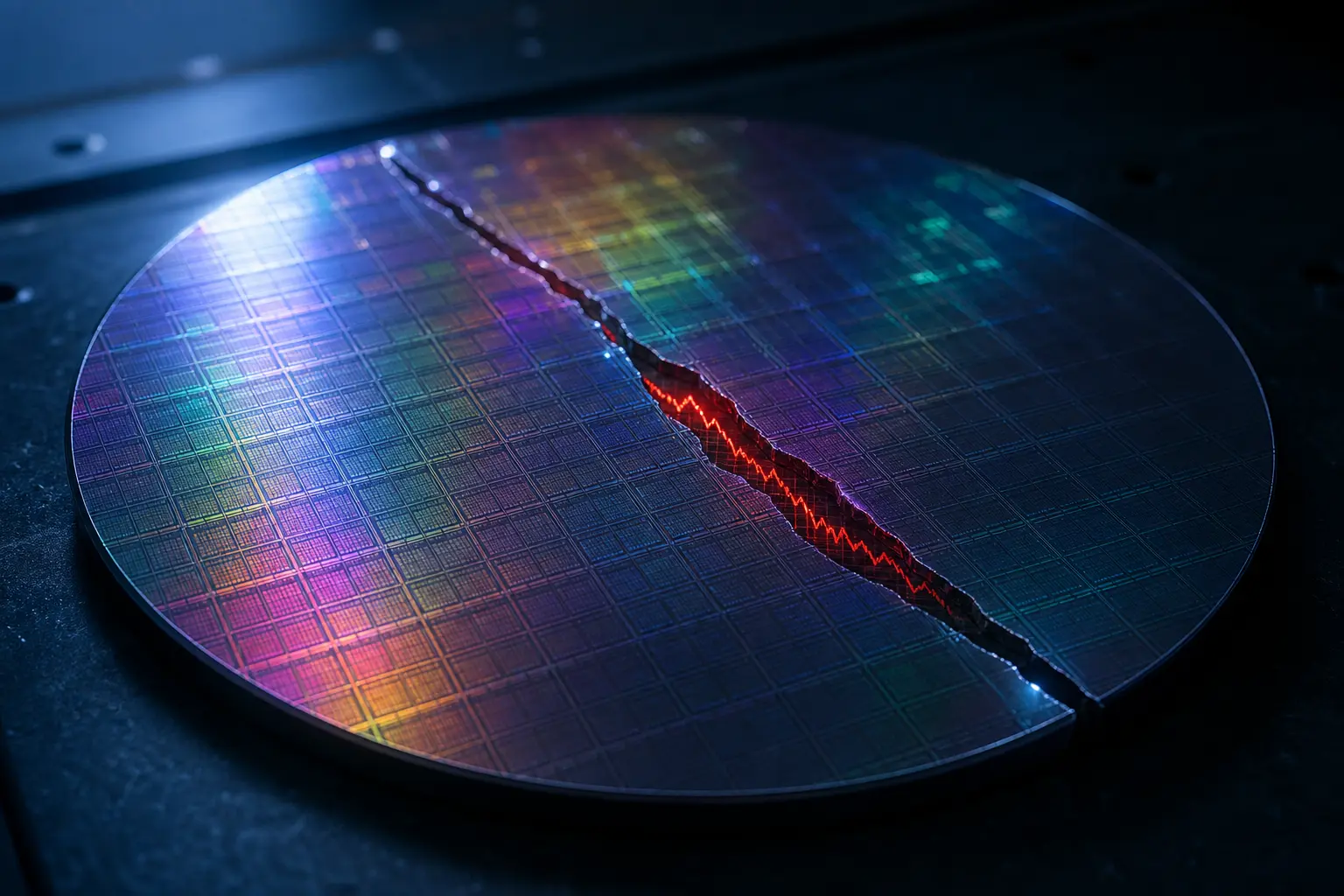
A Sector Priced for Perfection
Samsung Electronics ran into the same wall earlier this month. Its preliminary guidance showed quarterly profit topping both Nvidia and Apple, with operating profit expected to jump 1,800%. The stock dropped 8% anyway, part of a pattern this earnings season: a strong number, followed by a sell order.
Fragile sentiment is leading to a continued pullback in memory chip stocks after their gravity-defying run as investors fret about elevated valuations.
Dan Coatsworth, head of markets at AJ Bell trading group, made the point Thursday, as the same names that powered this year’s rally led it lower.
The scale of the reversal shows up in the numbers.
- Bear market: Micron, Samsung, SK Hynix and the Roundhill Memory ETF are all down more than 20% from their recent highs.
- $1.5 trillion: wiped off Yahoo Finance’s tracked basket of semiconductor stocks since June 25.
- $350 billion: Micron’s own market value lost over that same stretch.
- 229% and 581%: the gains Micron and Sandisk shares had posted this year before the reversal began.
The broader PHLX Semiconductor Index has not joined the memory names in a bear market yet. It would need to fall another 9% from a recent close to get there, meaning the sharpest pain so far has stayed concentrated in memory chips rather than the whole sector.
SK Hynix’s Six-Day Round Trip
No single stock captures the whiplash better than SK Hynix. The memory chipmaker’s American depositary receipts began trading on the Nasdaq on July 10, part of a share sale expected to raise roughly $28 billion, the second largest of its kind after SpaceX. They jumped 13% on debut day.
Three trading days later, the Seoul-listed shares fell 15.4%, the steepest single-day drop in the company’s history, according to data from the London Stock Exchange Group (LSEG). The slide continued into Thursday, with Seoul’s Kospi falling more than 6% as SK Hynix and Samsung both dropped sharply again amid growing doubt that this year’s AI rally still has room to run.
Phillip Wool, chief research officer at Rayliant Global Advisors, called the pullback a portfolio rebalancing exercise rather than a change in the industry’s outlook, saying the selling “doesn’t really speak to any sort of reduction in the excitement about AI hardware.”
Part of the swing comes down to simple math. Samsung and SK Hynix together make up “around half the Kospi’s total weight, up from around just a quarter at the end of last year,” eToro market analyst Zavier Wong has said, meaning a sharp move in either stock drags the whole index before its other roughly 900 listed companies get a say.
Is This 2000 All Over Again?
Nvidia trades at roughly 24 to 26 times expected earnings, well below Cisco’s 472 times earnings at the 2000 dot-com peak, and today’s AI leaders generate real profit and cash flow that most dot-com companies never had. Market concentration, though, is higher now than it was then, and several prominent investors say valuations still look stretched.
The comparisons keep surfacing this year. The Shiller cyclically adjusted price-to-earnings ratio topped 40 in 2025, a level reached only once before, just ahead of the dot-com crash. The top 10 stocks in the S&P 500 now account for 35% of the index, up from 25% at the 2000 peak.
Bridgewater Associates founder Ray Dalio has said his own bubble indicators show markets climbing toward levels last seen in 2000 and 1929. JPMorgan chief executive Jamie Dimon has said he thinks “AI is real,” but expects a chunk of the money pouring into it will end up wasted.
Not every prominent voice agrees. Goldman Sachs and JPMorgan strategists argue the growth is fundamentally justified, and asset manager GMO’s own research team argues that the classic signs of a bubble top, including a broad slowdown in the market’s pace of gains, have not shown up yet.
The debate keeps splitting analysts down the middle. Markets oscillate between believing “AI is going to be great and increase productivity and all these companies are going to win” and dismissing it all as one big bubble, Gil Luria, head of technology research at D.A. Davidson, told NPR. It is not the first time an AI bellwether’s good news has spooked the market either; Super Micro’s $7 billion capital raise touched off its own bout of AI-stock volatility earlier this year.
Oil Barely Blinks at Fresh Strikes
Crude told a quieter story. Brent crude for September delivery had settled at $84.95 a barrel Wednesday and WTI at $79.60, both little changed even as U.S. Central Command carried out fresh strikes on Iranian missile and drone facilities. Prices dipped again marginally Thursday as Iran hit back at U.S. allies in the Gulf.
The same morning brought U.S. retail sales figures showing a 0.2% month-on-month increase in June, in line with forecasts but slower than May’s 1.0% jump. Analysts read the slowdown as a sign of solid, if cooling, consumer demand, helped along by falling gasoline prices during the month.
“Higher oil is also increasingly testing the consensus view that peak cost pressures are behind us,” said Jose Torres, senior economist at Interactive Brokers.
Rystad Energy, an energy research and consulting firm, raised its odds that no “substantive agreement” will emerge between Washington and Tehran to 55%. The United States and Iran “have strong economic incentives to avoid a complete breakdown,” Rystad senior vice president Jorge Leon said, pointing instead to unresolved disputes over Iran’s nuclear program and the Strait of Hormuz.
Just over a week earlier, before the latest round of strikes, the U.S. Energy Information Administration had gone the other way, cutting its third-quarter Brent forecast to $74 a barrel on expectations that Hormuz traffic and output would keep normalizing. That forecast predates this week’s escalation.
The conflict has moved in fits and starts since February.
- Feb 28, 2026: The United States and Israel launch coordinated airstrikes on Iranian military and nuclear sites.
- March 4, 2026: Iran declares the Strait of Hormuz closed to shipping tied to the U.S., Israel and their allies.
- June 18, 2026: Washington and Tehran sign a memorandum of understanding to end the conflict, and Strait traffic begins recovering.
- July 11 to 16, 2026: Fresh U.S. strikes and Iranian retaliation resume, Brent jumps to a one-month high and Washington reinstates its naval blockade of Iranian ports.
Each attempt at normalizing has been followed by a new round of fighting. A prolonged escalation carries risks well beyond the pump: ratings agency S&P has estimated $307 billion in deposits at risk across Gulf banks if the war widens further, a reminder that oil is not the only channel through which the conflict reaches markets.
August 16 Becomes the Next Flashpoint
Traffic through the Strait of Hormuz, the narrow waterway that also carries helium, fertilizers and other industrial commodities beyond oil and gas, has thinned sharply since the fighting resumed. Ship-tracking platform MarineTraffic recorded just 57 transits from Friday through Sunday, more than 50% fewer than the previous week.
“Traffic through Hormuz is grinding to a halt, back to, or even below, our immediate pre-MoU pace,” Rory Johnston, founder of oil market research firm Commodity Context, told Al Jazeera.
Rystad’s Leon frames the next few weeks as a different kind of test. “After Aug 16, the question becomes whether the shipping market can adapt to a continuing threat rather than whether diplomacy can resolve one,” he said.
Brent’s climb this week is modest next to the spikes seen earlier in the war, when the same conflict briefly put a run toward $100 a barrel back on traders’ radar.
Back on the equities side, the test ahead is different but the stakes rhyme. “This all makes one wonder what US tech corporations will have to come up with to get investors genuinely excited again,” said David Morrison, market analyst at Trade Nation. “This is important, as the earnings season picks up several gears over the next fortnight.”
Frequently Asked Questions
Why did chip stocks fall even though TSMC and ASML posted record earnings?
Investors had already priced in near-flawless results, so beating estimates alone was not enough to justify further gains. Bank of America’s own Bubble Risk Indicator recently put the semiconductor sector at 0.91, a reading strategists flag as near-bubble territory even though it does not guarantee a crash is coming.
What is high-bandwidth memory and why does it matter to the sell-off?
High-bandwidth memory, or HBM, is a specialized type of memory chip built for the heavy data throughput that AI processors need for training and inference. It has become one of the most profitable products for memory makers like SK Hynix and Micron, so any hint of slower demand growth for it ripples through the whole sector’s valuation.
How does SK Hynix’s Nasdaq listing compare with other foreign chipmakers?
TSMC’s own U.S.-listed shares typically trade at a 13% to 14% premium over its Korean-listed stock. SK Hynix’s sharp slide after its debut instead opened a discount of more than 20% between its American and Korean shares, a gap analysts tie to the extra supply of stock the offering created.
Why didn’t oil prices spike further given the fresh US-Iran strikes?
A large global inventory cushion has let the market absorb repeated shocks without the sharper spikes seen earlier in the war. Oil market researcher Rory Johnston has said the market has stayed unusually calm through the crisis because of that stock cushion, even as shipping traffic through Hormuz keeps thinning.
What is the Strait of Hormuz and why does it matter to global oil markets?
The Strait of Hormuz is the narrow waterway between Iran and Oman connecting the Persian Gulf to open ocean, and the Congressional Research Service estimates it carries roughly 27% of the world’s maritime crude and petroleum trade. Any sustained disruption there raises shipping costs and insurance premiums well beyond the Gulf.
Disclaimer: This article is for informational purposes only and does not constitute investment, trading or financial advice. Stock and commodity markets are volatile and carry risk of loss; consult a licensed financial professional before making investment decisions. Figures are accurate as of publication on Jul 17, 2026.