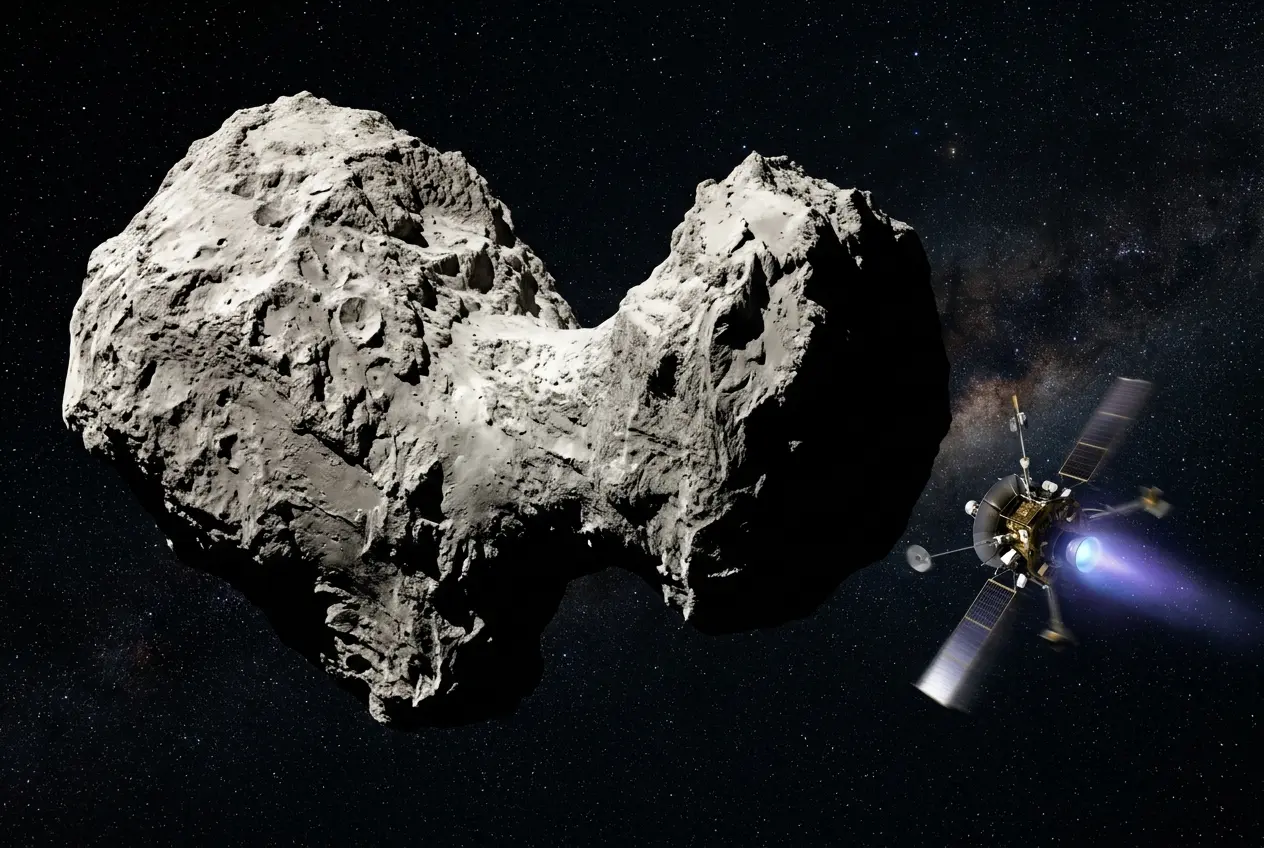
On July 5, 2026, Japan’s Hayabusa2 probe passed within 800 metres of asteroid Torifune, in a precision-navigation test the country’s space agency is framing as Japan’s standing in the planetary defence race. The fly-by was carried out at roughly 5 km/s with mission control about 100 million kilometres away, the Japan Aerospace Exploration Agency said on July 5. Hayabusa2 returned images confirming Torifune’s elongated, two-lobed shape. The probe is set to continue toward an 11-metre asteroid in 2031.
Tokyo, Washington, and Beijing are now running separate efforts to learn whether a kinetic impactor, explosives, or a crewed mission could one day deflect a rock on a collision course with Earth. JAXA’s wager on the Torifune pass is that the precision logged on July 5 earns Japan a voice in that conversation, even as the country remains short of the budgets and infrastructure of NASA, the European Space Agency, and China’s space programme. The Hayabusa2 mission itself dates to a December 2014 launch from Tanegashima Space Center. It spent roughly eighteen months at asteroid 162173 Ryugu, gathered 5.4 grams of samples, and dropped that capsule at Woomera, Australia, on 5 December 2020 UTC. The next phase of Hayabusa2’s extended mission will turn on what JAXA does with the navigation record it now holds. It is set to reach 11-metre 1998 KY26 in 2031.
A Twelve-Year Probe Slips Past a 450-Metre Rock
Hayabusa2’s Torifune pass was not on the probe’s original mission plan. The spacecraft was built to rendezvous with asteroid 162173 Ryugu, collect samples, and return them to Earth; everything after the 2020 capsule drop is a bonus phase called the Hayabusa2 Extended Mission. Astronomers had already clocked Torifune at roughly 450 metres in diameter with hints of an elongated shape. Getting close enough to image that shape without hitting it became the technical question JAXA set out to answer.
JAXA has now confirmed the result. Hayabusa2 came within 800 metres of Torifune’s centre, returned high-resolution imagery showing two distinct lobes, and stayed within the small amount of xenon left in its ion engines. JAXA confirmed a relative speed of roughly 5 km/s during the fly-by. Only some of the data captured during the approach has reached Earth so far, and the rest will follow in the coming weeks. The mission is now turning toward asteroid 1998 KY26, due in 2031.
The same problem, hitting a small moving target in deep space at high speed, sits at the heart of any future kinetic-impactor mission. Three agencies now have separate programmes underway, and each is taking its own route to the same objective. The Torifune pass is JAXA’s contribution.
| Agency | Programme | Target | Status |
|---|---|---|---|
| JAXA (Japan) | Hayabusa2 Extended Mission | Asteroid 98943 Torifune | Pass within 800 m on 5 July 2026 |
| NASA (United States) | DART | Asteroid Dimorphos | Kinetic impact in September 2022; orbital period shortened by 32 minutes |
| CNSA (China) | Near-Earth Asteroid Defence Mission | Asteroid 2015 XF261 | Plan to alter orbit by 2030 |
How Hard Hitting a 1-Yen Coin From Okinawa Would Be
The hardest part of the Torifune pass was not the imaging; it was staying on a precise enough trajectory to grab it. Yuya Mimasa, head of the mission team, framed the difficulty in geographic terms: the precision required was “as difficult as hitting a 1-yen coin placed in Hokkaido from Okinawa”, a comparison that lands because Japan’s two main islands sit at opposite ends of a long archipelago. The spacecraft had to make last-minute corrections to its path because Torifune is too small and too dark to track precisely until days before the closest approach. Mission control operated from Japan’s deep-space stations, with additional support from US, Australian, and Spanish antennas. The navigation precision JAXA logged on the fly-by is the same precision any future deflection campaign will have to clear. An asteroid on a collision course does not give a probe a second attempt.
As difficult as hitting a 1-yen coin placed in Hokkaido from Okinawa.
A spacecraft that can navigate within a few hundred metres of an asteroid at high speed is, in JAXA’s framing, a spacecraft that could be aimed at one. The same analytical chain covers rendezvous, sample return, and the kinetic impactor technique NASA proved with DART. JAXA’s mission team treated the July 5 pass as a chance to log a real-world data point on what such a manoeuvre takes, including the trade-off between getting close enough for science and staying far enough to avoid a collision. Japan has now logged a precision approach to a small body at high speed.
JAXA did not start at 800 metres. The team originally weighed an approach as close as 1 kilometre to Torifune’s surface, then pulled back the planning distance once more was learned about the asteroid’s exact size and shape. The 800-metre figure is what the agency’s pre-fly-by modelling could safely clear without endangering the probe before its 2031 goal. That buffer is the practical distance between a deflection demonstration and a deflection mission. The Torifune pass thus doubles as a margin-of-safety test for any follow-on spacecraft. JAXA’s mission team has not yet released the full navigational reconstruction.
Putting a number on what counts as a safe distance is the operating currency of planetary defence. The same question, in different units, will be on the table for any future deflection campaign. JAXA’s bet is that July 5’s pass moved that number in Japan’s favour.
JAXA Steps Forward With a Planetary-Defense Claim
Masaki Fujimoto, director of the JAXA Institute of Space and Astronomical Science, told reporters on July 6 that the pass let Japan stake a claim on the world stage. He said JAXA had been able to “demonstrate to the world that we possess the technology to change the orbit of an asteroid heading towards the Earth”. Changing an asteroid’s orbit, even by a small amount, is the threshold every deflection concept has to clear, from kinetic impactors to standoff explosives to longer-lead gravitational tractors. The Torifune pass is now Japan’s data point on the precision side of that threshold. The actual deflection hardware is a separate engineering programme. Fujimoto did not claim Japan is ready to run a deflection campaign today. The next fly-by, at 11-metre 1998 KY26, is scheduled for 2031.
JAXA’s own Hayabusa2 Torifune mission planning notes frame the precision exercise as a stepping stone toward “navigating with exceptional precision” and “intentionally crashing the spacecraft into a small asteroid”. Each step in that chain has to be cleared on its own timeline. JAXA’s published extended mission currently lists Torifune and 1998 KY26 as the next mission objectives. JAXA’s mission team has not yet released the full navigational reconstruction from July 5.
Why Bennu Sits at the Top of the Risk List
The reason the planetary defence conversation is louder than it was a decade ago is the underlying population. The catalogued asteroid count runs well into seven figures, and the slice that matters is the small fraction whose orbits can change in ways that put them on a collision course with Earth. Detection is the rate-limiting step, and it is the step that everyone in the field agrees is hard.
NASA’s worst-case rock on the current list is 101955 Bennu, a 74-million-tonne body roughly 500 metres across, with a one-in-2,700 chance of striking Earth when its trajectory brings it close in September 2182. Bennu was the target of NASA’s OSIRIS-REx mission, which arrived at the asteroid in 2018 and returned a sample capsule in September 2023. That mission gave astronomers the mass, shape, and density data needed to model Bennu’s orbit centuries ahead. OSIRIS-REx also documented that Bennu’s rotation is speeding up by about one second every 100 years because of the Yarkovsky effect, a small photon-driven thrust that long-horizon impact models must include. The refined Bennu model is the template every future risk-list entry will be benchmarked against.
- 1.2 million asteroids identified in the solar system
- More than 36,000 classified as near-Earth objects
- 1,700 on the European Space Agency’s risk list
Detection is what gates everything. Lance Gatling, president of Tokyo-based Nexial Research, said the data has to be analysed because if an asteroid on a collision course was identified tomorrow, then there would be a huge scramble to intercept it. Hayabusa was primarily designed to be an asteroid rendezvous, recovery, and return mission, with this additional fly-by an extension, he added. The scramble Gatling described is the same scramble every agency is trying to pre-empt.
NASA Hit One, China Plans Another
NASA has already executed the first controlled asteroid deflection. In September 2022, the DART spacecraft slammed into Dimorphos, a small moonlet of the asteroid Didymos, and shortened Dimorphos’s orbital period by 32 minutes, per the DART asteroid impact confirmation statement. NASA Administrator Bill Nelson called the impact “a watershed moment for planetary defense and all of humanity”. The mission beat its pre-defined success threshold of 73 seconds by more than 25 times. NASA’s release at the time said DART marked “humanity’s first time purposely changing the motion of a celestial object”.
China has a kinetic-impactor plan of its own, with asteroid 2015 XF261 as the target. According to plans reported by China’s National Space Science Center, the mission is set to launch in 2027, reach the rock around 2029, and demonstrate an orbital change by 2030, per the 2015 XF261 kinetic impactor plan summary. The 30-metre size of 2015 XF261 makes the test similar in spirit to a hypothetical deflection of a city-killer rock. A successful impact would put China in the small club of agencies that have actually moved an asteroid under controlled conditions.
ESA’s contribution is on the science side. ESA’s Hera mission, planned for later in the decade, will survey the Didymos system to measure the crater DART left on Dimorphos and to pin down Dimorphos’s mass. Hera does not deflect anything on its own; its job is to make the DART data interpretable.
Kazuto Suzuki, a professor at the University of Tokyo, said these three efforts are running in parallel rather than in coordination. He acknowledged that Japan was yet to catch up with NASA, the European Space Agency, and China’s space programme. The underlying problem, on Suzuki’s telling, is an extinction-level asteroid strike similar to the Chicxulub event, which hit the Yucatan Peninsula in Mexico 66 million years ago, wiping out about 75 per cent of all species. Each agency, he said, is solving a piece of the same puzzle without sharing the answer key. Japan’s contribution to the open record, the precision logged on July 5, is now public.
From Robots to the Bruce Willis Scenario
Once a dangerous asteroid is identified, the toolkit is wide open. Suzuki listed the techniques under active discussion: robots to excavate the surface, explosives to destroy the rock or change its course, and a deliberate spacecraft impact. “Everything is on the table to be discussed”, he told this newspaper. The most crew-intensive version is the one Suzuki called the “Bruce Willis scenario”, borrowing the storyline from the 1998 film Armageddon, in which a crew lands on an incoming asteroid and detonates it from the surface. None of the agencies has committed hardware to that plan.
- Robotic excavation of an asteroid’s surface to destabilise its trajectory
- Explosives designed to destroy or redirect a body
- Deliberate kinetic impact, the technique NASA proved with DART
- Positioning astronauts on the surface and detonating it, the “Bruce Willis scenario”
The Hayabusa2 fly-by sits as a step forward inside that open question. Such asteroid-deflecting technology had yet to take flight in hardware form before DART, and Hayabusa2’s Torifune pass has now added Japanese navigation precision to that thin record. Japan has not built any of the four options on the list, but it has joined the navigation set. Whether either data point scales to a real deflection is the next decade’s question.
An Open Question of Whether Japan Has Caught Up
Kazuto Suzuki, a professor at the University of Tokyo and a member of the Japanese government’s committee on National Space Policy, put Japan’s standing in a deliberately qualified line. He called Japan “one of the most capable countries” at asteroid defence. On the same day, he acknowledged that Japan was yet to catch up with NASA, the European Space Agency, and China’s space programme.
The gap Suzuki drew is one of openness. He said Beijing was less open to collaboration with other space agencies due to concerns over potential leaks of sensitive data. Tokyo, he added, played an “active” role inside COSPAR, the Committee on Space Research, where scientists from the France-based agency exchange ideas on what could be done when an asteroid that posed a threat was identified. The two roles are not symmetric, with one operating as a closed laboratory and the other a venue for shared capacity building. Suzuki called the detection task, the prerequisite for any of the options on the table, “very difficult”.
Lance Gatling, the Tokyo-based aerospace analyst, recommended extending that open role into space situational awareness, the part of the field that runs like air traffic control for orbit. He urged JAXA to work closely with other Asian nations to put their satellites into orbit under Japan’s “goodwill science” policy. If JAXA can repeat the Hayabusa mission multiple times and demonstrate that it can rendezvous with asteroids at great distances, this will be a big step towards reducing the threat they pose, he added. The next move on Gatling’s recommendation is to repeat Hayabusa, not to build a one-off deflection mission.
Frequently Asked Questions
How close did Hayabusa2 get to asteroid Torifune?
JAXA confirmed on July 5, 2026 that Hayabusa2 passed within 800 metres of asteroid 98943 Torifune at roughly 5 kilometres per second relative speed. Mission control operated from Japan’s deep-space stations about 100 million kilometres away.
What is asteroid Torifune?
Torifune, also catalogued as 98943 Torifune and previously designated 2001 CC21, is a near-Earth asteroid roughly 450 metres in diameter. JAXA’s Torifune imagery shows a two-lobed contact binary with a rotation period near five hours.
Why does the Torifune fly-by matter for planetary defence?
Hitting a small asteroid at high speed and surviving the encounter is the same technical chain an asteroid-deflection mission requires. JAXA’s argument is that the precision navigation logged at Torifune is a step toward the navigation accuracy any future kinetic impactor would need.
What other agencies are working on asteroid defence?
NASA’s DART mission shortened Dimorphos’s orbit by 32 minutes in September 2022. China is targeting 30-metre asteroid 2015 XF261 with a kinetic impactor mission aimed at changing its orbit by 2030. ESA’s Hera mission is set to survey the Didymos system in detail after DART.
What is Hayabusa2’s next target?
Hayabusa2’s final objective is 1998 KY26, an 11-metre asteroid that would be the smallest body ever visited up close by a spacecraft. The probe is scheduled to reach 1998 KY26 in 2031 and attempt to orbit and land on the rock.