Presage Technologies, a 10-person startup based in St. Louis’s Cortex innovation hub, has put a free smartphone app on the Apple App Store that reads a user’s vital signs through the phone’s camera, with no sensors, no wearables, and no contact required. The app, called Coherence by Presage Tech, won FDA 510(k) clearance (K254169) on July 7, 2026 for pulse rate and breathing rate on iOS and Android.
The company says the app hits an RMSE of 1.32 BPM for heart rate and 1.75 BrPM for breathing rate, the same accuracy standard the FDA applies to remote patient monitoring hardware, and is making the cleared metrics free for hospitals, clinics, health organizations, and individual users. “Over 90% of Americans have a smartphone, but more than 25 million lack access to regular healthcare, with affordability and accessibility being the primary drivers,” said Mark Oliver, founder and CEO. Chief technology officer Jimmy Winkelmann framed the launch as a tech-equity play: “Anyone who has a smartphone anywhere in the world, all of a sudden, now you’ve enabled accessible, equitable healthcare.”
A Free App Reads Heart Rate Through the Camera
The launch pairs the consumer app with the release of SmartSpectra Vital Signs Monitor 1.0 SDK, a developer toolkit that exposes the same measurements to other apps. Hospitals, clinics, global health organizations, and educational institutions can use the cleared metrics at no cost, the company said in its FDA 510(k) clearance announcement. The consumer Coherence app is also out now, on the Apple App Store and on a limited set of Google Play devices.
The clinical evidence behind the clearance ran through Baylor College of Medicine, where 111 participants spanning all skin tones, ages, and BMI groups were enrolled in a validation trial. Presage says the SmartSpectra measurement met FDA accuracy standards with an RMSE of 1.32 BPM for heart rate and 1.75 BrPM for breathing rate, results the company describes as “peer-reviewed and published.” Per the federal trial registry entry for the Presage study, the comparison reference was a Philips Intellivue MX450 patient monitor, with sessions lasting about 10 minutes and skin tone measured on the Fitzpatrick scale. The clearance is a 510(k), the same pathway the FDA uses for established remote patient monitoring hardware. The FDA-cleared SmartSpectra device is “statically mounted” on an iPhone 16 Pro or Samsung Galaxy S24e, in hospitals and general care settings, and is “not intended for use in an at-home environment.”
The 10-person development core sits inside the Cortex innovation hub in St. Louis City, while the company lists Leesburg, Virginia as its corporate base. Founder and CEO Mark Oliver framed the free model as a closing of a care gap, citing smartphone penetration and gaps in healthcare access in the same breath. Winkelmann, the CTO, called the clearance proof that “our lean, high-velocity team can deliver clinical-grade accuracy that meets the same stringent standards as established medical device manufacturers.” The company lists the SmartSpectra SDK separately from the consumer app, with its own pricing tiers for developers.
The clinical trial that backed the clearance ran on a specific protocol, per the federal trial registry. Each measurement used a 30-second spot check period, with sessions lasting about 10 minutes at the Ben Taub Emergency Department, where the Baylor trial ran. Subjects were aged 18 to 75, skin tone was measured on the Fitzpatrick scale, and the study was funded by the Department of Defense under grant HQ08452390071.
Two Taps, Then an Accuracy Gate
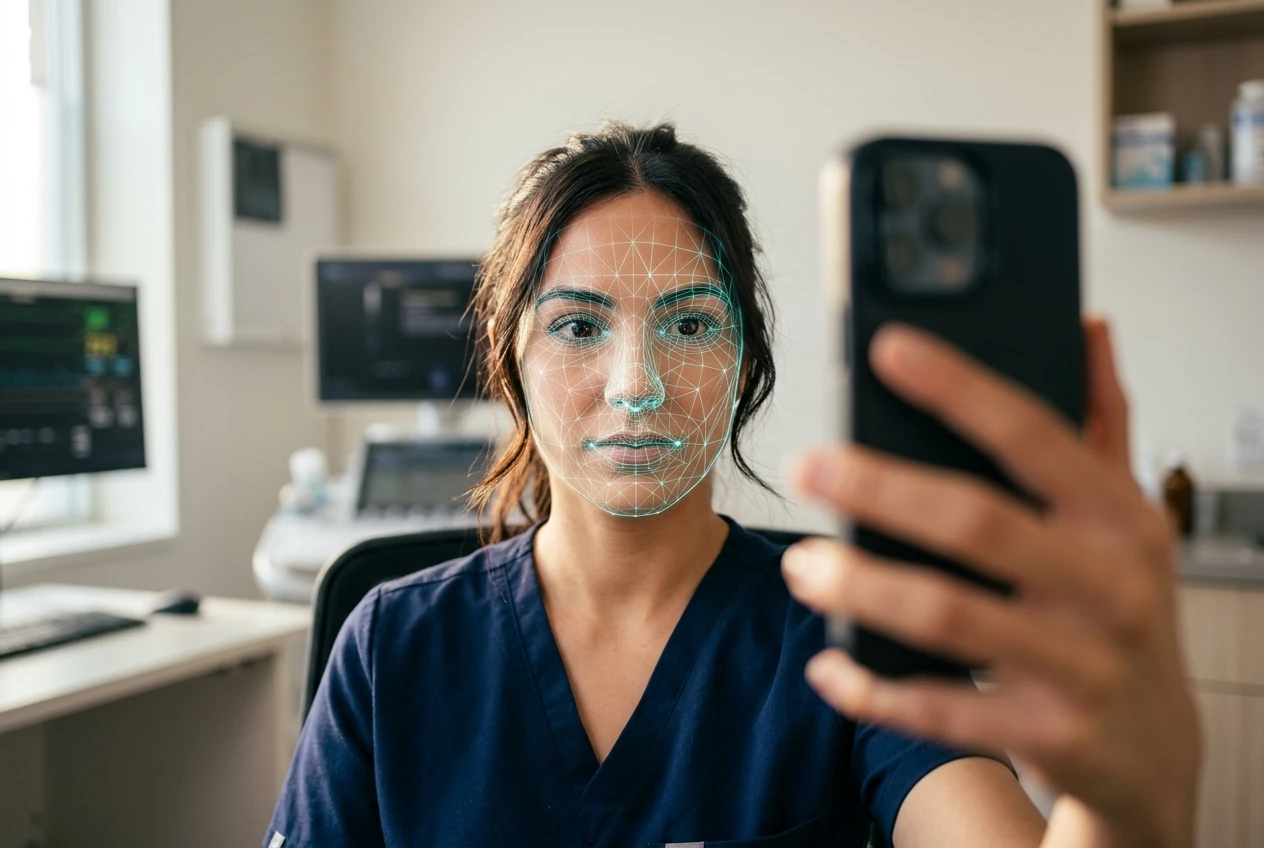
The consumer app is built to be friction-free at the start and ruthlessly honest at the end. A user opens Coherence, taps twice, and a 3D map of their face appears on screen as the camera starts the reading. The app requires the user to be centered in the camera frame with adequate lighting and minimal movement, and it will not return a number unless it is confident in the result.
“It has to have a certain level of confidence and accuracy before we’re gonna give you any kind of metric,” said Aristotle Pippa, a member of the Presage Technologies team. Pippa, who said monthly cardiac events once sent him to the emergency room, sketched out the use case he wishes he had owned at the time: a daily reading of resting heart rate, sent straight to a doctor, would have surfaced his tachycardia days before a 911 call. The Presage website broadens the SDK’s marketed capabilities to include heart rate variability, blood pressure changes (uncalibrated), pulse waveform, micro-expressions, lip activity, and blink rate, on top of the FDA-cleared heart rate and breathing rate. The site also flags the limit: “Accuracy depends on lighting and motion. Metrics beyond heart rate and breathing rate are not FDA cleared.” Developers can build on top of the SDK through a free community tier with 10,000 virtual sessions per month, a $99 per month Pro tier for production apps with up to 5,000 real users, and custom enterprise plans.
Why St. Louis, and Why a 70% African-American Data Set
Winkelmann is blunt about the technology’s biggest known weakness. “One of the problems with this technology is it cannot perform well in dark skin tones,” he said in a local news profile of Presage’s 10-person team. The reason the company is in St. Louis is to attack that problem, with a data set that is “actually like 70% African-American.”
The strategy is visible in the FDA filing, with the Baylor College of Medicine trial having enrolled 111 participants with skin tone measured on the Fitzpatrick scale, and the intended-use statement explicitly covering “humans aged 18 and older of all skin types.” The clearance was held to the same standard applied to remote patient monitoring hardware, and the company says its results are “peer-reviewed and published.” The data set is the sales pitch: more diverse training data, more accurate readings on darker skin, a clearance for hospital and general care use. “This has been years of work by an incredible team, and getting FDA clearance for camera-based vital signs is a moment we are really proud of,” Winkelmann said in the company’s clearance release.
The local talent pipeline is part of the pitch. Some of the Presage coders received their training through LaunchCode STL, a St. Louis-based nonprofit that provides free tech education and job placement. The team has also recruited internationally; senior research scientist Jitesh Josi came to St. Louis on an O-1 visa. Winkelmann described Josi as “one of the top publishers in the field for building neural networks from vitals by video” and said the firm “convinced them to come here to St. Louis.” The 10-person team is the entire Presage development core, per the local profile.
“I think St. Louis isn’t dead for tech. There’s still hope that we can really build some cool stuff in St. Louis,” Winkelmann said. The Cortex innovation hub in St. Louis City is where the team sits, even though Presage’s corporate base is in Leesburg, Virginia. The company says it serves healthcare, government, and wellness markets, per its own announcement.
A Chiropractor in Greece Is Already Using It
Down the hall from the Presage team, a chiropractor is already running the app inside his practice. Dr. Charles Quigless Jr. said he uses Coherence to start the intake process for new patients before they ever walk into his office, including patients who live as far away as Greece. “I would have never thought it, but it’s working,” Quigless said. The patient downloads the app, taps twice, and sends vitals to the doctor before the visit.
“Sometimes with some of these patients, the new patients, I can actually start an intake with them remotely with this particular app,” Quigless said. “Have them download the app and we can start the vitals process before they even hit the office.” The intake runs on the phone before the patient walks in. Pippa’s case is the consumer version: a daily reading of resting heart rate that would have surfaced his tachycardia days before a 911 call. The app is the same one Quigless uses for clinical intake and Pippa describes for daily self-monitoring.
The Next Target Is Blood Pressure, Where Samsung and Google Are Circling
The next metric on the roadmap is blood pressure, and the competition is the hardest in consumer health. Presage is competing against Google, Samsung, and others to deliver a camera-based blood pressure reading, per the local news report. The platform already lists “blood pressure changes (uncalibrated)” among the signals it can extract, according to the company’s product page.
I really think we are on the verge of cracking blood pressure. I think we, over the past month or so, had a major breakthrough. And we’re going to get there.
Winkelmann, the Presage CTO, said this in a recent news profile of the St. Louis team. The next regulatory submission, if it lands, would put the 10-person team in the same race as Google and Samsung. Google and Samsung are large platform companies that can ship blood pressure monitoring through existing phones and watches, with user data and clinical partners already in place. Presage has a 10-person team in St. Louis, a public study, and one FDA clearance to its name.
The narrow path forward runs through the data. The published list of capabilities includes heart rate, breathing rate, HRV, blood pressure changes (uncalibrated), pulse waveform, micro-expressions, lip activity, and blink rate. Only the first two are FDA-cleared for marketing in the U.S., and the company has been explicit about that boundary. The rest of the list is the R&D agenda, with each metric gated by its own regulatory submission. Winkelmann’s prediction is that the team will be back at the FDA with a blood pressure submission, and that St. Louis will be the place that produced the training data to support it.
Frequently Asked Questions
How does the Presage app read heart rate and breathing without sensors?
Coherence uses the smartphone’s camera to capture video of the user’s face, then runs the footage through Presage’s SmartSpectra algorithms to extract pulse and respiratory signals from the color changes and chest wall movements visible on screen. A 3D map of the face appears during the reading. The app requires the user to be centered in the frame with adequate lighting and minimal movement, and the system will not return a metric until its confidence threshold is met.
Is the app accurate, and has it been FDA cleared?
Yes, with a specific scope. Presage’s SmartSpectra Vital Signs Monitor 1.0 SDK received FDA 510(k) clearance (K254169) on July 7, 2026 for pulse rate and breathing rate on iOS and Android. The company reports an RMSE of 1.32 BPM for heart rate and 1.75 BrPM for breathing rate. The clinical trial ran at Baylor College of Medicine with 111 participants spanning all skin tones, ages, and BMI groups. The FDA-cleared device is prescription-only and uses statically mounted iPhone 16 Pro or Samsung Galaxy S24e units in hospitals. The free Coherence consumer app is built on the same SDK.
Where can I download the app?
Coherence by Presage Tech is available now on the Apple App Store. It is also available on a limited set of devices on the Google Play Store. The underlying SmartSpectra SDK is also available to developers, with a free community tier with 10,000 virtual sessions per month, a $99 per month Pro tier for production apps with up to 5,000 real users, and custom enterprise plans.
Does the app work on all skin tones?
Winkelmann has been explicit that camera-based vital signs technology historically does not perform well in dark skin tones. Presage’s published data set in St. Louis is “actually like 70% African-American,” and the Baylor College of Medicine trial enrolled 111 participants with skin tone measured on the Fitzpatrick scale, with the intended-use statement covering humans aged 18 and older of all skin types. The diverse data is the company’s pitch for accuracy across the population.
What is Presage building next, and who is it competing with?
Blood pressure is the next target. Winkelmann has said the team is on the verge of cracking blood pressure and pointed to a major breakthrough in the past month. The company is competing against Google, Samsung, and others to deliver a camera-based blood pressure reading, and is recruiting volunteers to sit in front of the camera for the research that would back an additional FDA filing.
Disclaimer: This article is for informational purposes only. The vital signs data, FDA clearance information, and accuracy figures described here are accurate as of publication on July 8, 2026. Vital signs monitoring is not a substitute for professional medical advice, diagnosis, or treatment. Always consult a qualified healthcare provider for medical concerns, especially those related to heart rate, breathing, or blood pressure.