French energy technology company Schneider Electric and Southern California Edison will install pure air and vacuum switchgear at two California substations, replacing sulfur hexafluoride (SF6), a greenhouse gas 23,500 times more potent than carbon dioxide, in the first large U.S. utility substation deployment of the technology. The June 30 collaboration, announced from Costa Mesa, California, is expected to help double capacity within the existing substation footprint at sites where demand for new connections is climbing.
Schneider Electric and SCE Move to Scale SF6-Free Substations in the U.S.
Schneider Electric and SCE announced the deployment on June 30, marking the first time SF6-free, gas-insulated medium-voltage switchgear will be deployed at scale across U.S. utility substations. The two companies will integrate the new equipment into existing facilities, accelerating substation modernization while the grid absorbs surging demand from data centers, electric vehicles, and building electrification. SCE plans to roll out similar substation approaches over time, the release said.
The first two installations target the Great Lakes substation in the Antelope Valley region of northern Los Angeles County and the Running Springs substation in the San Bernardino Mountains east of Los Angeles, both existing SCE facilities. Installation is scheduled to begin in 2027. The partners expect the approach to “help double capacity within the existing substation footprint,” according to the Schneider Electric press release. The deployment builds on Schneider’s GMAirSeT platform, the company said.
Utilities shouldn’t have to choose between speed, cost and clean energy. This enables SCE to bring new capacity online faster, manage project costs and reduce emissions at the same time.
Ruben Llanes, chief executive of Schneider Electric’s Digital Grid business and president of its North America Power & Grid division, said in the release.
What SF6 Is and Why Utilities Are Walking Away
Sulfur hexafluoride is a synthetic, fluorinated compound the U.S. electric power industry has used since the 1950s for high-voltage insulation, current interruption, and arc quenching in transmission equipment. Its dielectric strength made it the standard insulator inside circuit breakers, gas-insulated substations, and other switchgear across the high-voltage grid. The U.S. Environmental Protection Agency calls SF6 the most potent greenhouse gas known, with a 100-year warming potential 23,500 times greater than carbon dioxide. The gas has an atmospheric lifetime of greater than 1,000 years, so a small amount emitted today persists in essentially undegraded form for many centuries.
The EPA attributes about 67% of U.S. SF6 emissions in 2022 to the electrical transmission and distribution sector, and notes that old circuit breakers can hold up to 2,000 pounds of SF6, while modern units usually hold less than 100 pounds. The tradeoffs, drawn from EPA and Schneider Electric product documentation, look like this:
| Attribute | SF6-based switchgear | Pure air and vacuum switchgear |
|---|---|---|
| Insulating medium | Sulfur hexafluoride gas | Atmospheric air with vacuum interrupters |
| 100-year global warming potential | 23,500 times that of CO2 (EPA) | No F-gas emissions from operation |
| Atmospheric lifetime of insulator | Greater than 1,000 years (EPA) | None from the insulating medium |
| U.S. utility deployment | Industry standard since the 1950s (EPA) | Limited; widespread in Europe and parts of Asia (Schneider Electric) |
The Capacity Play Driving the Switch
Schneider Electric’s release headline reads “Add Grid Capacity Faster With SF6-Free Technology,” framing the project as a capacity play first. The pitch is that compact, modular switchgear can be installed without full substation rebuilds, freeing the same physical footprint to host more transformers, more circuits, and more customers. SCE serves roughly 15 million people across 50,000 square miles of central, coastal, and Southern California, excluding the City of Los Angeles and some other cities, the utility’s own website says. Its service area spans more than 180 incorporated cities and 15 counties.
“Demand continues to grow at an unprecedented pace across our service area,” Shinjini Menon, SCE’s senior vice president of system planning and engineering, said in the release. Menon tied the new switchgear directly to that growth: compact gear “has a smaller footprint, can be installed quicker, and is safe and reliable by design,” she said. The release positions the approach as part of a broader shift toward standardized, modular substation designs that can be deployed more efficiently to meet rising electricity demand. SCE’s parent Edison International (NYSE: EIX) says the utility was incorporated in 1909 and today, per the utility’s own website, serves 15 million people across 50,000 square miles, 180 incorporated cities, and 15 counties. The grid is one of the largest in the U.S. and full of substations that need more capacity without years of permitting and rebuild cycles.
Edison International puts the picture in scale: 125,000 miles of distribution and bulk transmission lines, 1.4 million electric poles, 142,000 transmission structures. By the numbers, the deployment context looks like this:
- 23,500x: SF6’s 100-year warming potential vs CO2 (EPA)
- Greater than 1,000 years: SF6’s atmospheric lifetime (EPA)
- 67%: share of U.S. SF6 emissions from electric T&D in 2022 (EPA)
- 15 million: people SCE serves across 50,000 square miles (SCE)
- More than 180: incorporated cities in SCE’s service area (SCE)
SCE’s First Two Substation Sites
The two initial deployments sit in very different parts of SCE’s territory. The Great Lakes substation is in the Antelope Valley region of northern Los Angeles County, a high-desert area that has seen rapid residential growth and large solar build-outs. The Running Springs substation is in the San Bernardino Mountains east of Los Angeles, a mountain community where wildfire risk and winter load spikes drive distinct reliability needs.
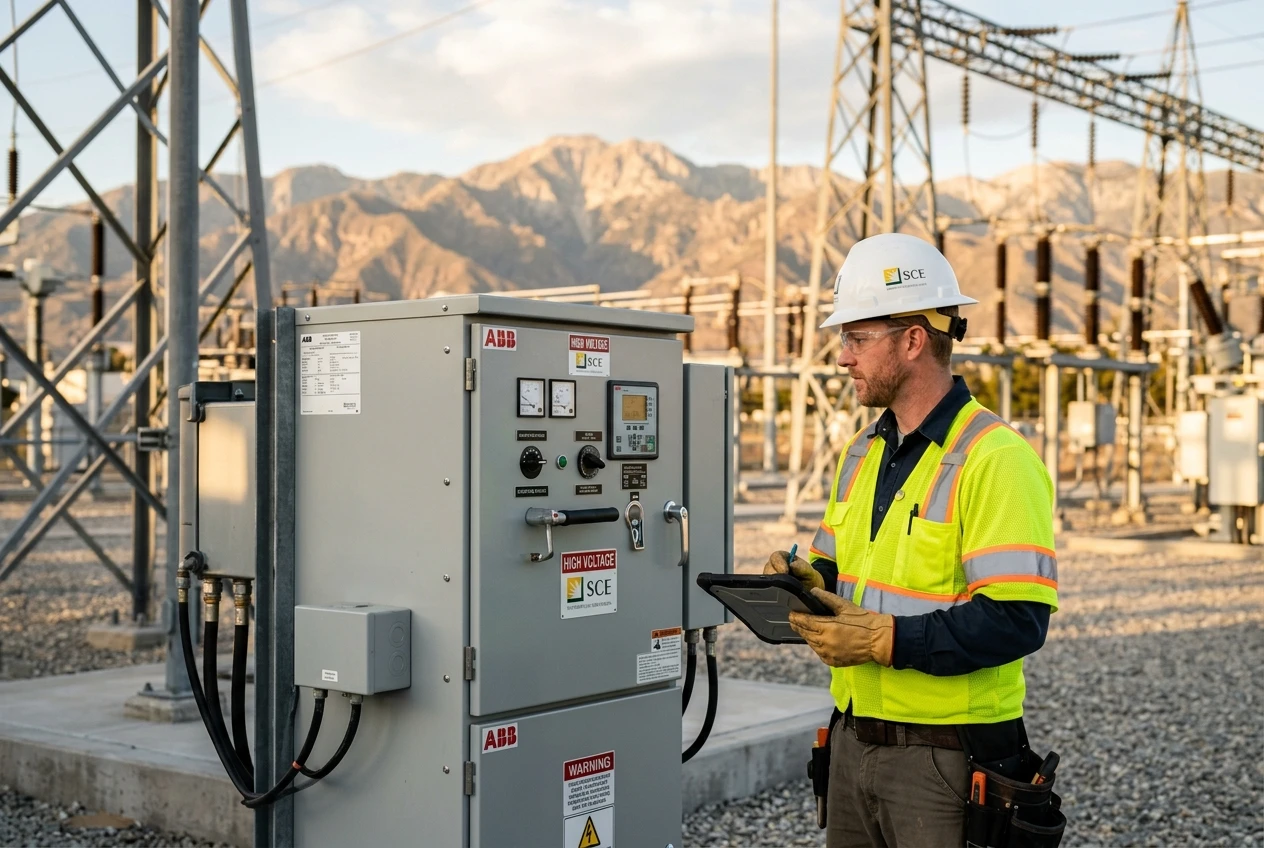
Schneider Electric will deliver its GMAirSeT switchgear pre-assembled into enclosed, modular substation systems designed for faster installation. The product line replaces the F-gas with clean air for insulation and vacuum interrupters for current interruption, with built-in sensors for arc-flash protection, condition-based maintenance, and remote operation. Schneider’s GMAirSeT product page describes the design as “free from SF6, F-gases or proprietary mixes,” with optical arc-flash sensing and digital monitoring embedded in the cabinet. The compact form factor is the key feature for SCE: more switching equipment in the same fenced yard, without pouring new concrete or rebuilding buswork. Below are the key features of the GMAirSeT system being deployed.
- Insulating medium: atmospheric air (no F-gases)
- Interrupting technology: vacuum interrupters
- Form factor: factory-sealed, modular, pre-assembled cabinets
- Sensors: optical arc-flash detection, condition monitoring, remote operation
- Maintenance: condition-based, no gas handling required
A Modular Substation That Fits Inside an Existing Yard
The deployment model is as important as the chemistry. Schneider Electric is shipping pre-assembled, enclosed switchgear modules that drop into existing substation footprints, sidestepping the long permitting and construction cycles a greenfield substation requires. SCE has to add capacity in yards it already operates, and the new gear fits the bill. Menon made the case for the switchgear in the release, and the argument is about more than emissions: speed and footprint matter as much.
Our customers and communities are becoming increasingly dependent on electricity. Demand continues to grow at an unprecedented pace across our service area, and we are committed to updating our grid architecture so that we can energize customers faster and keep electric bills affordable. Compact switchgear has a smaller footprint, can be installed quicker, and is safe and reliable by design. It is also digital-ready and environmentally friendly, making it a key component of our grid buildout going forward.
Shinjini Menon, SCE’s senior vice president of system planning and engineering, said in the release. Llanes pointed to the cost and emissions math in the same statement: “This enables SCE to bring new capacity online faster, manage project costs and reduce emissions at the same time,” he said. The release notes that SF6-free medium-voltage technology has seen widespread adoption in Europe and parts of Asia, but its use in U.S. utility substations has been more limited, and the SCE project is positioned as a proof point for U.S. utilities watching the same capacity crunch.
Regulatory Tailwinds from Sacramento to Albany
California’s grid planning has tilted toward modular, lower-emission equipment for years, and the SCE project is the first large U.S. utility substation deployment of pure air and vacuum switchgear at this scale. Schneider Electric’s release notes the timing aligns with rising demand across multiple states, not just California.
In addition to California, New York has enacted SF6 phase-out regulations, according to the release. The New York Independent System Operator (NYISO) projects significant load growth, with electricity demand expected to increase by roughly 1,600 to more than 4,000 megawatts by 2030. Michele Hix, vice president of strategic customers and segments for Schneider Electric’s North America operations, said “California and New York are advancing electrification and grid modernization, and meeting this moment requires deep collaboration between utilities and technology partners.” Her line in the release frames the SCE project as a template for the second-largest U.S. state-level phase-out, not a one-off California pilot.
The release does not list additional utilities lined up behind SCE. It also does not put a dollar figure on the deployments or a specific completion date beyond the 2027 installation start. What it does commit to is a 2027 construction start at two named sites, with SCE planning to scale the same approach over time as its grid needs it.
Hix said in the release that the innovations lay the foundation for a more resilient, digital, and decarbonized U.S. energy future. The SCE rollout begins in 2027 and is positioned to scale.
Frequently Asked Questions
What is sulfur hexafluoride and why is it used in electrical substations?
Sulfur hexafluoride has exceptional dielectric strength, the property that made it the standard insulating gas inside high-voltage circuit breakers and gas-insulated substations since the 1950s. The trade-off, the U.S. EPA says, is that SF6 is the most potent greenhouse gas it tracks, and once it leaks, it stays in the atmosphere for more than 1,000 years.
When will the SF6-free switchgear be installed at SCE substations?
Schneider Electric’s release puts the start of construction at 2027, with the Great Lakes and Running Springs sites as the first two SCE installations. The release does not give a completion date, so anyone watching for an in-service date will need to wait for SCE’s next construction update.
Where are the first two SCE substation projects located?
The Great Lakes substation is in the Antelope Valley, a high-desert growth corridor in northern Los Angeles County. The Running Springs substation is in the San Bernardino Mountains, a mountain community east of Los Angeles. Both are existing SCE facilities, which is the deployment model: the new gear drops into yards SCE already operates, so no greenfield siting is required.
How does GMAirSeT switchgear work without SF6?
The GMAirSeT design uses atmospheric air as the insulator and vacuum interrupters to break the circuit, replacing both the F-gas insulation and the arc-quenching function SF6 historically performed. Schneider Electric’s product literature calls the units factory-sealed, which means no on-site gas handling during installation or maintenance, a key difference from legacy gear, where leak prevention is a constant operation.
How much capacity will the SCE deployments add?
Schneider Electric’s release says the SF6-free design roughly doubles the switching equipment SCE can fit on the same substation land at the two named sites. SCE’s release does not put a megawatt number on that, so the gain is about physical capacity, not a power-flow guarantee.